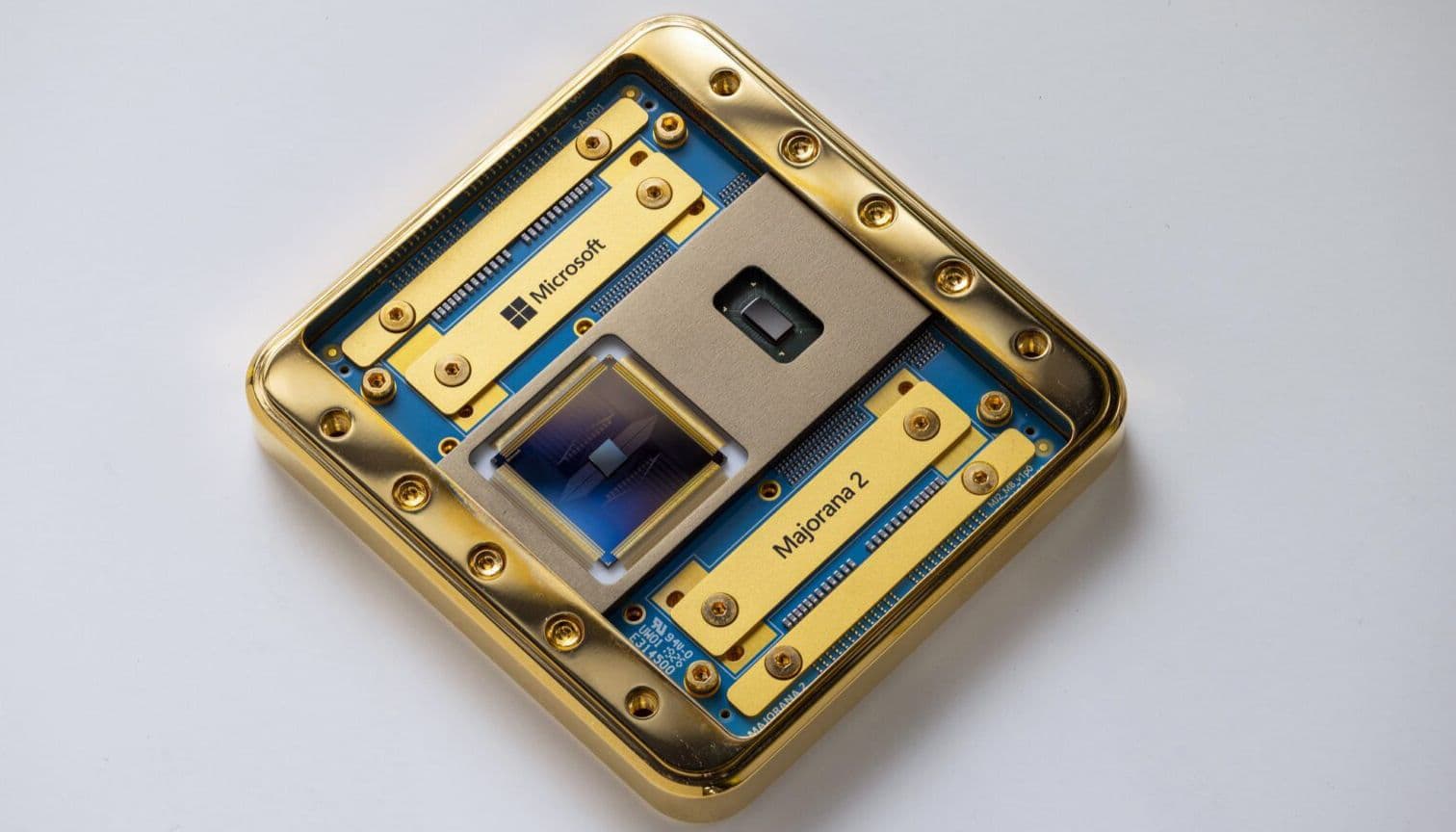
Microsoft’s Majorana 2 quantum chip shows how agentic AI may help accelerate materials discovery, chip reliability and the race toward scalable quantum computing.
Microsoft’s Majorana 2 launch is one of the clearest examples of AI and quantum computing converging. The company describes Majorana 2 as its next-generation topological quantum chip, built with a new materials stack and improved reliability. The headline claim is dramatic: Microsoft says the chip is 1,000 times more reliable than its prior generation and moves the company closer to scalable quantum computing.
The AI angle is what makes this especially important for NexusAI readers. Microsoft says its Discovery platform and agentic AI workflows helped researchers navigate materials choices, fabrication challenges and engineering tradeoffs. In other words, AI was not only the topic of the announcement; it was part of the research process that helped produce the chip.
This does not mean useful quantum computers are suddenly available for everyday users. Quantum hardware remains difficult, expensive and scientifically contested, and some researchers continue to ask for more evidence around Microsoft’s topological-qubit claims. But Majorana 2 still matters because it shows how AI-assisted discovery could compress timelines in fields where progress depends on materials, physics, simulation and experimental iteration.
Why Majorana 2 matters for Microsoft’s quantum strategy
Microsoft has taken a different route from many quantum competitors by focusing on topological qubits. The promise of this approach is greater stability and error resistance, which could make large-scale quantum computers easier to build if the underlying physics and engineering can be proven at scale.
Majorana 2 strengthens that strategy by showing progress in qubit lifetime, materials engineering and device reliability. For enterprise users, this matters because useful quantum computing could eventually transform optimization, chemistry, cryptography, materials science, logistics and complex simulation workloads that are difficult for classical computers.
The real story is AI-assisted scientific discovery
The most interesting part of the announcement is not only the chip, but how Microsoft says it was made. The company credits Microsoft Discovery and agentic AI with helping researchers improve the materials stack and move faster through a complex engineering problem. That turns the announcement into a case study for AI as a research accelerator.
This is important because scientific discovery often depends on searching through huge design spaces. Materials, fabrication processes, temperature conditions, device structures and measurement strategies can create more possibilities than human teams can test manually. Agentic AI can help generate hypotheses, compare options, summarize results and guide the next experiment.
Why topological qubits could change the quantum race
Quantum computers are extremely fragile because qubits are easily disturbed by noise, heat, vibration and measurement errors. Most quantum approaches require heavy error correction because individual qubits are unstable. Microsoft’s topological approach aims to make qubits more naturally protected by encoding information in a way that is less exposed to local noise.
If Microsoft can prove this approach at scale, it could reduce the overhead needed for useful quantum machines. That is the long-term prize. A quantum computer with reliable, scalable qubits could open new possibilities in molecular simulation, battery design, drug discovery, advanced materials, security and AI infrastructure optimization.
The breakthrough is promising, but caution still matters
Majorana 2 should be viewed as a major research milestone, not proof that commercial quantum computing has arrived. Microsoft’s claims are ambitious, and the broader physics community has debated parts of the company’s Majorana evidence in the past. Users should separate the strategic importance of the announcement from the assumption that every claim is already independently settled.
That caution is healthy. Quantum computing is a field where progress is real but difficult to verify from headlines alone. The most important future signals will be peer-reviewed evidence, reproducible measurements, larger qubit arrays, error correction progress, third-party validation and access to useful workloads through platforms such as Azure Quantum.
What NexusAI users should watch next
NexusAI users should watch whether Microsoft can turn Majorana 2 into a credible path toward scalable systems by 2029. The key signals are not only chip announcements, but improved qubit stability, clearer benchmarks, accessible developer tools, Azure Quantum integration and useful demonstrations that solve problems classical computers cannot handle efficiently.
The bigger AI lesson is that agentic systems may become essential for deep technology development. If AI agents can help design better chips, materials, lab workflows and scientific experiments, then the future of AI is not limited to chat, coding or content. It becomes an engine for discovering the next generation of computing itself.