Microsoft’s seven new MAI models show how the company is building its own multimodal AI stack for reasoning, coding, image generation, speech, transcription and enterprise workflow adaptation.
Microsoft’s launch of seven new MAI models is one of the clearest signs that the company wants more control over its AI stack. For years, Microsoft’s AI story was closely tied to OpenAI and Copilot distribution. The new MAI family shows a broader strategy: build first-party models that can power real Microsoft products, serve enterprise developers through Foundry, and adapt to the workflows where people already work.
The model family covers reasoning, coding, image generation, transcription and voice. That matters because Microsoft is not only releasing one flagship chatbot model. It is building a multimodal model ecosystem where different specialized models can support different parts of the user journey: writing code in VS Code, generating images, transcribing domain audio, creating speech, reasoning through complex tasks and tuning models for enterprise workflows.
For AI users and businesses, this changes how Microsoft should be evaluated. Copilot is no longer just an interface layered on third-party models. It is becoming a distribution layer for Microsoft’s own model portfolio, optimized around the company’s products, enterprise data boundaries, developer tools and long-term AI infrastructure strategy.
Why the MAI launch matters for Microsoft’s AI strategy
The most important signal is self-sufficiency. Microsoft is still deeply connected to external model providers, but the MAI launch shows the company wants more first-party capability across the model stack. That gives Microsoft more control over cost, safety, product integration, data lineage, model tuning and the pace of product deployment.
This matters because Microsoft owns some of the largest AI distribution channels in the world: Windows, Microsoft 365, GitHub, Azure, Foundry, Teams, Edge and Copilot. If Microsoft can combine that distribution with specialized in-house models, it can optimize AI experiences for real user workflows instead of treating the model as a generic external service.
MAI-Thinking-1 gives Microsoft a reasoning anchor
MAI-Thinking-1 is the flagship reasoning model in the new family. Microsoft positions it as a medium-sized model built for serious math, coding and real-world enterprise deployment, with strong software engineering performance and a smaller inference footprint than much larger models.
That positioning is important because not every enterprise workflow needs the largest possible frontier model. Many organizations want models that are capable, cost-efficient, easier to deploy, safer to govern and tuned for their systems. MAI-Thinking-1 gives Microsoft a model that can support reasoning-heavy tasks while fitting into the company’s enterprise cloud and productivity stack.
The multimodal stack expands beyond chat
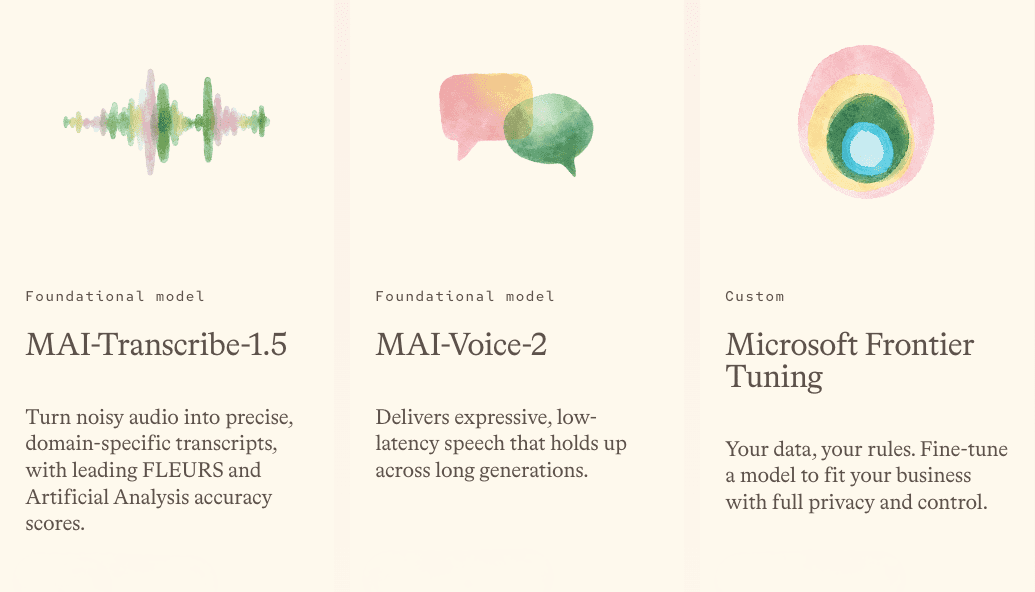
The new MAI family also includes models for image generation, transcription and voice. MAI-Image-2.5 targets text-to-image and image editing. MAI-Transcribe-1.5 focuses on accurate, domain-specific transcription across many languages. MAI-Voice-2 brings natural-sounding speech generation and multilingual support.
This matters because Microsoft’s AI surface area is much wider than a chatbot. Teams calls, meeting summaries, developer tools, creative assets, documents, accessibility features, customer support, training content and enterprise knowledge workflows all benefit from specialized models. A multimodal MAI stack gives Microsoft more ways to embed AI into real work.