

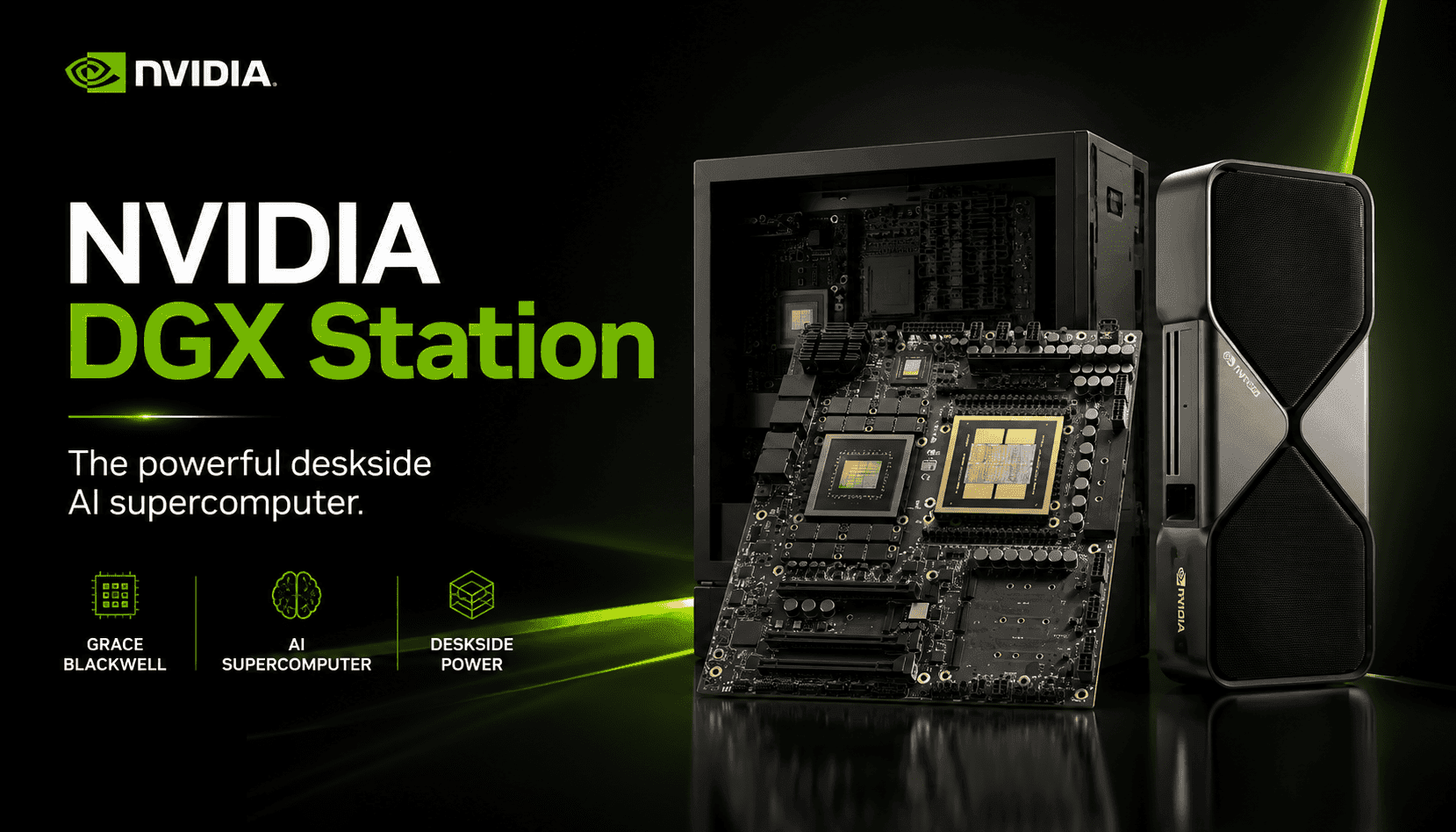
NVIDIA’s DGX Station collapses a slice of data‑center capability into a deskside form factor. The GB300 Grace Blackwell Ultra Desktop Superchip links a 72‑core Grace CPU and a Blackwell Ultra GPU over NVLink‑C2C, exposing high‑bandwidth, coherent access to a very large memory pool. For researchers and product teams, that coherence reduces shuffling between CPU and GPU and removes a class of latency and capacity bugs that derail large‑model experiments. Combined with preconfigured Ubuntu and CUDA‑X tooling, the system behaves more like a ready appliance than a bare server, so you can spend the first week shipping baselines rather than wrestling with drivers, firmware, and container kernels.
The performance pitch centers on FP4 tensor compute—up to 20 petaFLOPS—and 748 GB of coherent memory, which together make giant context windows, agent toolchains, and multi‑model graphs more practical locally. FP4 and sparsity can be remarkably accurate when well‑calibrated, but they demand disciplined quantization, calibration sets, and guardrails. Practically, that means DGX Station shines on LoRA/QLoRA fine‑tuning, retrieval‑heavy LLM workflows, multi‑modal pipelines, and iterative agent development where turnaround time and privacy matter more than squeezing the last point of benchmark accuracy with higher precision.
Connectivity and manageability push it into enterprise territory. ConnectX‑8 up to 800 Gb/s enables fast dataset ingest, low‑latency RPC for agent swarms, and even linking two DGX Stations to stretch capacity. MIG partitioning lets platform engineers carve the GPU into up to seven guaranteed‑QoS slices for concurrent users, while BMC with Redfish and NVIDIA management tools give IT out‑of‑band telemetry and lifecycle control. For visual simulation and digital twins, an optional RTX PRO Blackwell‑generation card pairs data‑center‑grade training/inference with ray‑traced visualization in the same chassis, reducing context switching between compute and design review cycles.
Buyer calculus comes down to data gravity, latency, and utilization. If your workloads shuffle proprietary data, depend on predictable token latency, or run 24/7 agents, deskside can beat cloud queues and egress surprises—provided you can keep utilization high and plan for power and thermals. The chassis is rated at roughly 1,600 W, so facilities, rack‑adjacent airflow, and a storage plan for multi‑TB datasets matter. A pragmatic approach is a 90‑day pilot: benchmark a target LLM/agent stack, test FP4 vs. BF16 accuracy impacts, measure wall‑clock throughput and energy, and compare to an equivalent reserved cloud footprint. Use those measurements—not peak FLOPS marketing—to make the capex decision.