

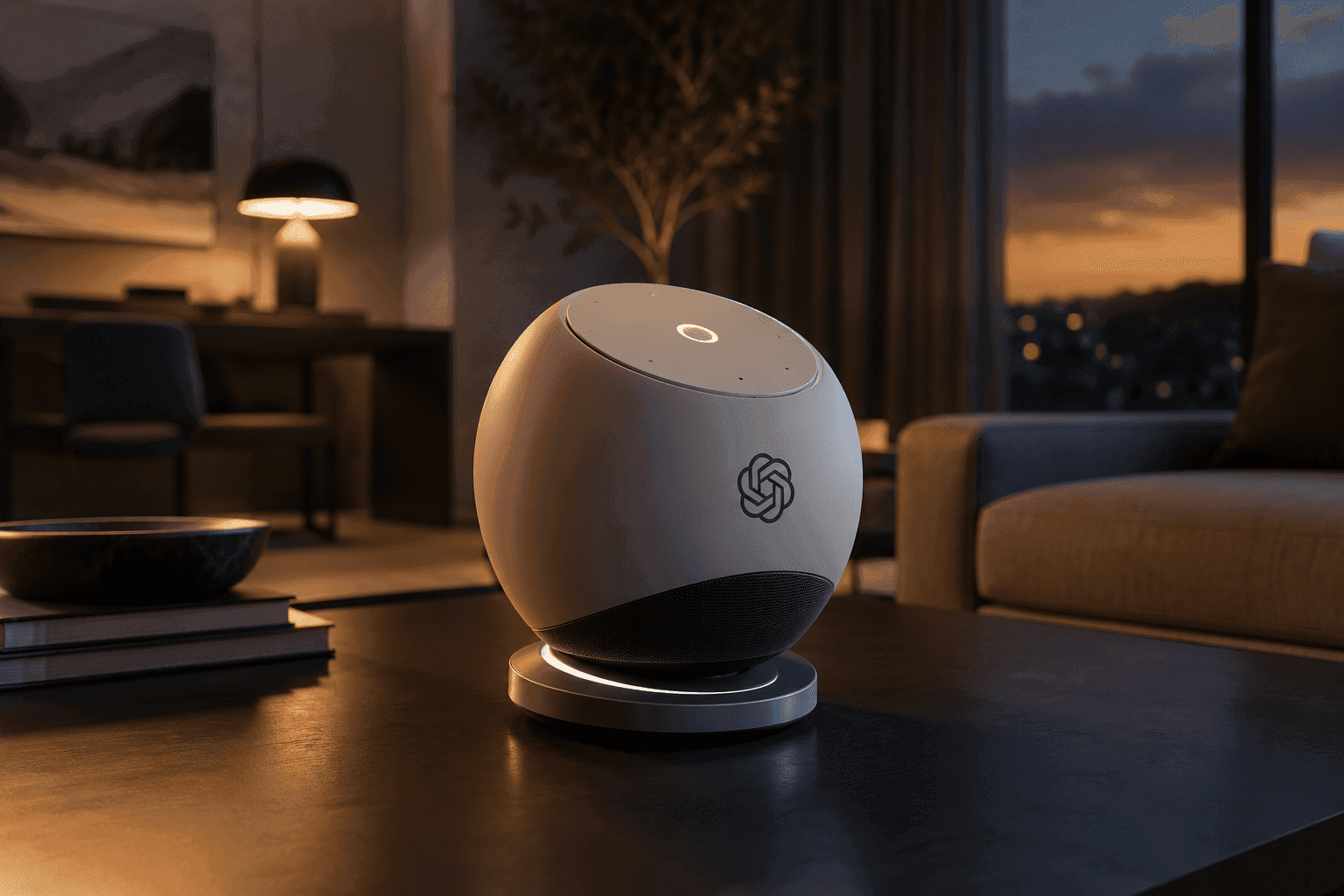
OpenAI is reportedly developing a screenless smart speaker that can move and act as a humanlike AI companion. Framed as a physical manifestation of ChatGPT, the concept pivots from app-based assistants toward an ambient presence that hears, understands, and acts without demanding visual attention. If this direction holds, the platform contest shifts from smartphones and flat screens to always-available, voice-first agents that live in our spaces. The value is less about a new gadget and more about a new interface layer: persistent context, proactive assistance, and tighter loops between intent, understanding, and execution across home and small-office routines.
Technically, an ambient companion requires a robust edge+cloud stack: low-latency automatic speech recognition and synthesis, a multi-microphone array with beamforming, wake-word reliability, and on-device inference for privacy-sensitive or offline tasks. Motion introduces safety, localization, and sensor fusion challenges—think proximity, touch, and environmental audio at minimum, with optional vision features gated by clear user controls. The device must navigate power, thermals, and intermittent connectivity while meeting sub-500 ms perceived response targets for natural conversation. Continual learning and memory raise the bar for permissioning, redaction, and clear user override to keep personalization useful yet governable.
Strategically, the move redefines assistant economics. Instead of being a feature within someone else’s device, the companion can own engagement cycles, behavioral data, and subscription bundling with premium assistant features and memory. That control could produce defensible moats: a home graph of routines, device integrations, and personal context layered atop the base model. Competition will be fierce—incumbent platforms already own voice endpoints and distribution—but a credible, proactive companion that reliably handles daily tasks could pry time away from phones and legacy smart speakers, especially if it proves meaningfully more precise, faster, and safer for high-frequency household or office tasks.
For professionals and buyers, the practical path is to prepare for ambient workflows without overcommitting to any single vendor. Identify high-frequency, low-risk voice tasks with clear success metrics—calendar triage, reminders, home/office automations, meeting room orchestration, and hands-busy information retrieval. Establish evaluation protocols: end-to-end latency in noisy conditions, wake-word false accepts/rejects, data minimization at the edge, and auditable memory permissions. Require network segmentation, device-level kill switches, and incident response playbooks. Run a 90-day pilot with exit criteria and a TCO model that compares this device to smartphone or smart-speaker baselines. If results beat the baseline, scale with guardrails; if not, pause without sunk-cost drag.