

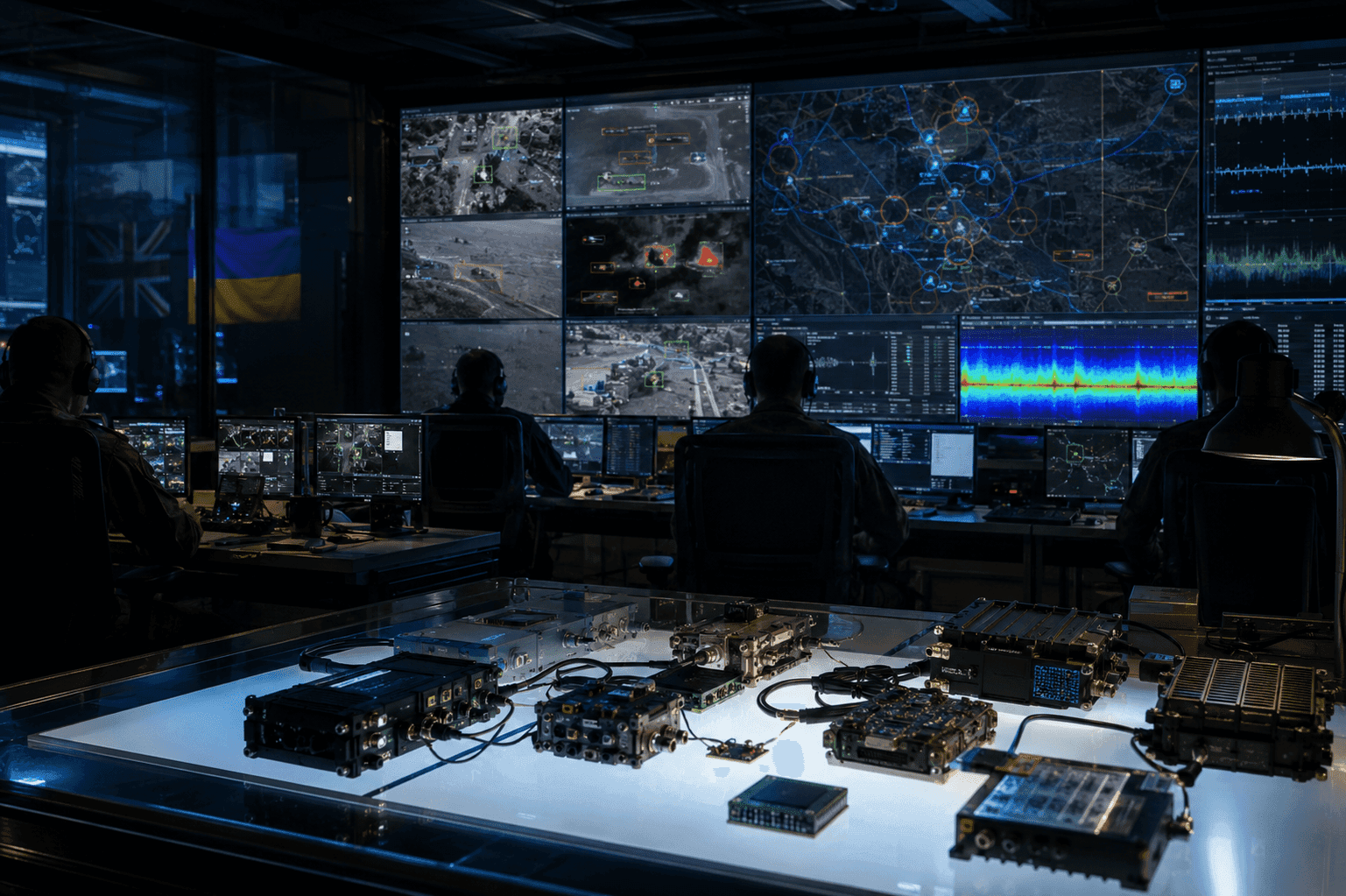
This pact is not a typical research MoU. It ties UK labs into Ukraine’s operational AI stack—Avengers AI Labs and data streams from the DELTA combat system—where annotated imagery, drone video, and sensor telemetry are already shaping daily tactics. The practical prize is resilient perception: models that detect and track under smoke, camouflage, jamming, weather, and intense motion blur. With roughly five million labeled images and six-figure monthly drone feeds, UK researchers gain the data scale and distribution shift required to push beyond lab benchmarks and raise real-world precision and recall against time-sensitive targets.
Two capabilities stand to benefit most. First, real-time target identification under contested comms, where every millisecond of on-drone inference reduces latency and exposure. Second, multi-sensor fusion across RGB, IR, SAR, and acoustic cues that can disambiguate decoys, shadows, and structural lookalikes. Pair this with British strength in model compression and low-power hardware, and you have a path to credible autonomy at the tactical edge—without continuous cloud uplinks—plus a validation loop to measure effects, not just ROC curves, in live operations.
The data itself is the moat and the risk. High-value, high-noise labels from a fluid battlespace encode adversary countermeasures and friendly TTPs. That demands strict chain-of-custody, differential access, and policy firewalls: what enters joint model training, what remains sovereign, and what is export-controlled. Expect model and data cards with provenance, scenario tags, confidence intervals, and fine-grained audit trails so procurement and commanders can reason about reliability under specific terrain, weather, and EW conditions—not just average-case performance.
The near-term milestones are concrete: uplift detection from ~70% to mission-viable accuracy against priority target classes; shrink models to run on low-power chipsets with thermal and bandwidth limits; and harden pipelines for continuous learning without catastrophic forgetting. The broader implication is doctrinal: a data alliance that shortens the sensor-to-shooter loop while embedding guardrails—human-in/on-the-loop, positive identification thresholds, and red-team adversarial testing—to prevent automation bias and escalation from model errors. If executed, the partnership becomes a repeatable template for coalition AI that moves beyond paper MOUs to measurable, safe capability gains.