

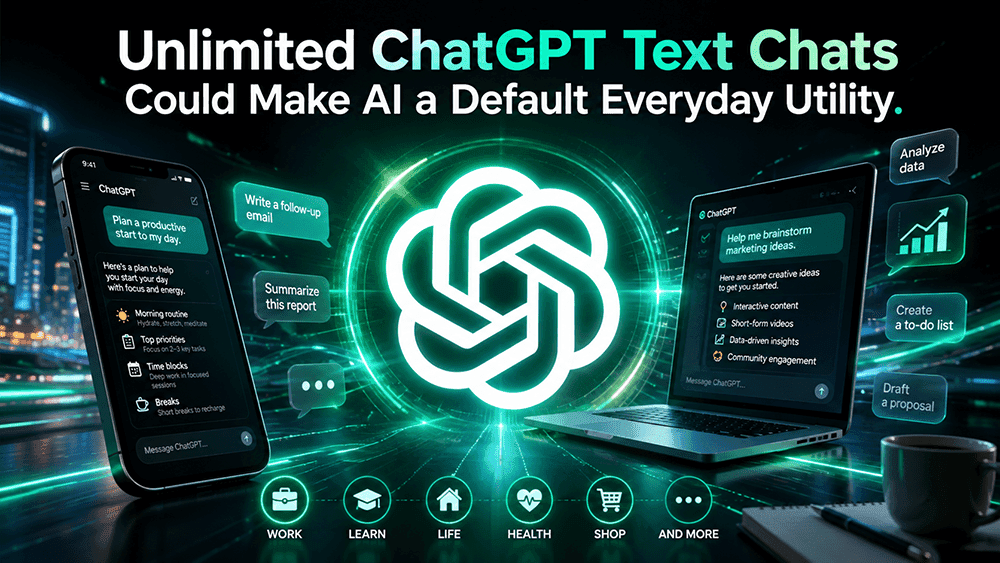
OpenAI’s decision to uncap text-only conversations for Free and Go users, upgrade the default model to GPT-5.6 Luna, and add a Think button for tougher prompts reframes ChatGPT as a true utility. Text is the cheapest, most universal interface; by removing hard stops, OpenAI lowers friction at the exact moment most users would otherwise bounce. Meanwhile, Plus and Pro users get a more factual GPT-5.6 Sol and a slider to tune depth, aligning price with precision. The result is a two-lane system: unlimited baseline conversation for habit formation, and metered, higher-cost modalities for moments when accuracy or modality breadth matter.
This shift will change usage curves. Expect more frequent, shorter daily sessions and a growing share of queries that would previously go to search, internal wikis, or lightweight tickets routed to support. Unlimited text nudges users to converse first, document later. The Think button then acts like a local turbocharger—opt-in depth when the question is tricky, without pulling in expensive file or image processing. For product teams, that means redesigning onboarding, toolbars, and prompt templates to start with text summaries and branch into attachments only when necessary, capturing maximum value within the cheapest path.
Economically, the model favors variable monetization where costs spike: reasoning time, structured retrieval, and multimodal I/O. By gating files and images while leaving text uncapped, OpenAI preserves margin and encourages trial that feeds Plus and Pro upgrades. For buyers, this creates a clearer procurement playbook: standardize casual Q&A on unlimited text and reserve budget for measurable outcomes—claims adjudication, code migration, or regulated content handling—where the premium tiers and multimodal features deliver quantifiable ROI. The slider for “how much thought” effectively becomes a cost-control dial, translating cognitive effort into an expense you can intentionally manage.
Operationally, unlimited text will surface new risks. Abuse and automation spikes will test rate-limiting heuristics. Think mode may increase latency and prompt brittleness if teams aren’t explicit about goals, constraints, and evaluation. To keep quality stable, instrument sessions to capture task success, time-to-answer, and handoff rates to tools or humans. For governance, treat text conversations as a first-class data stream: classify by sensitivity, mask PII, and route only selected segments to improvement loops. The winners will codify when to stay in text, when to escalate to “think,” and when to invoke files or images—then train users to do it consistently.