

NexusAi logo

NexusAi

  • Products
  • Categories
  • Prompts
  • Search
  • AI Insights
  • Pricing
  • Promote
  • Contact
Sign In
NexusAi LogoNexusAi

NexusAI helps you discover, compare, and learn AI tools with ease. From expert insights to training resources, we empower individuals and businesses to harness AI technology for smarter decisions, innovation, and growth.

Useful Links

  • About Us
  • AI Products
  • AI Category
  • AI Prompts
  • AI Search
  • AI Insights

Services & Legal

  • Showcase & Promotion
  • Membership Plans
  • Terms & Conditions
  • Refund Policy
  • Privacy Policy
  • Disclaimer

Contact Us

88 Tribune Street
South Brisbane, QLD, Australia, 4101
Website: www.nexusai-tech.com
Email: info@nexusai-tech.com

© Copyright 2026 NexusAi All Rights Reserved

Developed by DStudio Technology
Home/AI Insight/AI Product News/Warp Factories Make Coding Agents Persistent: From Copilots to a Real Software Line
AI Product NewsAgent Infrastructure

Warp Factories Make Coding Agents Persistent: From Copilots to a Real Software Line

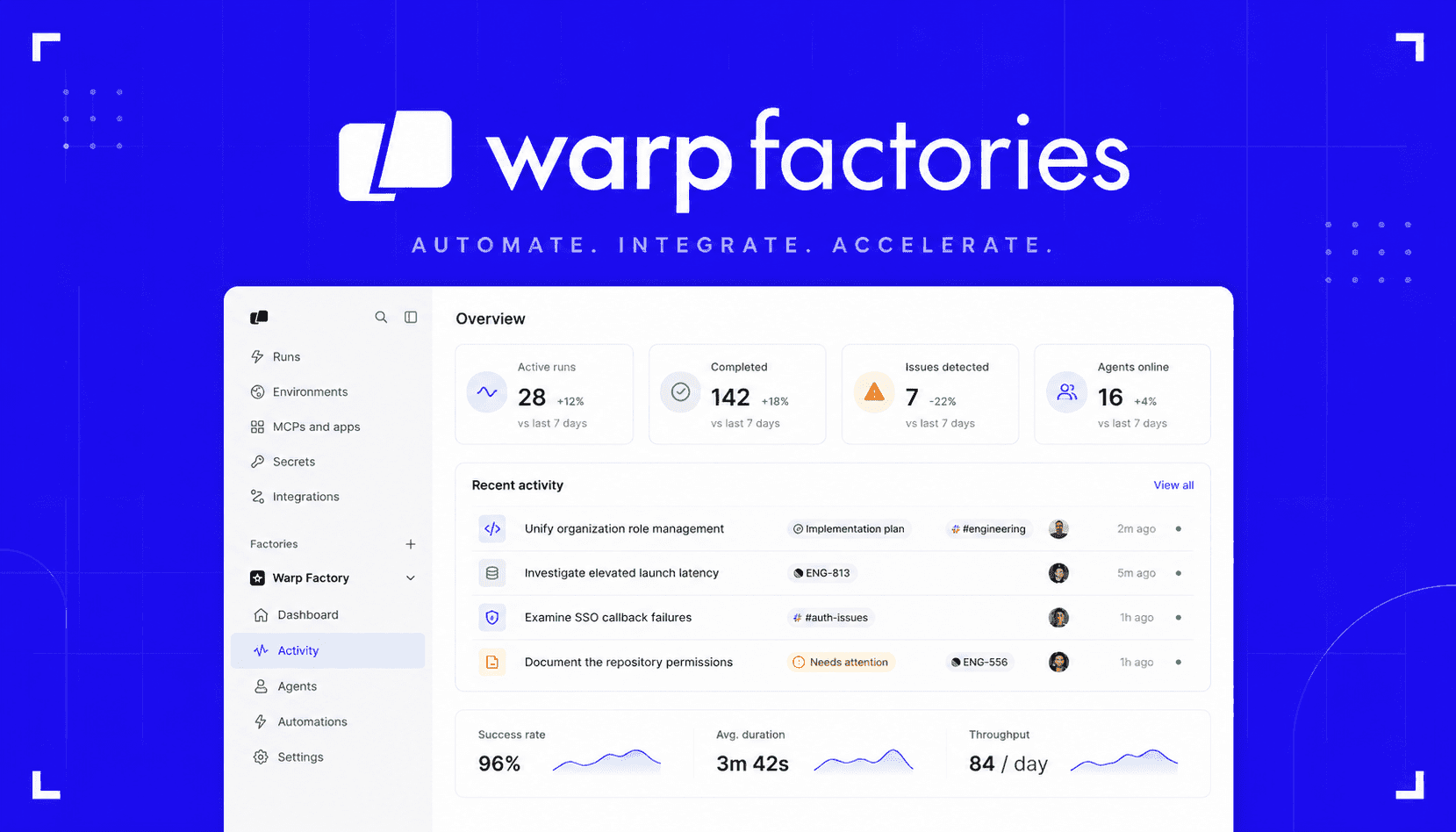
Warp has launched Warp Factories, an infrastructure layer that turns fleets of coding agents into an always-on software production line. Instead of one-off prompts, teams can define factories as code, govern models, track ROI, and continuously improve automation across triage, spec, implementation, review, and verification.

NexusAI Research DeskAug 20, 20261.6K views8 min read
Warp Factories Make Coding Agents Persistent: From Copilots to a Real Software Line
AI Brief

Warp’s new Factories reframe coding agents from laptop-side helpers into governed, measurable, cloud software factories. Definitions live as code, enabling versioning, canaries, and agent-driven self-improvement. The platform is multi-model and multi-harness, with built-in evals, ROI metrics, and a control room to monitor throughput, cost, and quality. It integrates with Slack, Jira/Linear, GitHub/GitLab, terminals, and any MCP-enabled agent. The pitch to engineering leaders: standardize skills and permissions, centralize data exhaust and governance, and iterate towards higher automation rates while keeping humans in the loop. The implication for buyers is clear—treat agent automation like CI/CD: a durable, auditable system you operate, not a collection of ad-hoc assistants.

Interactive coding agents boosted commit velocity, but they scattered control and made ROI hard to prove. Warp Factories aims to consolidate that sprawl into a cloud software factory—an always-on assembly line where specialized agents triage, spec, implement, review, and verify tasks against your repos. Crucially, factory definitions are version-controlled, so changes to prompts, skills, MCPs, models, and guardrails are treated like infrastructure—not ephemeral config on a developer’s laptop. That shift unlocks governance, benchmarking, and repeatability that individual copilots struggle to deliver at scale.

Operationally, Warp positions Factories as agnostic plumbing: bring your own models or harnesses, mix open-weight and frontier models, and select per-task configurations to balance cost and quality. A foreman agent orchestrates flows from Slack, Linear/Jira, or GitHub triggers, spawning scoped subagents with specific permissions and memories. Built-in metrics and evals show throughput, token spend, PR quality, and defect rates. Observer agents can even file PRs to the factory definition itself—closing the loop between measurement and improvement without waiting for a quarterly platform sprint.

For engineering leaders, the appeal is governance and compounding ROI: standardized skills, reproducible computer-use verification, model choice experimentation, and a clear control plane over data exhaust. For developers, the win is less bespoke scaffolding: an MCP-enabled path to push work into the factory and pull it back for local iteration. The broader market signal is that agentic development is converging on CI/CD-like discipline: factories as durable systems with SLAs, benchmarks, and budgets—rather than a patchwork of sidekick bots that can’t be audited or improved systematically.

Key Takeaways

Treat Agents as Infrastructure

Define agents, skills, and permissions as code, canary changes, and measure performance like you would CI/CD—this is how you avoid prompt sprawl and governance gaps.

Optimize Model Mix by Workflow

Use evals on your own repos to decide where frontier models matter and where open weights suffice; route per task to balance latency, cost, and quality.

Make Verification Non-Negotiable

Invest early in computer-use verification, artifact capture, and rollback paths. Strong verification is the difference between safe automation and scaled mistakes.

What Changed: From Prompted Agents to Defined Factories

Warp introduces a factory-as-code model where each stage of the SDLC is handled by distinct, permissioned agents—Triage, Spec, Implement, Review, Verify—coordinated by a foreman. Triggers originate in Slack, Jira/Linear, GitHub, or terminals; the factory selects the best model/harness per task and captures artifacts, from reproduction videos to PR descriptions. Because the factory is defined in code, teams can canary changes, roll back misconfigurations, and treat prompt/skill evolution like any infrastructure update, tightening control over quality and spend.

Why It Matters: ROI, Governance, and Data Exhaust

Laptop-side agents make ROI opaque and governance brittle. Factories move usage into a central plane with measurable throughput, token budgets, PR acceptance, and defect rates. Skill sets are standardized, agent permissions are explicit, and memories/data exhaust are retained for audits and improvement. Leaders can compare open-weight vs frontier models per workflow and decide where high-cost inference is actually warranted. That translates into a credible automation roadmap with milestones, budget controls, and compliance narratives—key for regulated industries and enterprise adoption.

How to Deploy: A Pragmatic Factory Blueprint

Begin with a narrow slice—bug triage plus computer-use verification—on one repo. Connect Slack/Linear and GitHub; define clear skills (logs parsing, test runner control, code search) and a conservative permission set. Use multi-model routing only where it moves quality or latency; otherwise default to a cost-efficient model. Establish evals on your own tickets and PRs, then enable observer agents to propose factory PRs. Canary factory updates on a small team, expand to refactors/migrations once acceptance and rollback patterns are battle-tested. Treat the control room as your SRE dashboard for agent throughput and failure modes.

Interoperability: MCP, Terminals, and Model Mix

Factories expose an MCP interface so any compatible coding agent can push work to the assembly line or pull tasks for local iteration. This avoids forcing a single IDE/plugin and lets teams meet developers where they work. The platform’s multi-model, multi-harness stance supports frontier APIs and open weights, so procurement and security teams can blend cost control with sovereignty—bring-your-own inference, hosting, and data policies. Practically, this means you can standardize workflows without dictating a one-size-fits-all agent front-end.

Risks and Limits: Verification, Change Management, and Drift

Two pitfalls dominate early deployments: weak verification and unmanaged evolution. If computer-use checks are shallow or flaky, you’ll ship regressions faster. Invest in hermetic test environments and artifact capture (videos, traces, logs) to tighten review loops. Second, factory definitions can drift—skills, prompts, and permissions accumulate. Enforce change control with canaries, schema linting, and periodic prompt/skill cleanups. Finally, remember humans in the loop: mandate checkpoints for riskier changes and maintain a clear escape hatch so developers can reclaim tasks locally without breaking the factory’s audit trail.

Frequently Asked Questions

How should we pick the first workflows to automate in a factory?

Start with predictable, high-volume tickets where verification is objective: flaky test fixes, log-level changes, dependency bumps, or scoped bug reproductions. Wire Slack/Linear and GitHub triggers, add strict permissions, and require artifact-backed verification before merge.

What’s the practical way to measure ROI beyond token spend?

Track PR acceptance rate without human rewrites, median lead time from ticket to merge, post-merge defect rate, and delta in developer focus time. Compare per-workflow model costs versus these quality/latency gains to decide where to deploy frontier vs open-weight models.

How do we prevent factory definitions from becoming another maintenance burden?

Version everything, require small PRs with canaries, run prompt/skill linting, and enable observer agents to propose changes tied to eval regressions. Schedule quarterly cleanups and maintain a clear owner for factory governance, just like you do for CI/CD.

#Multi-Agent Orchestration#Agent Control Plane#Agent-Native Platforms#Autonomous Agent Loops#Agent Evaluation Loops#Verification and Evals#Computer Use Automation#Memory Persistence for Agents#Sovereign AI Infrastructure#Self-Hosted Automation#Open-Weight Models#Developer-in-the-Loop#Agentic Code Review#Pull Request Automation#Agent CLI#Provenance and Version Control#Software Factories#Agent Governance#Factory-as-Code#MCP Interoperability#Self-Improving Agents#ai sovereignty

AI Insight Newsletter

Get the latest AI updates, tool news, and insights delivered to your inbox.

No spam. Unsubscribe anytime.
On This Page
1.What Changed: From Prompted Agents to Defined Factories2.Why It Matters: ROI, Governance, and Data Exhaust3.How to Deploy: A Pragmatic Factory Blueprint4.Interoperability: MCP, Terminals, and Model Mix5.Risks and Limits: Verification, Change Management, and Drift
Share this article

Related Articles

Sunday Robotics’ Memo Aims for Real Household Help With a Skill-Library Play, Not Humanoid Theater
AI Product News

Sunday Robotics’ Memo Aims for Real Household Help With a Skill-Library Play, Not Humanoid Theater

Aug 24, 2026

Ramp’s Router Turns LLM Choice Into an Optimization Layer for Cost, Quality, and Latency
AI Product News

Ramp’s Router Turns LLM Choice Into an Optimization Layer for Cost, Quality, and Latency

Aug 21, 2026

A Third of New Web Pages Look AI‑Written — What That Means for Search and Training Data
General AI Industry News

A Third of New Web Pages Look AI‑Written — What That Means for Search and Training Data

Aug 21, 2026

The Rack Is the System: AI Infrastructure Competition Moves Beyond Chips
General AI Industry News

The Rack Is the System: AI Infrastructure Competition Moves Beyond Chips

Aug 6, 2026

ZML LLMD Targets Multi-Chip LLM Inference Without Nvidia Lock-In
AI Product News

ZML LLMD Targets Multi-Chip LLM Inference Without Nvidia Lock-In

Jul 9, 2026

Related AI Tools

View All
Warp: The Intelligent, AI-Enhanced Terminal for Developers

Warp: The Intelligent, AI-Enhanced Terminal for Developers

Developer & Coding AI