

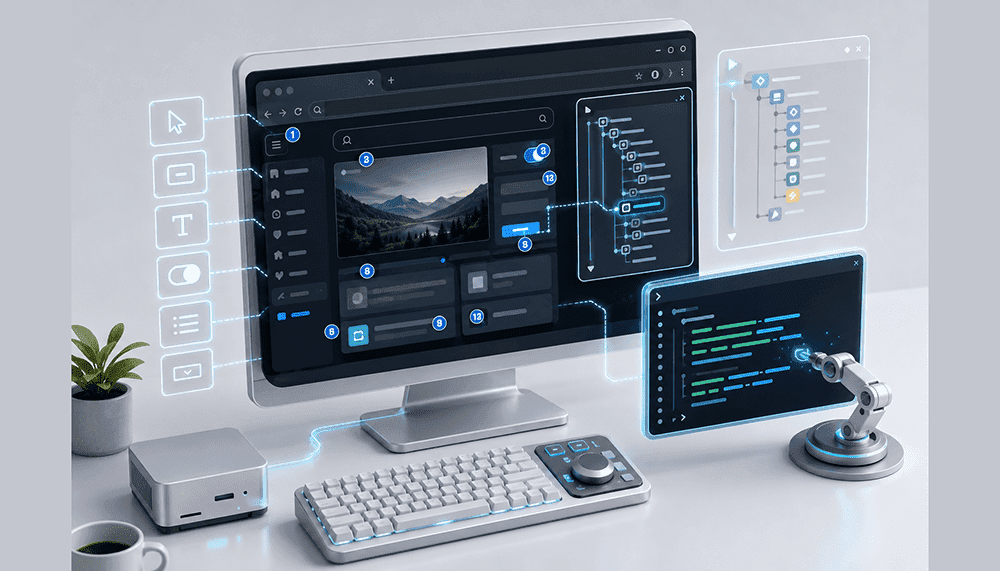
Agent Browser is a Rust-native browser automation CLI built for AI agents, not humans. Instead of fragile CSS or XPath selectors, it exposes accessibility snapshots that assign stable element references like @e1 to the live page structure, plus semantic locators by role, label, text, or placeholder. It returns agent-readable Markdown or JSON, so planners and tools can reason about the page rather than raw click coordinates. Because it is a small, fast binary, teams can embed it in toolchains or call it from agent runtimes without a heavy framework, turning the open web into a more structured surface for autonomous workflows.
Reliability is the differentiator. Refs survive minor DOM churn and scroll, and commands fail early when targets are occluded, helping agents handle consent banners and dialogs deterministically. Stable tab identifiers (t1, t2) and frame controls preserve handles across navigation. Semantic find commands aligned with ARIA roles and labels reflect how users perceive the UI, reducing coupling to transient class names. Combined with annotated screenshots and a read mode for extracting structured text, the stack converts fuzzy pages into predictable targets that agents can retry, explain, and verify with less brittleness.
Operationally, the tool lowers latency and cost. Batch mode compresses multi-step scripts into a single process, eliminating per-command startup overhead. Streaming enables event-driven control, while read can fetch content without launching Chrome when rendering is unnecessary. Network routing, cookies, and storage controls support end-to-end tasks like login, paywalls, and A/B variants. Safeguards such as allowed domains, content boundaries, and output limits reduce prompt-injection blast radius. The result is agents that ship with fewer flaky runs, faster recovery paths, and a clearer audit trail for security and QA teams.
Where it fits: use Agent Browser when agents must robustly navigate consumer-grade web apps, produce explainable summaries, or complete multi-step forms. Keep heavyweight test frameworks for deep component testing or bespoke in-process control. For production agents, pair snapshots with deterministic retries, capture HAR files for regressions, and persist tab or frame context across tasks. Treat the browser as a capability, not a crutch—plan with textual reads first, then interact with refs only when the plan requires side effects.