
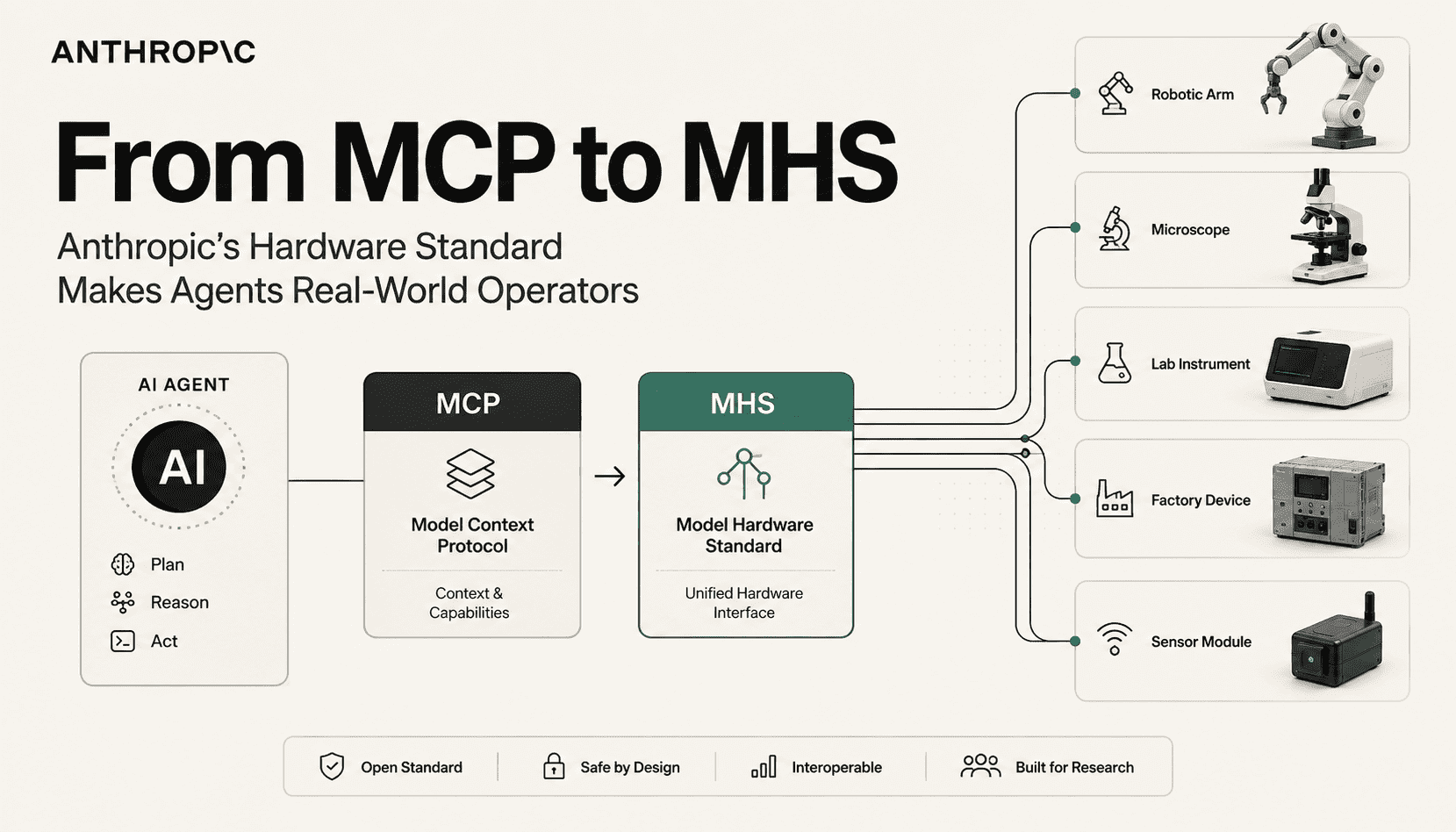
Model Context Protocol (MCP) gave agents a safe, standardized way to click, query, and call software. Anthropic’s Model Hardware Standard (MHS) pushes that same unification into the physical world by defining a device-agnostic driver layer. The driver exposes simple primitives—read, write, and structured capabilities—that make instruments discoverable with machine-readable limits, modes, and safety envelopes. Crucially, MHS blends code and natural-language tags so operators can capture tacit know‑how (weights, travel limits, handling cautions) that isn’t in firmware. Agents can access hardware through MCP, CLI, or code files, coordinate multiple devices, and compile repeatable scripts once exploratory steps converge on a stable routine.
Why this matters: hardware integration is today’s bottleneck. Many labs and factories spend weeks building bespoke adapters across liquid handlers, robotic arms, readers, and sensors—often fragile and non-portable. MHS reframes the stack: a standard driver, discoverable capabilities, consistent telemetry, and enforceable limits. Early demonstrations show agents tuning flow rates, sequencing multi-instrument steps, and recovering from routine errors, then packaging the findings into deterministic scripts to run at hardware speed without step-by-step reasoning. If adopted widely, MHS could normalize cross-vendor orchestration, uplift utilization, and enable night-and-weekend autonomous runs while preserving human oversight at policy and exception layers.
For buyers and builders, the opportunity is paired with accountability. MHS does not erase physics: cavitation, bubbles, misalignment, and tolerance drift remain real failure modes. The win is a safer control surface with declarative limits, plus a pathway to standard validation and audit. The near-term work is practical: inventory devices with programmable interfaces, map readiness (I/O, drivers, network isolation), define safety interlocks and human-in-the-loop steps, and select pilot workflows with measurable KPIs (cycle time, error rate, yield variance). Expect compliance reviews (change control, incident logging, chain of custody) and vendor negotiations around warranties, certifications, and responsibility for automated operation.
Strategically, MHS sits alongside OPC UA, ROS, and ISA/IEC 62443-aligned practices—overlapping but not identical. Where OPC/fieldbuses standardize plant data and control, and ROS targets robotics middleware, MHS expresses AI-relevant device semantics, guardrails, and orchestration patterns. If Anthropic and partners harden conformance tests and open the spec, expect a marketplace of vetted drivers, skills, and validated workflows. The first movers will likely be high-mix labs and advanced manufacturers where setup time dominates costs. The long game: autonomous discovery engines and continuously optimized production cells—if governance, verification, and incident response stay ahead of the curve.