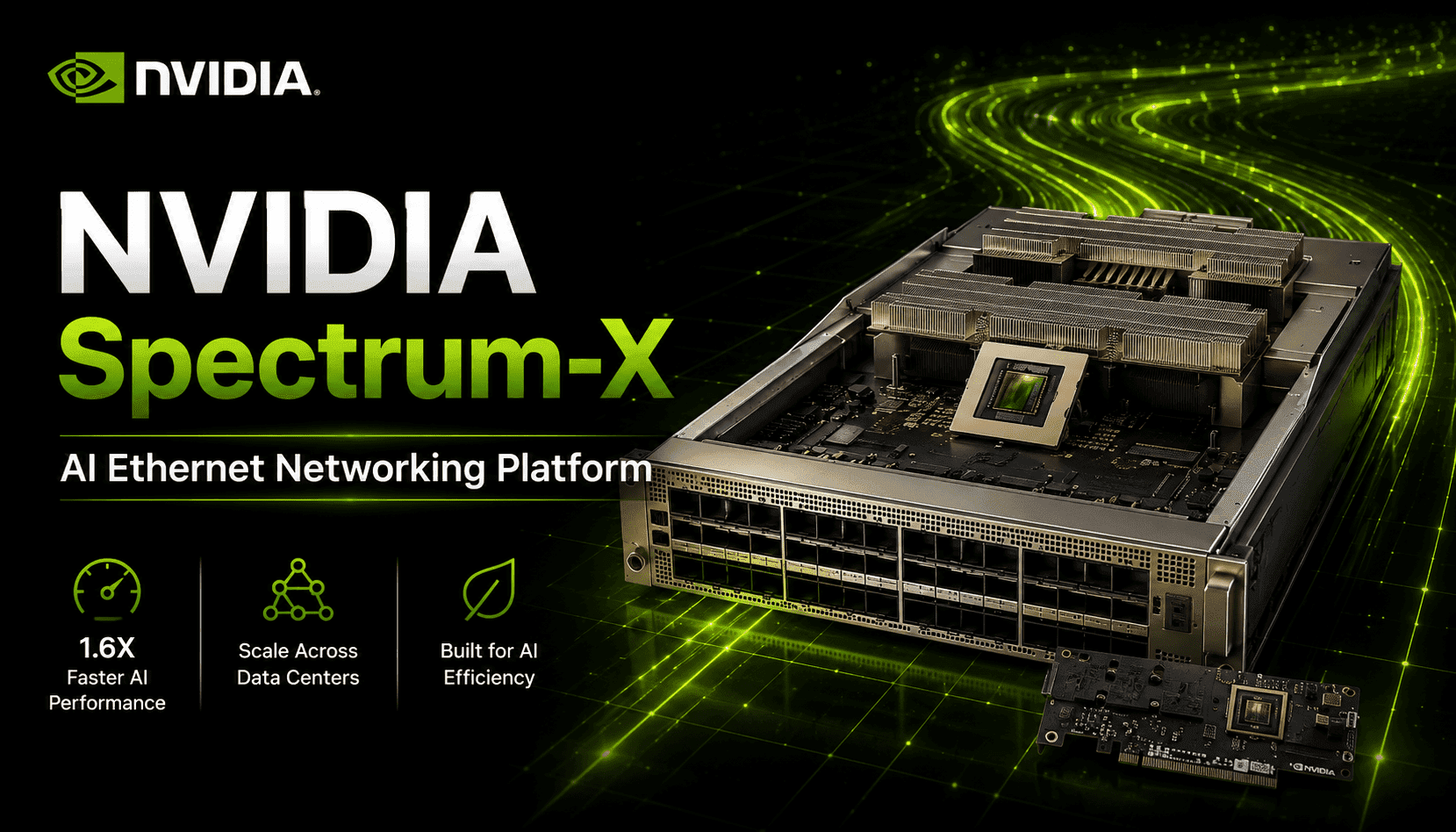
As AI clusters scale beyond tens of thousands of GPUs, the real limiter is no longer compute—it’s the network. NVIDIA’s Spectrum‑X pairs Ethernet switches with SuperNICs to deliver predictable, low‑latency, high‑bandwidth fabrics, reshaping buyer calculus on Ethernet vs. InfiniBand, optics, and multi–data center scale-out.
Most AI teams learn the hard way that when clusters pass a few thousand accelerators, the long pole in training is not FLOPS, it’s the fabric. Collective operations like all‑reduce amplify tail latency and incast; jitter cascades into idle GPU time; and bandwidth efficiency diverges from headline link rates. Spectrum‑X targets those exact pathologies by pairing AI‑tuned Ethernet switches with SuperNICs and an end‑to‑end control plane that squeezes out microbursts and enforces predictable queueing. The pitch is simple but consequential: keep Ethernet’s ecosystem and tooling, but deliver behavior close to specialized HPC interconnects for AI workloads.
Under the hood, the platform leans on advanced RoCE extensions, topology‑aware congestion control, per‑tenant performance isolation, and precise telemetry to push effective throughput toward near‑line rate at scale. SuperNIC offloads and pacing reduce host jitter; switch scheduling and explicit buffering contain incast; and queue‑level guarantees stabilize multi‑tenant behavior. A multiplane design splits NIC bandwidth across independent network planes, lifting scalability and resilience while avoiding deep hierarchies. Co‑packaged optics aim to cut power and improve thermals compared to pluggables, which matters as 800G links proliferate and rack‑level power ceilings tighten.
Strategically, Spectrum‑X expands NVIDIA’s grip on the AI data center from compute into Ethernet fabrics long stewarded by merchant silicon and switch OEMs. For cloud operators who prefer Ethernet’s operational model, this is an on‑ramp to AI‑grade performance without abandoning tooling, SONiC‑style NOS choices, or familiar optics supply chains. It also blurs the historic Ethernet vs. InfiniBand boundary: the choice increasingly reflects tenancy patterns, manageability, and interoperability needs—more than raw speed stickers. Expect competitive responses from merchant‑silicon ecosystems around congestion control, scheduling, and host offloads to close the gap.
For buyers, the evaluation lens should shift from port speeds to job completion time under stress: measure effective bandwidth for all‑reduce at scale, tail latency under incast, and performance isolation in mixed tenancy. Plan for multiplane designs, budget for optics and liquid‑cooling spillover, and model cross‑data center topologies if training must span campuses. The practical move: pilot with representative model sizes and batch schedules, enable explicit congestion control end‑to‑end, and validate telemetry granularity before committing to a fabric generation.
What Changed: Ethernet, Tuned for AI Rather Than General Cloud
Classic Ethernet is optimized for aggregate throughput across many independent flows. AI training flips that: a few elephant flows dominate, with tight synchronization windows that hate jitter. Spectrum‑X aligns switch silicon, NIC offloads, and stack behavior to that reality, prioritizing determinism over best‑effort fairness. The result is higher effective bandwidth for collectives and less idle GPU time—especially as node counts rise.
The platform’s differentiation is not a single feature but the coupling: host pacing and RoCE tuning, switch scheduling that anticipates topology hot spots, and telemetry that lets operators catch tail blow‑ups before jobs stall. For multi‑tenant AI clouds, the ability to bound noisy neighbors while preserving utilization is the operational unlock.
Architecture Primer: Switches, SuperNICs, Multiplane, and Telemetry
SuperNICs shift pacing and congestion handling closer to the wire, reducing host jitter and CPU tax. On the fabric, queue‑level isolation and congestion signaling keep elephant flows from starving mice. A two‑tier, multiplane topology splits NIC links across independent planes, improving failure resilience and scaling while avoiding deep Clos complexity for up to very large GPU counts.
Telemetry should be topology‑aware and fine‑grained enough to trace tail outliers to queues, ports, and flows. That enables automatic rate adaptation and targeted remediation instead of blunt throttling. In cross‑data center designs, latency management and congestion control must consider inter‑site links explicitly, or NCCL performance will crater despite fast local fabrics.
Risks and Trade‑offs: Interoperability, Lock‑in, and Operational Complexity
Tighter coupling between NICs, switches, and software can raise performance—but it can also narrow interoperability with mixed vendor gear or legacy observability tools. Ensure SONiC or chosen NOS images, orchestration, and CI/CD can carry fabric configuration drift safely. Validate that host agents and drivers align with your kernel baselines and container images.
Vendor concentration is another consideration: if your GPUs, NICs, and switches come from one roadmap, supply and pricing risks are correlated. Maintain optionality where possible—e.g., optics supply and cabling plant—and confirm clear rollback paths for congestion control settings to avoid cluster‑wide regressions.