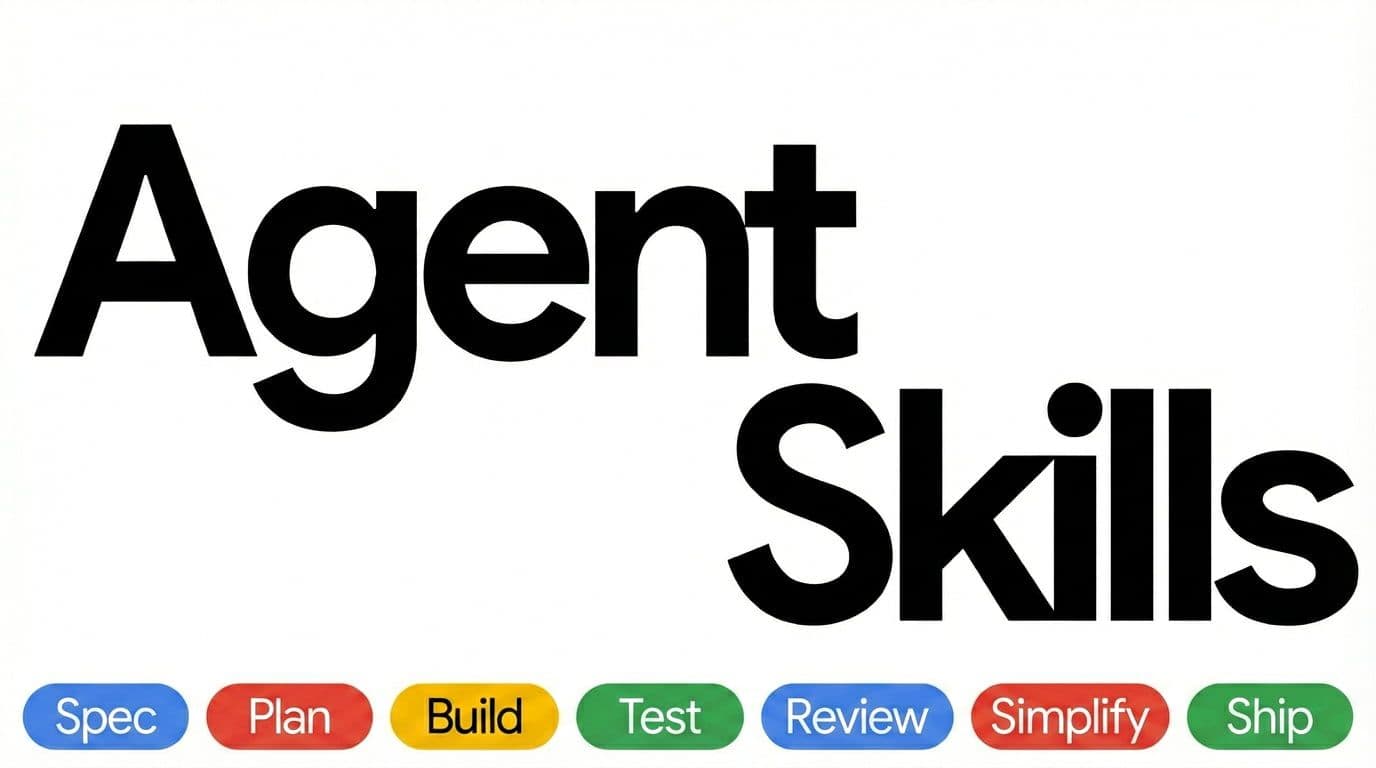
Agent Skills turns senior engineering workflows into reusable instructions that help AI coding agents follow specs, tests, security checks, reviews and production-ready delivery habits.
AI coding agents are becoming more capable, but capability alone does not make them reliable software engineers. Left alone, agents often rush toward visible completion: they write code, modify files, claim the task is done and skip the slower engineering steps that keep production systems safe. Agent Skills is designed to fix that gap by packaging senior engineering workflows into reusable instructions that agents can follow consistently.
The core idea is simple: instead of asking an AI agent to “build this feature” and hoping it remembers best practices, developers can attach a skill that defines how the agent should approach the work. A skill can guide the agent through requirements, planning, test creation, implementation, verification, review and shipping behavior. That turns agent usage from ad hoc prompting into a more structured engineering system.
For developers, founders and technical teams, this is a major workflow shift. The question is no longer only which coding agent is best. The better question is whether the agent is operating inside a workflow that enforces quality gates. Agent Skills points to a future where teams build reusable skill libraries that encode how their organization actually ships reliable software.
Why AI coding agents need engineering skills
Most coding agents are optimized to be helpful and fast, which can make them dangerously eager. They may implement a feature before clarifying the spec, skip test-first thinking, ignore edge cases, overlook accessibility, miss security boundaries or produce a pull request that looks complete but is hard to review. These are not model intelligence problems only; they are workflow discipline problems.
Agent Skills addresses this by giving agents structured playbooks. A skill can tell the agent what to do before coding, what evidence to collect during implementation, which checks to run before declaring success and how to communicate tradeoffs to a reviewer. That makes the agent more predictable and reduces the need for the human developer to repeatedly restate basic engineering expectations.
The workflow: define, plan, build, verify, review and ship
The strongest part of Agent Skills is that it mirrors the real software development lifecycle. Before implementation, the agent should define the problem, understand acceptance criteria and plan the work. During implementation, it should make focused changes rather than broad uncontrolled edits. After implementation, it should verify behavior through tests, static checks, manual reasoning and review-ready summaries.
This structure matters because production software is not only about writing code. It is about reducing uncertainty. Good engineers ask what success means, what could break, what the user expects, what risks the change introduces and how the reviewer can quickly understand the diff. Agent Skills tries to make AI agents follow that same pattern.
Quality gates are the real value
The value of Agent Skills is not simply that the instructions are written in Markdown. The real value is the quality gate. A good skill defines what must be true before the agent moves forward: tests pass, security assumptions are checked, accessibility is considered, performance risks are reviewed, the diff is understandable and the final answer includes evidence rather than vague confidence.
This is especially important because autonomous coding agents can produce convincing but incomplete work. Quality gates force the agent to slow down and show proof. For teams adopting AI coding agents, this can reduce wasted review time and help prevent the common pattern where the agent says the task is finished but a human reviewer has to discover the missing checks later.
How Agent Skills differs from Loop Engineering
Loop Engineering focuses on the repeated cycle of agent action, observation, evaluation and improvement. Agent Skills complements that idea by defining the repeatable behaviors the agent should follow inside the loop. In simple terms, Loop Engineering designs the process engine, while Agent Skills provides the reusable playbooks that tell the agent how to behave at each stage.
That distinction is useful for teams. A loop without strong skills can become repeated trial and error. Skills without a loop can become static instructions that still depend heavily on manual prompting. Together, they create a stronger pattern: a coding agent that follows disciplined engineering workflows and improves through structured feedback.
How NexusAI users should apply Agent Skills
Developers should start by using Agent Skills for workflows where quality matters more than speed: feature implementation, bug fixing, refactoring, test generation, security review, accessibility review, performance checks and pull request preparation. These are areas where an agent can save time, but only if it follows a disciplined process.
Teams can also adapt the skills to match internal standards. A startup might create skills for shipping MVP features safely. An enterprise team might add compliance, code ownership, security and review policy requirements. Over time, Agent Skills can become a lightweight way to encode institutional engineering knowledge so AI agents follow the same expectations across projects.