

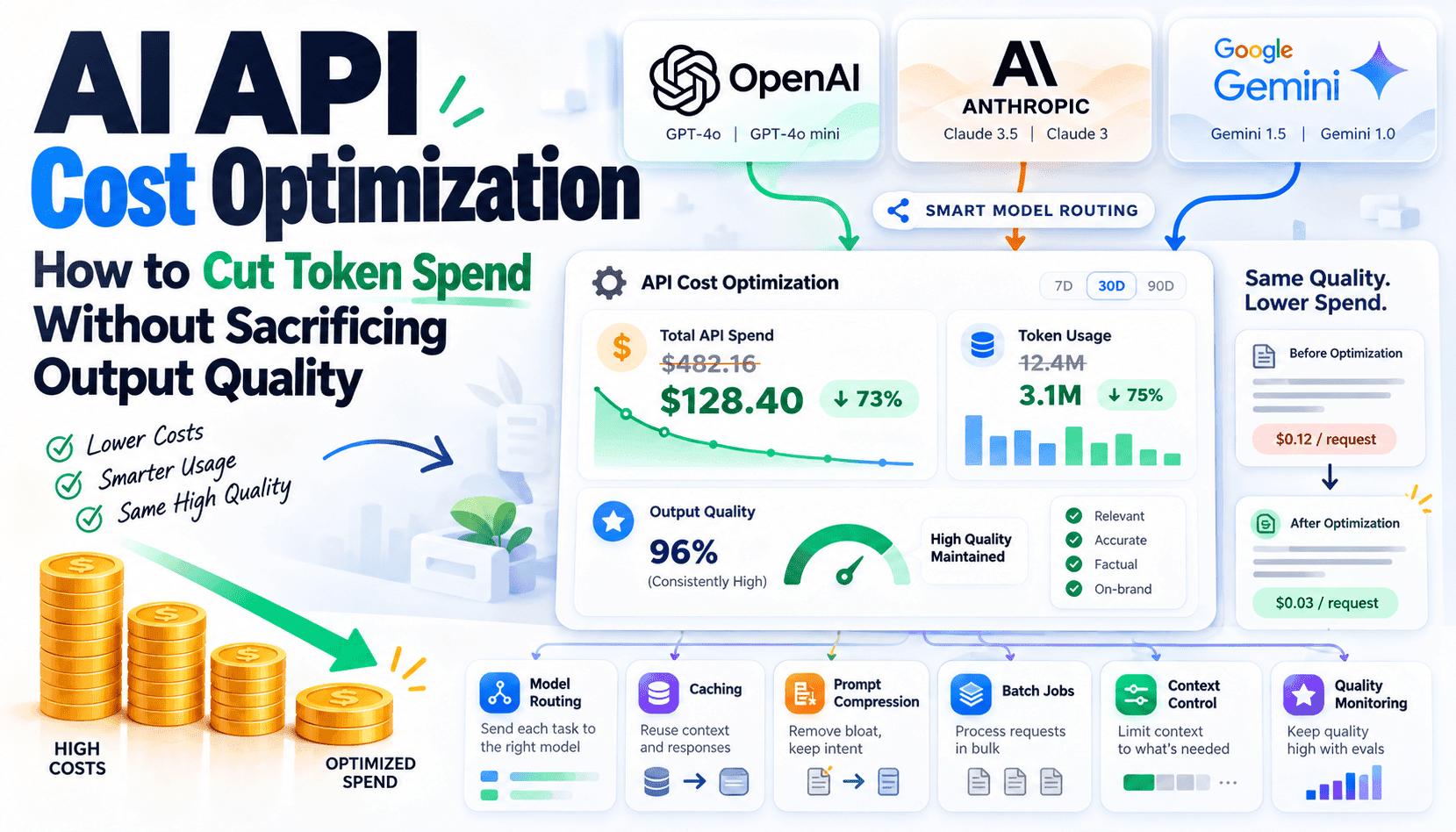
The growth of generative AI has made token costs a material line item. Left unmanaged, token spend scales with user volume, long contexts and uncontrolled outputs. Cost optimization is not about always choosing the cheapest model; it’s about matching model capability to task complexity, reducing unnecessary tokens in both inputs and outputs, and changing workflows so expensive inference is used only when it meaningfully improves business outcomes. This article lays out the operational levers teams can pull and the metrics needed to measure trade-offs.
Start with a routing and capability map: classify requests by complexity and expected quality sensitivity, then route low-complexity tasks to smaller, cheaper models or deterministic modules. Examples: short copy edits, strict-format translations, or simple intent extraction can often run on distilled models or heuristics; creative long-form generation and nuanced multi-step reasoning should be gated to stronger models. Instrument each route for success rate and fallthrough so you can detect when cheaper paths fail and escalate selectively.
Prompt engineering for cost control has three practical moves: compress instructions without losing semantics, maximize shared system context, and trim dynamic context. Use compact templates, numbered few-shot examples, and structured function schemas to reduce verbosity. Keep stable system context on the server and only append incremental dynamic elements. For long conversation histories, summarize rather than resend raw messages; for document-heavy tasks, retrieve and rank the most relevant passages instead of pushing entire documents into the prompt.
Beyond prompts, build caching, batching and pipeline controls into your stack. A hybrid semantic + exact-match cache prevents rerunning the same expensive inference. Batch low-priority work during off-peak hours or in cheaper compute pools. Enforce output limits, stop tokens, and deterministic function calls where possible so models don’t generate unbounded text. Finally, adopt a unified cost-control framework that tracks input tokens, output tokens, cache hit rate, latency and quality metrics together—so decisions balance price with product success.