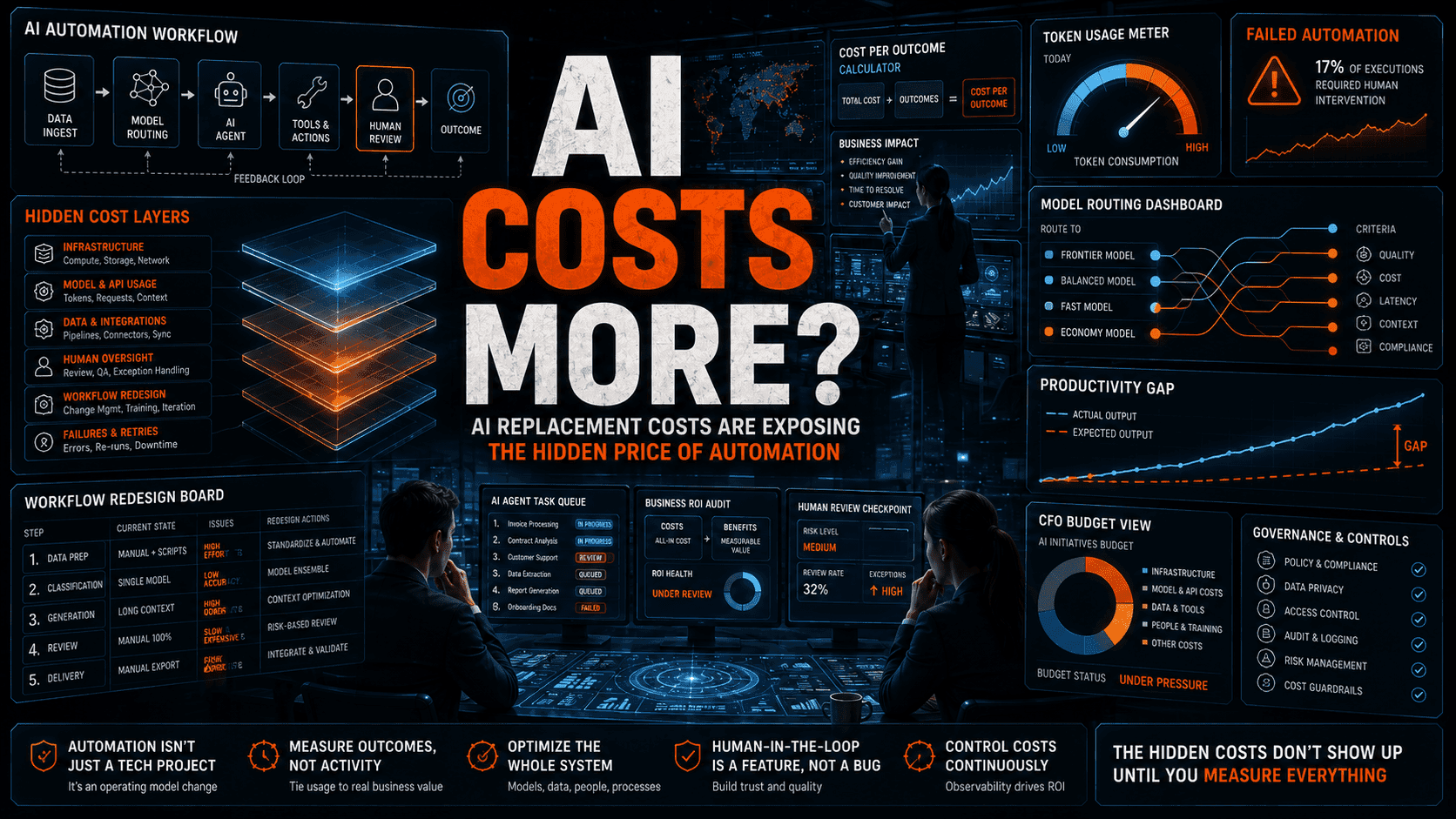
AI can cost more than the work it replaces when companies ignore token usage, human review, integration effort, workflow redesign and cost-per-outcome measurement.
AI adoption is entering a more uncomfortable phase. Companies that rushed to replace repetitive work with AI are discovering that automation is not automatically cheaper. A model may complete parts of a task, but the surrounding workflow can become more expensive if it requires constant supervision, retries, integration fixes, legal checks and human correction.
This does not mean AI is failing. It means the basic ROI story is changing. The real question is not whether AI can perform a task, but whether it can perform the task reliably, safely and cheaply enough to improve the business outcome.
At the same time, Big Tech is still spending aggressively on AI infrastructure because compute capacity, models, agents and cloud platforms remain strategic. That creates a split: platform companies continue building, while enterprise buyers are forced to become much more disciplined about which AI tools actually reduce total cost.
Why AI replacement can become expensive
The obvious AI cost is the subscription or API bill. The hidden costs are often larger: prompt engineering, workflow mapping, data cleanup, model routing, human review, security controls, hallucination checks, escalation paths, staff retraining and governance overhead.
When those costs are ignored, a company may remove a human role but create a more complex system around the AI. The result can be slower handoffs, more review work and unpredictable usage bills instead of genuine automation savings.
The wrong metric is headcount removed
Many early AI business cases start with a simple comparison: the cost of a worker versus the cost of an AI tool. That comparison is too narrow. It misses reliability, context, accountability, judgment, error handling and the operational cost of keeping the AI system useful.
The better metric is cost per completed outcome. A customer-support AI should be judged by cost per resolved issue. A coding agent should be judged by cost per accepted pull request. A research assistant should be judged by cost per verified insight, not the number of tokens it generated.
Token bills can hide workflow waste
Token usage becomes dangerous when teams treat it as background infrastructure instead of a controllable cost. Long prompts, repeated retries, oversized models, unfiltered document context and poorly designed agents can increase spend without improving the final output.
This is why token optimization, model routing and context management are becoming core enterprise AI practices. The goal is not to use the cheapest model for everything. The goal is to match model capability to task difficulty, risk and business value.
Big Tech spending makes the ROI pressure sharper
Major technology companies are still investing heavily in AI data centers, chips, models and cloud capacity. That spending may be rational for platform companies because AI infrastructure can support search, cloud, productivity software, agents, advertising, developer tools and consumer assistants.
For ordinary businesses, however, the economics are different. They are not building the AI stack; they are buying access to it. That means every AI workflow must justify itself against existing labour, software and process costs.
How AI buyers should prevent cost overruns
NexusAI users should choose AI tools with clear cost controls. Useful features include usage dashboards, model selection, workflow templates, approval gates, audit logs, human review thresholds, context limits and integrations that reduce manual handoffs.
The strongest AI deployments start with one measurable workflow. Define the baseline cost, redesign the process, set quality thresholds, measure review time, cap token usage and compare the final cost per outcome before scaling the tool across the business.