

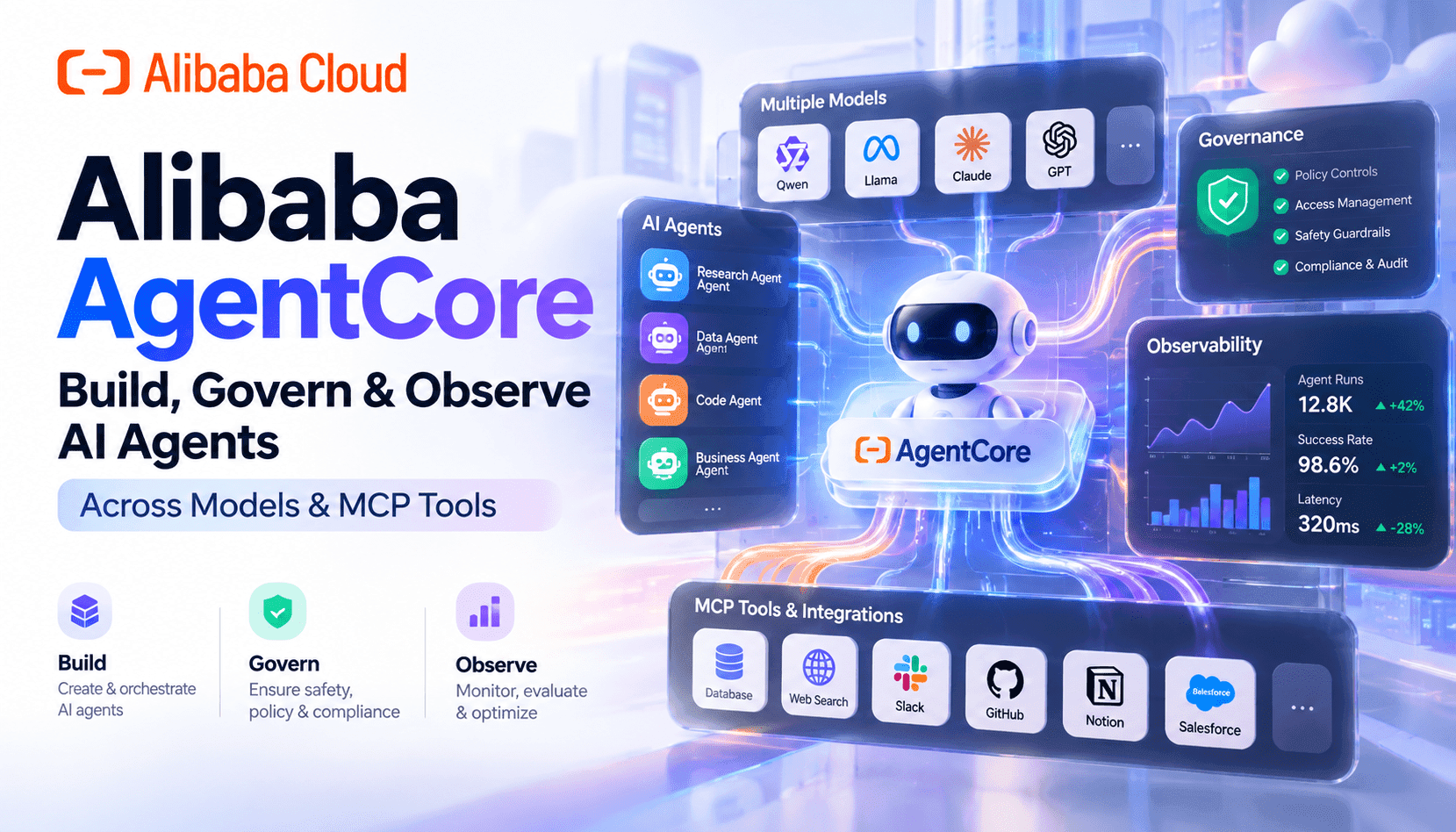
AgentCore is Alibaba Cloud’s bid to make AI agents an enterprise-first primitive rather than a lab experiment. It consolidates agent creation, configuration, and deployment into a single console that speaks to multiple model providers, integrates Model Context Protocol (MCP) tools, and manages access centrally. Teams can register self-built agents, open-source harnesses, and commercial SaaS agents side by side, apply templates to standardize behavior, and roll out updates in batches. Unified credentials reduce key sprawl, while role-based controls align responsibilities across engineering, ops, and business stakeholders. The aim is to keep experimentation fast without sacrificing auditability, observability, or compliance in production environments.
Under the hood, AgentCore brings three pillars together: lifecycle management, collaboration and governance, and observability and evaluation. Model routing and configuration are abstracted so teams can swap providers per agent without rewriting glue code. Skills and tools can be cataloged, versioned, and reused; third-party capabilities flow in through MCP so agents can safely call out to external systems. The runtime surfaces traces, token usage, and performance signals end to end—critical for SLOs and cost controls. Enterprise IM connections (e.g., DingTalk, WeChat, Lark) help situate agents in daily workflows. Optional cloud dependencies power tracing, private connectivity, and scheduling, but are billed separately—an important TCO nuance for buyers.
The commercial value shows up in concrete scenarios: digital employees that retain context via memory stores and KBs, customer service agents with elastic sandbox runtimes, conversational analytics teams decomposing tasks across agent teams, and coding assistants orchestrated across heterogeneous toolchains. Governance features constrain data access while preserving agility, and observability enables iterative tuning. Early adopters should probe multi-region support, MCP coverage breadth, and evaluation depth across model families. The strategic bet is that a neutral control plane will outpace one-off framework builds on reliability and cost attribution, while giving enterprises the freedom to evolve model choices as performance and pricing shift.