

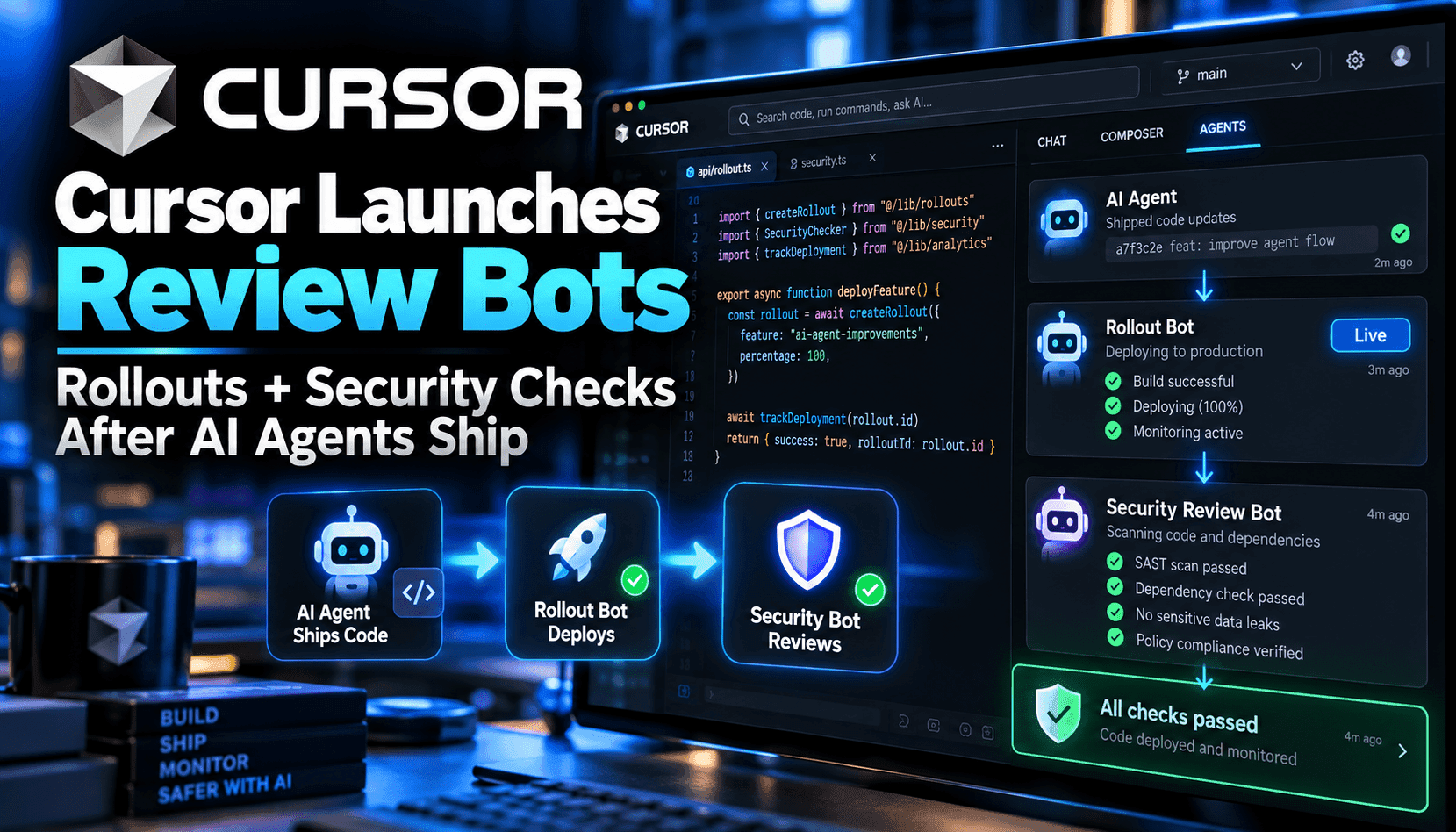
The center of gravity for coding agents is moving from IDEs to production. Cursor’s Rollouts bot attaches to each pull request, converts the diff into a monitoring plan, and evaluates deploys against real telemetry—separately for staging and production. Instead of a single green check from CI, teams get a verdict on whether the change achieved its intended effect and whether it introduced regressions. That verdict lives back on the PR thread, where authors and reviewers already work, creating a closed loop from code to impact.
Security Review complements this by posting one consolidated comment focused on exploitable bugs, not style. It tracks common injection surfaces (SQL, commands, templates), authentication and authorization bypasses, secrets in source, SSRF and unsafe redirects, unsafe deserialization, and dependency upgrades with known CVEs. Findings include severity, an attack path explaining how input flows to a sink, and a proposed fix. Teams can add project‑specific rules—such as mandatory client wrappers or tables never queried in handlers—and the bot will enforce them consistently on every PR while skipping drafts.
Operationally, Rollouts wires into source control, your delivery system for deploy events, and observability providers. It wakes on deploys for a commit, runs its plan against logs, metrics, and traces, and can escalate regressions by notifying authors, proposing a revert PR, or handing the issue to a cloud agent for a fix. Crucially, it does not auto‑merge or auto‑rollback—teams stay in control. Environment isolation means a change can validate in staging while still being flagged in production, an important guardrail for progressive delivery and feature flags.
For buyers, the value is clear: convert ambiguous post‑deploy firefighting into explicit plans, verdicts, and fixes—without adding another dashboard. But the efficacy depends on the quality of your telemetry and policies. If you lack golden signals, structured logs, or proper traces, the bot’s verdicts will be noisy or inconclusive. Likewise, Security Review’s precision improves when you codify team rules and maintain a clean secrets‑handling posture. Treat this as an accelerator for mature DevSecOps practices, not a substitute for them.