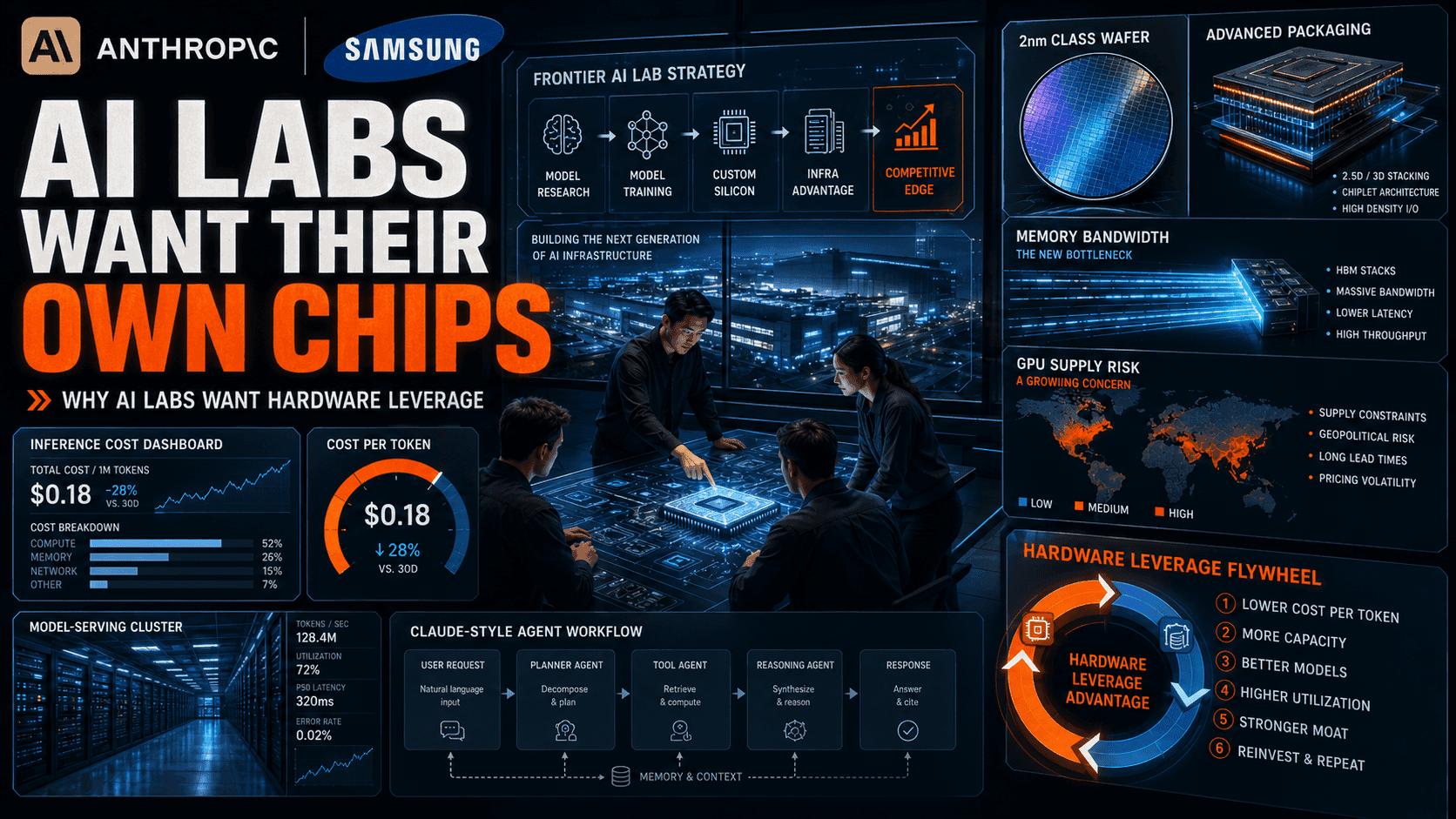
Anthropic’s reported talks with Samsung over a possible 2nm custom AI chip show how frontier model labs are trying to gain more control over compute cost, supply and inference strategy.
Anthropic is reportedly exploring early talks with Samsung over a potential custom AI chip, placing the Claude developer into the same strategic conversation as OpenAI, Google, Amazon, Microsoft and Meta: how much of the AI hardware stack should model companies control themselves?
The talks are preliminary, and Anthropic has not committed to a chip, a design, a server architecture or a manufacturing partner. But the fact that Samsung’s 2nm process and advanced packaging are reportedly part of the discussion is enough to show where the industry is moving.
AI labs are under pressure from two sides. They need massive compute to train and serve frontier models, while also needing lower inference costs for coding agents, enterprise assistants, long-context workflows and high-volume chatbot usage. Custom silicon is one path toward better economics, more supply flexibility and deeper optimization around a lab’s own model architecture.
Why Anthropic would care about custom chips
Anthropic’s Claude models are increasingly used for coding, enterprise work, long-context analysis, agentic workflows and high-volume API usage. Those workloads are expensive to serve at scale. Even small efficiency gains in inference can matter when millions of users and developers are calling models repeatedly.
A custom chip could eventually let Anthropic tune hardware around its own model patterns, memory needs, latency targets and deployment stack. The goal would not necessarily be to replace Nvidia overnight, but to create leverage: lower cost per token, more predictable supply and less dependence on one external GPU ecosystem.
Samsung gives Anthropic a different hardware path
Samsung is strategically interesting because it combines memory expertise, advanced packaging and foundry manufacturing. AI chips are not only about the compute die. They depend heavily on memory bandwidth, packaging, interconnects, power efficiency and the ability to assemble complete systems at scale.
The reported 2nm discussion matters because advanced process nodes can improve performance and power efficiency, but manufacturing at the leading edge is difficult. For Samsung, a major AI-lab win would be a powerful signal that its foundry business can compete for high-value AI workloads against the industry’s dominant manufacturing options.
This is about inference economics as much as training
Training gets the attention because it requires enormous clusters, but inference may be the business-model bottleneck. Every chat response, coding-agent step, document analysis task, tool call and enterprise workflow consumes compute. As AI usage scales, serving models cheaply becomes just as important as building them.
This is why custom chips are becoming more attractive. A chip optimized for the specific patterns of a model family could make high-volume usage more sustainable. It could also support model-routing strategies where different chips serve different workloads based on cost, latency and complexity.
The gap between talks and production is huge
Custom AI chips are difficult, expensive and slow. A reported conversation with Samsung does not mean Anthropic will ship hardware soon. The company would still need to define the chip’s purpose, validate architecture, secure packaging and memory, build server systems, integrate software, test reliability and prove that the economics beat existing options.
There is also strategic risk. If a custom chip is too narrow, it may age poorly as model architectures change. If it is too general, it may not deliver enough advantage over GPUs. The best outcome is a hardware roadmap that complements Nvidia, Amazon Trainium, Google TPUs and other accelerators rather than forcing Anthropic into a brittle single path.
What this means for AI tool users
For users, custom chips may sound remote, but they can shape product experience directly. Better hardware economics can mean faster responses, cheaper API pricing, higher rate limits, better long-context workflows, more affordable coding agents and stronger enterprise deployment options.
NexusAI users should watch whether AI labs can turn chip strategies into practical advantages. The key signals are not only announcements, but deployment timelines, cost per token, latency, model availability, enterprise pricing, inference reliability and whether new hardware enables workflows that were previously too expensive.