

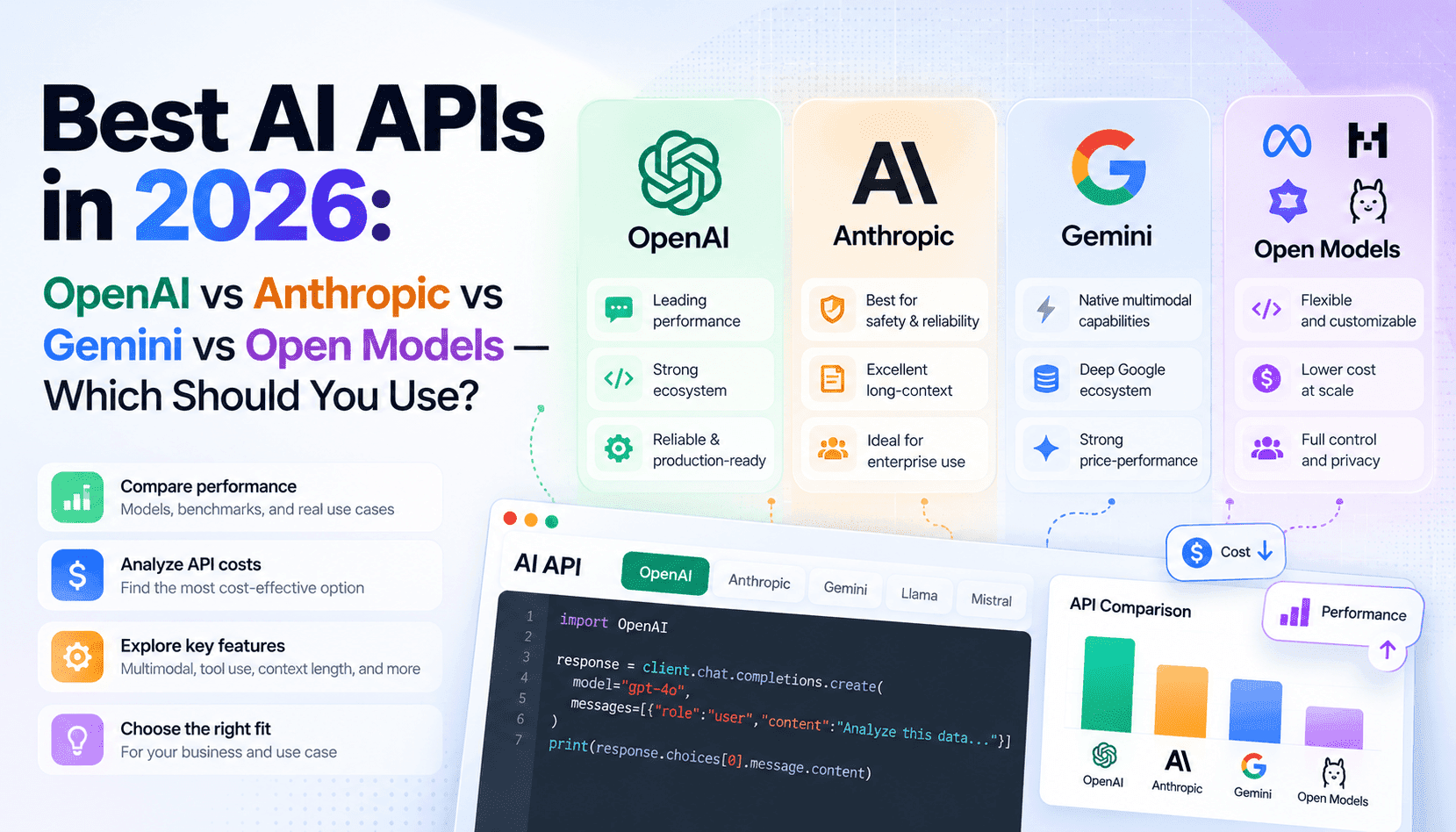
Choosing an AI API in 2026 feels less like picking a single winner and more like matching workloads to the economics and capabilities that matter for your product. The market now splits into several practical camps: closed APIs with continually updated high-performance models (OpenAI, Anthropic, Gemini), large open-weight models you can self-host for control and privacy, and multi-model gateways that route between providers for cost and capability optimization. Each option shifts effort across engineering, compliance and ops; the right choice depends on your latency targets, data controls, and whether model determinism or raw reasoning quality is paramount.
From a technical buyer’s perspective, evaluation should be dimension-driven and experiment-focused. Run small, representative benchmarks: few-shot reasoning tasks for product logic, real code-rewriting samples for developer tools, multimodal prompts for document and image pipelines, and structured-output tests for ingestion into databases. Measure not just quality but cost per useful token, latency P95 for synchronous flows, batch throughput for offline jobs and failure modes under degraded network conditions. Combine these signals into a per-workload ‘acceptance threshold’ and use it to choose the least costly provider that meets your SLA.
Operational concerns are as decisive as model accuracy. Vendor lock-in often appears subtle: proprietary tool integrations, unique function-calling semantics, or closed auditing features can help early delivery but complicate future migrations. Open-weight models give maximum control over data residency and inference cost but shift the burden of scaling, security patching and reliability onto your infra teams. Multi-model gateways and model routers add indirection and complexity but let you stitch together cheaper base models with a high-quality fallthrough, balancing immediate unit economics against long-term engineering cost.
This article lays out a pragmatic decision matrix, deployment scenarios, and an operational playbook—model routing, fallback strategies, observability signals and cost-monitoring setups—so teams can adopt a modular architecture. The goal is not a single vendor recommendation but a repeatable approach: define workload requirements, run targeted evaluations, choose the simplest architecture that meets those requirements, and design your stack so switching providers becomes an operational configuration rather than a costly rewrite.