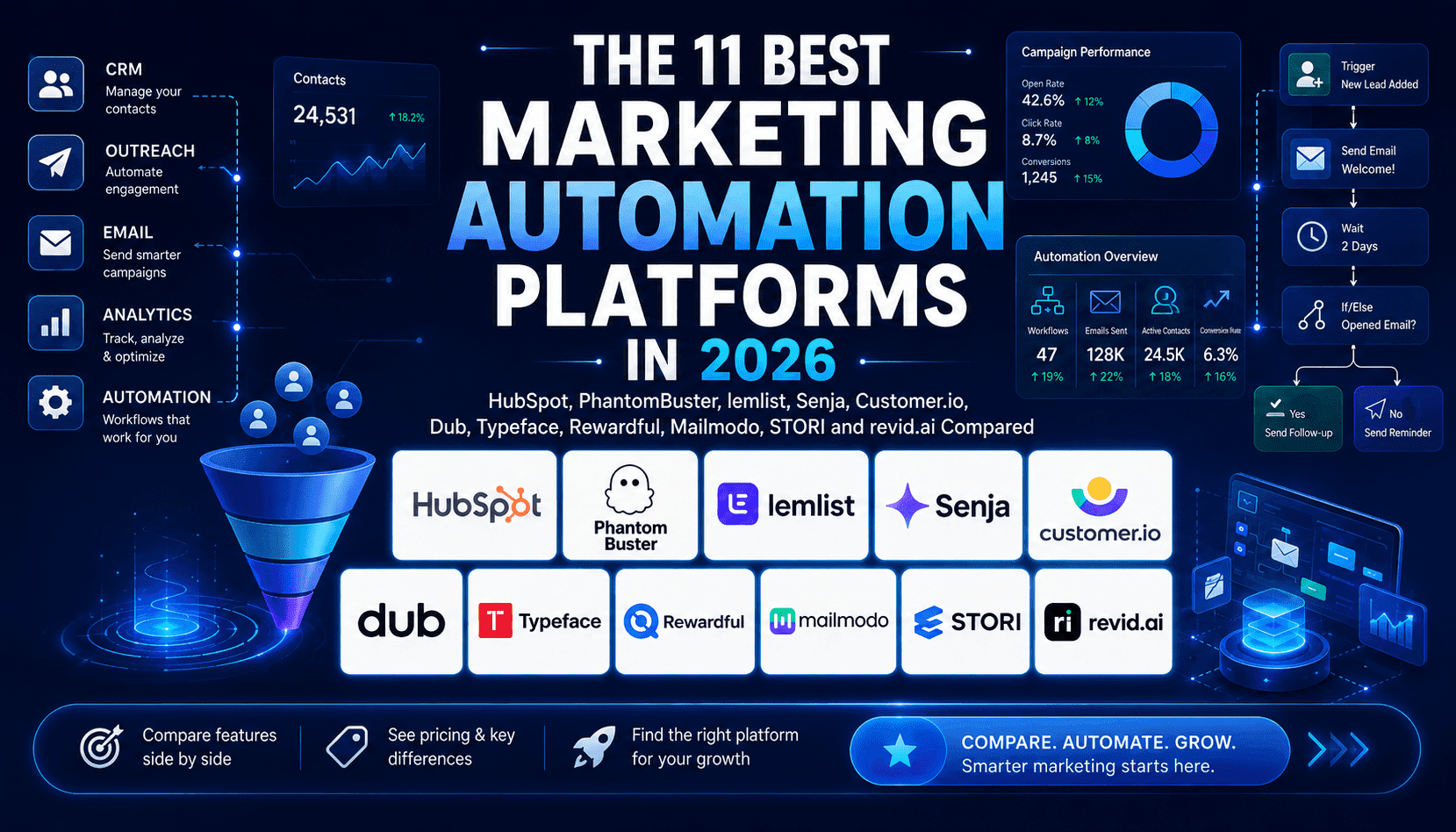
A practical, role-by-role guide to choosing marketing automation in 2026. We map HubSpot, PhantomBuster, lemlist, Senja, Customer.io, Dub, Typeface, Rewardful, Mailmodo, STORI, and revid.ai to real growth priorities—acquisition, nurturing, content, attribution, partnerships, and conversion—so teams assemble a stack that fits how they actually win customers.
The crowded “marketing automation” label hides a simple truth: teams rarely need one monolith; they need a compact set of systems that reflect how pipeline is created, qualified, and closed. In 2026, the winning stacks blend one CRM-led hub with best-of-breed execution for outbound, lifecycle, content, and attribution. That cut keeps data authoritative, workflows auditable, and experiments shippable. This guide maps 11 tools to outcomes—acquisition, nurturing, content, attribution, partnerships, and conversion—so buyers avoid redundant features and invest where marginal returns are highest.
Start with the backbone. If your org needs a shared system for contacts, deals, tickets, and marketing ops, HubSpot remains a pragmatic center of gravity—particularly when SDRs, AEs, CS, and marketing must see the same timeline. From there, specialize: PhantomBuster handles prospect data collection and trigger-based enrichment; lemlist personalizes multichannel outbound; Customer.io operationalizes event-driven lifecycle messaging; Mailmodo unlocks interactive email journeys. Dub and Rewardful cover link-level attribution and partner/affiliate programs, while Senja, Typeface, STORI, and revid.ai close the loop with social proof, brand content, and fast video production.
The decision lens is less about features and more about data contracts and handoffs. Who is source of truth for identities and events? Where are segmentation rules maintained? Which system sends messages and which records consent? Teams that define those lines ship faster and measure cleaner. As a rule: centralize identity and attribution, federate content creation and channel sending, and automate transitions at the moments that unlock revenue—first meeting booked, PQL reached, trial activation, expansion signal, or referral triggered.
Choose-by-Outcome Framework
Map tools to outcomes, not categories. If your priority is acquisition, anchor on PhantomBuster for targeted data collection and enrichment, and lemlist for high-relevance outreach. For nurturing, Customer.io is strong on event-driven logic and channel breadth, while Mailmodo adds interactive email that nudges trial users and buyers forward. Conversion hygiene lives in HubSpot, which maintains the definitive activity timeline and supports revenue ops at scale.
Content and trust signals split across Senja for testimonials and social proof, Typeface for enterprise-grade brand content and guardrails, STORI for AI-assisted brand and social workflows, and revid.ai for fast, repeatable short-form video. Attribution and partner revenue hinge on Dub for link-level accuracy and Rewardful for affiliate and referral operations. This allocation reduces overlap and clarifies who owns which KPI.
Attribution, Partnerships, and Risk Controls
Without trustworthy attribution, optimization stalls. Dub gives modern link-level and campaign attribution with first/last-touch options and clean URL governance. Rewardful layers in SaaS-focused affiliate and referral management—eligibility, payouts, and partner performance. Define a single attribution model for leadership reporting and tag all partner and creator links consistently. Mirror partner IDs into your CRM so revenue ops can reconcile commission and pipeline without manual spreadsheets.
Risk checklist: maintain consent logs across outbound and lifecycle tools, throttle scraping and outreach to respect platform terms, and ensure PII only flows through systems with proper security and DPA coverage. Create incident playbooks for list contamination, deliverability drops, or mis-tagged affiliate links so you can correct course within hours, not quarters.