

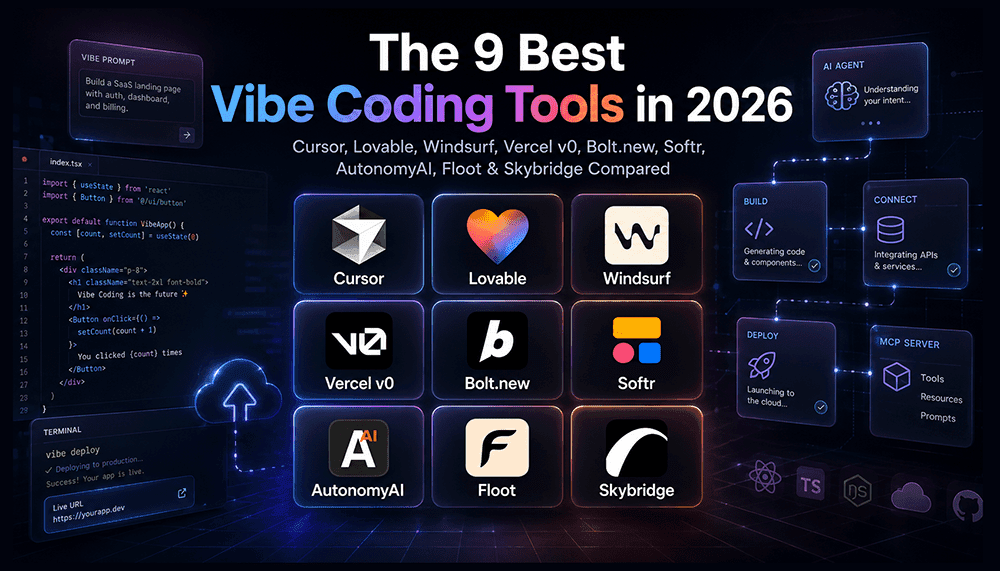
“Vibe coding” has matured from clever demos into practical pipelines that compress scoping, scaffolding, coding, and deployment into hours—not weeks. The nine tools here cluster into three lanes: developer-first IDE copilots (Cursor, Windsurf), prompt-first builders for full-stack and UI (Lovable, Vercel v0, Bolt.new, Floot), and business or production frameworks (Softr, AutonomyAI, Skybridge). We evaluated them across AI-assisted editing depth, prompt-to-app fidelity, deployment cleanliness, integrations, scalability, and open-source flexibility to surface clear recommendations by persona and project stage.
If you live in Git, Cursor’s repository-aware refactors, reviews, and multi-file edits feel like a natural extension of disciplined engineering. Windsurf adds agentic tasking inside a modern IDE for multi-step changes. Lovable, v0, and Bolt.new shine for fast prototypes and polished UIs, while Floot reduces roadblocks for non-technical makers. Softr remains strong for no-code business apps and portals. AutonomyAI is geared for production AI engineering workflows, and Skybridge provides open-source React and MCP primitives when you want code you own and can refactor freely.
Most teams benefit from combinations, not a single bet. A common pattern: design the interface with Vercel v0, wire real features in Cursor, and standardize deploys on your existing CI while you keep an open-source escape hatch with Skybridge. Non-technical founders can validate in Softr or Floot, escalate complexity in Lovable or Bolt.new, then graduate high-value services to a developer-centric workflow. Your decision hinges on cost-of-change: how easily can you test, integrate, and later replatform without rewriting the spine of your app?
Before committing, pressure-test each option with a two-week pilot: ship one end-to-end user journey, integrate a third-party API, add observability, and rehearse a rollback. Tools that feel fastest on day one sometimes add friction when models drift, repos grow, or auth and data contracts harden. The winners below are chosen not just for speed, but for ownership, maintainability, and the path from demo to dependable production.