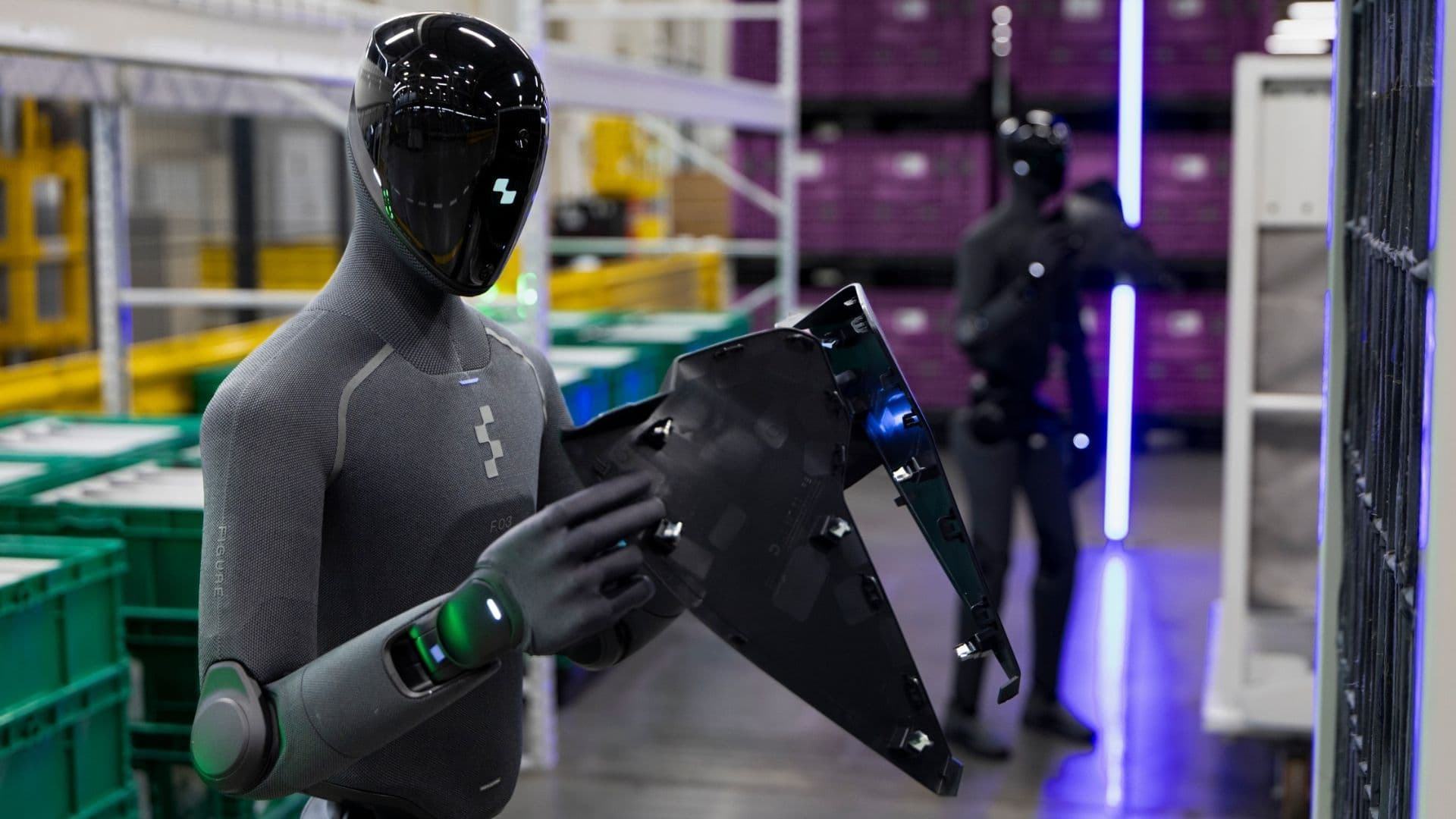
BMW’s Figure 03 project at Plant Spartanburg shows humanoid robots moving into real factory logistics, where Physical AI must prove reliability, safety and workflow value.
BMW’s Figure 03 project at Plant Spartanburg is a useful signal for the Physical AI market. Instead of showcasing a humanoid robot in a controlled demo, BMW is applying the technology to production logistics, one of the most practical areas for humanoid robots to prove value.
The project follows BMW’s earlier Figure 02 deployment, where the robot supported production of more than 30,000 BMW X3 vehicles over ten months by handling sheet-metal insertion in the body shop. BMW says the collaboration demonstrated that humanoid robots can safely perform precise, repeatable work steps under real production conditions.
Figure 03 now moves the story into advanced logistics. In the new use case, the robot will pick up components delivered in larger unsorted containers and sort them into sequencing trolleys, supporting just-in-sequence delivery to assembly employees. This is exactly the type of repetitive, physically demanding and variable factory work where humanoid robots must prove they are more than science-fiction hardware.
Why BMW’s Figure 03 project matters
Humanoid robotics has often been judged by viral videos: walking, carrying boxes, folding laundry or doing staged manipulation tasks. BMW’s Spartanburg project is more important because it places the robot inside a production environment where uptime, safety, repeatability and workflow integration matter.
For Physical AI, real factories are a difficult proving ground. The robot must operate around people, parts, trolleys, schedules, changing component flows and established production systems. A successful deployment is less about looking human and more about fitting into the factory operating system.
The logistics use case is more practical than it looks
Sequencing work may sound less exciting than a robot building an entire car, but it is strategically important. Automotive production depends on getting the right part to the right place at the right time. If a humanoid robot can handle unsorted components and organize them into a precise flow, it can reduce friction in a high-volume production system.
This is also where humanoid form can make sense. Existing factories are designed around human reach, human walking paths, human-sized containers and human-accessible workstations. A general-purpose humanoid does not need the factory to be rebuilt from scratch, which is part of the appeal for manufacturers testing Physical AI.
Figure 03 adds features aimed at factory readiness
BMW highlights several Figure 03 improvements that are relevant to industrial deployment: soft components for enhanced safety, wireless charging for higher availability, speech-to-speech audio functions, improved hands, tactile sensors and palm cameras designed to improve precision and dexterity.
Those details matter because factory robots fail or succeed on operational fit. Better dexterity helps with varied parts. Safer surfaces matter around people. Charging availability affects uptime. Speech interaction can make human-robot coordination more natural, although it still needs strict safety procedures and clear task boundaries.
BMW is treating humanoids as a complement, not a full replacement
BMW’s framing is important: humanoid robotics is described as a value-adding complement to existing automation. The target work includes monotonous, ergonomically demanding or safety-critical activities where robots can protect employees and improve workplace design.
That framing is more credible than claiming humanoids will suddenly replace entire manufacturing teams. In the near term, the strongest use cases are likely to be narrow but valuable: repetitive handling, logistics support, material movement, inspection assistance and tasks where human ergonomics are a real constraint.
What AI tool buyers should watch next
The next important signals are not only robot videos. Buyers should watch deployment duration, task repeatability, safety incidents, downtime, cost per task, charging logistics, human approval loops, training data needs and how quickly a robot can be redeployed to adjacent workflows.
For NexusAI users, BMW’s project shows how Physical AI will likely enter business gradually. The winning products will not be the robots with the most impressive demos, but the systems that can integrate into real operations, reduce repetitive strain, and prove measurable value under production constraints.