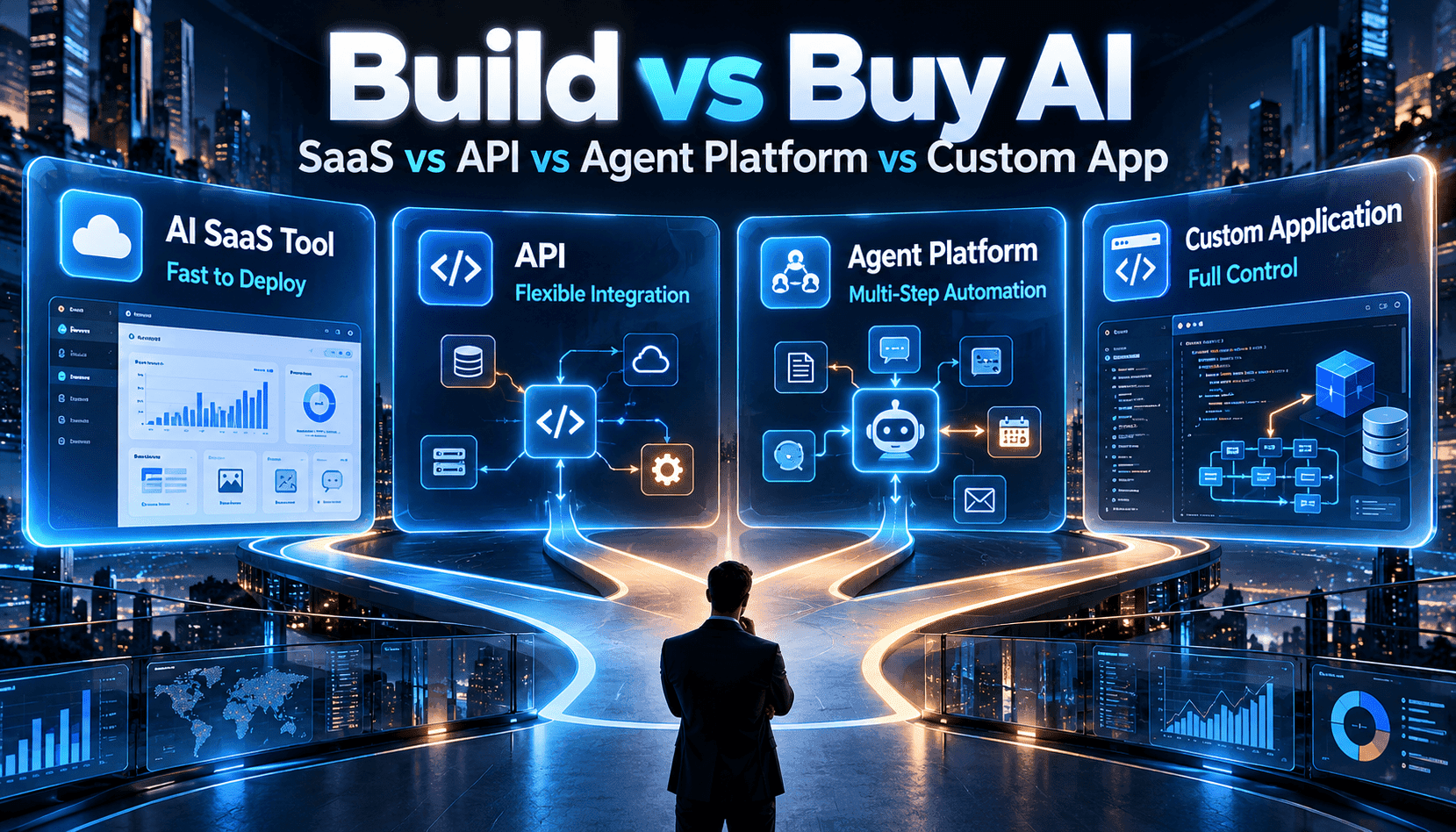
A practical decision framework for choosing between SaaS, APIs, agent platforms, and custom AI applications. This guide compares speed, cost, customization, data risk, integrations, scalability and maintenance, then gives executives a simple decision matrix and TCO model to pick the option that delivers measurable business value.
Companies face a recurring strategic choice: buy a ready-made AI service, stitch an API into existing systems, run workflows on an agent platform, or create a proprietary application. Each path trades off speed, cost, differentiation and governance. For many teams the real decision is not whether AI is valuable but which delivery pattern aligns with product roadmaps, compliance posture and expected user experience. This article lays out pragmatic signals and quantitative factors—implementation time, up-front vs ongoing spend, vendor lock-in, and operational overhead—so leadership can make repeatable, defensible choices.
Start by mapping three business axes: required differentiation (how unique must outcomes be), allowable time-to-value (how fast you must deliver), and data sensitivity (how regulated or private the inputs/outputs are). If differentiation is low, time-to-value high, and data sensitivity moderate, SaaS often wins. If you need custom model behavior but want fast iteration, APIs provide controlled flexibility. Where multi-step decisioning, dynamic state, or cross-system orchestration matter, agent platforms reduce engineering glue. A fully custom build is justified when core competitiveness depends on proprietary workflows, data exclusivity, or fundamental product features that cannot be achieved by composable tools.
Total cost of ownership (TCO) is rarely the single deciding factor, but it exposes hidden trade-offs. SaaS minimizes up-front investment but can carry high per-seat or per-call costs and limited customization. API-first approaches shift spend from licensing to development and monitoring, with predictable variable costs by usage. Agent platforms can reduce orchestration costs but introduce platform fees and potential vendor lock-in for connectors and orchestration logic. Custom builds front-load engineering and ongoing MLOps, data ops, and security expenses—acceptable when the expected competitive lift outweighs long-term operational burden.
This guide presents scenarios—customer support augmentation, regulated-document processing, sales automation, and differentiated product features—and evaluates which delivery pattern matches each. It also includes a simple decision matrix executives can use in one meeting and a TCO worksheet with realistic line items: licensing, engineering, cloud inference, data storage, compliance, and model maintenance. The goal is to make the build-vs-buy conversation measurable, repeatable and aligned to business value rather than to engineering preference.
When to Buy: SaaS First
SaaS is the correct first choice when speed, predictable outcomes, and low internal maintenance are the priorities. SaaS products deliver polished UIs, ongoing feature development, and built-in analytics that reduce time-to-value to days or weeks. They are ideal for standardized use cases—help desks, transcription, lead enrichment—where the vendor’s model accuracy and workflow coverage meet business requirements without heavy customization.
SaaS trade-offs include limited control over model updates, potential data residency concerns, and per-user or per-call pricing that scales with usage. Choose SaaS when internal teams lack bandwidth for model ops, when compliance can be met via vendor contracts or dedicated instances, and when the feature delivers near-term revenue or cost savings. Run a short pilot, measure accuracy and integration overhead, and include an exit plan that preserves data exports and workflow scripts.
When an API Provides the Right Balance
APIs to foundation models are the middle ground: they allow teams to embed advanced capabilities without training from scratch while preserving control over integration, UX, and data routing. Use APIs when you need model-level custom behavior—prompt engineering, retrieval-augmented generation, or fine-tuning—alongside existing services and data stores. API approaches reduce time-to-market compared with full builds and give flexibility to iterate on prompts, chains, and evaluation metrics.
Key considerations include inference cost, rate limits, data privacy (send-only vs bring-your-own model), and operational responsibilities for observability and testing. For regulated data, prefer private deployment or on-premise API options. Plan for model lifecycle management—monitoring for drift, evaluating responses, and budgeting for inference when usage spikes. APIs are especially attractive for product teams that want targeted customization without the MLOps burden of maintaining underlying models.
Agent Platforms for Multi-Step Automation
Agent platforms are designed for multi-step, context-rich workflows that orchestrate models, connectors, and stateful logic. They reduce glue code by providing prebuilt connectors, policy layers, and state management. Use agent platforms when the system must reason across different repositories, consult external APIs, and maintain conversational or procedural state across long-running interactions—examples include automated claims processing, complex customer onboarding, and intelligent assistants that perform transactions on behalf of users.
Agent platforms can accelerate delivery but introduce platform dependency for connectors and orchestration patterns. Evaluate the platform’s extensibility, security posture, audit logs, and ability to run on private cloud or isolated environments. If you adopt an agent platform, keep critical business rules and data transformation logic modular so you can replatform without full rewrites. Use sandbox pilots to validate end-to-end latency, error handling, and governance capabilities before committing.
When to Build a Fully Custom AI Application
Custom development is justified when AI capability is core to competitive differentiation—where novel models, proprietary data, or unique UX are the product. Firms should build when expected margin or market position improvement exceeds the long-term cost of engineering, model training, governance, and ops. Custom builds give full control over data flows, fine-tuning, model selection and integration patterns that SaaS or APIs cannot replicate.
However, custom projects carry the greatest risk: long timelines, hidden MLOps costs, ongoing retraining needs, and staff turnover. A proven pattern is to prototype on APIs or agent platforms, validate the model behavior, then selectively migrate components into a bespoke architecture. Budget conservatively for compliance, security engineering, labeled data pipelines, and model validation, and stage delivery into measurable milestones tied to business KPIs.