

NexusAi logo

NexusAi

  • Products
  • Categories
  • Prompts
  • Search
  • AI Insights
  • Pricing
  • Promote
  • Contact
Sign In
NexusAi LogoNexusAi

NexusAI helps you discover, compare, and learn AI tools with ease. From expert insights to training resources, we empower individuals and businesses to harness AI technology for smarter decisions, innovation, and growth.

Useful Links

  • About Us
  • AI Products
  • AI Category
  • AI Prompts
  • AI Search
  • AI Insights

Services & Legal

  • Showcase & Promotion
  • Membership Plans
  • Terms & Conditions
  • Refund Policy
  • Privacy Policy
  • Disclaimer

Contact Us

88 Tribune Street
South Brisbane, QLD, Australia, 4101
Website: www.nexusai-tech.com
Email: info@nexusai-tech.com

© Copyright 2026 NexusAi All Rights Reserved

Developed by DStudio Technology
Home/AI Insight/AI Model & Platform Updates/Claude Fable 5.1 Tops Opus 5 on Agent Benchmarks—and Lowers Cost per Task
AI Model & Platform UpdatesAgent Cost Analysis

Claude Fable 5.1 Tops Opus 5 on Agent Benchmarks—and Lowers Cost per Task

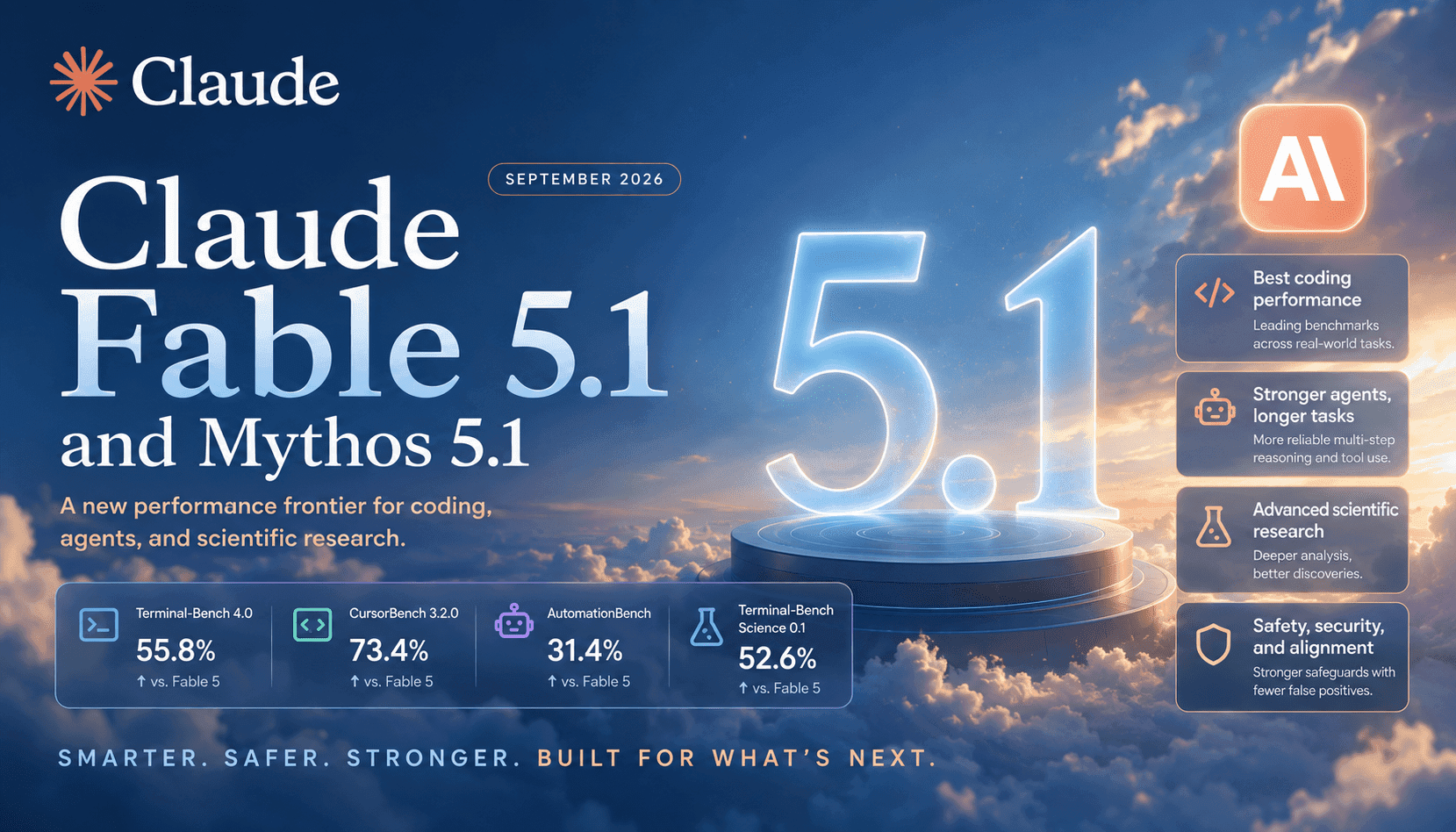
Anthropic’s Claude Fable 5.1 posts stronger results than Opus 5 on several agent benchmarks and trims cost for long-running, tool-using workflows. For engineering teams, this means faster terminal coding, more reliable multi-step research, and lower per-task spend when caching, effort levels, and tooling are tuned.

NexusAI EditorialSep 3, 20262.5K views9 min read
Claude Fable 5.1 Tops Opus 5 on Agent Benchmarks—and Lowers Cost per Task
AI Brief

Anthropic’s Claude Fable 5.1 aims to compress frontier-level reasoning, faster execution, and lower agentic cost into a single model. Early results suggest stronger performance on agent and workflow benchmarks (terminal coding, browser automation, research) at meaningfully lower cost—especially when cache reads and effort modes are tuned. For builders and operators, this shifts the default choice for unattended, long-horizon tasks where verification loops, tool use, and state reuse dominate cost. The practical takeaway: re-benchmark against your real workloads, push state into caches, and calibrate effort modes by task class. If you’re migrating from Opus 5 or Fable 5, expect improved throughput and lower mean cost per task with the right orchestration strategy.

Claude Fable 5.1 is positioned as Anthropic’s most capable all-rounder for coding, computer use, and long-running agentic work—and it shows up where it counts: agent benchmarks and cost per solved task. The headline isn’t just higher scores; it’s a better performance-to-cost curve. In practical terms, teams running terminal agents, structured research loops, or browser automation can achieve higher completion rates with fewer tokens when they exploit cache reads and select the right effort level per task. This unlocks use cases that were previously too slow or too expensive to run continuously.

Across well-known evaluations—Terminal-Bench variants for agentic coding, CursorBench for IDE-like workflows, OSWorld for computer use, AutomationBench for business tasks, and Humanity’s Last Exam for reasoning—Fable 5.1 generally lands ahead of Opus 5 and improves over Fable 5, particularly when tools are enabled and tasks run for longer. The model appears to avoid shortcutting behaviors that tank reliability in multi-step chains, and its verification loops more often localize root causes rather than papering over symptoms. That reliability translates into fewer reruns, which matters as much as list-price tokens when you’re operating agents at scale.

Cost is where the upgrade becomes operational. Anthropic’s pricing emphasis on cheaper cache reads—in combination with Fable 5.1’s ability to reuse state effectively—means agentic workloads can push more plan, context, and tool schemas into reusable memory. For buyers, savings compound when you: 1) front-load planning and constraints into cached system prompts; 2) drop the default effort level for routine steps; 3) escalate effort only at verification gates; and 4) scope tool access so the model performs fewer exploratory calls. The result is better throughput, saner bills, and simpler SLOs for unattended jobs.

Key Takeaways

Performance Gains Grow With Task Depth

Fable 5.1 separates more clearly on longer, tool-rich chains—terminal coding, browser agents, and multi-document tasks—where verification reduces reruns and stabilizes outcomes.

Engineer for Cache and Effort Discipline

Push reusable context into caches, default to Medium effort, and escalate only at gates. Constrain tools and add assertive checks to curb loops and token drift.

Plan Governance with EFS in Mind

Prepare for customer-controlled storage, stricter data boundaries, and fewer false positives. Map safeguard interventions and define fallbacks for sensitive workflows.

What Changed in Fable 5.1

Fable 5.1 raises accuracy on agentic coding, computer use, and multidisciplinary reasoning while holding or reducing mean cost per task. Effort modes (Low/Med/High/Max) remain a practical dial, but the cost curves now make Medium viable for many tasks that previously required High. Tool-enabled runs especially benefit: stronger verification reduces loop count, and better search/browse patterns mean fewer dead-end steps. The model’s improvements show up in harder, longer chains where earlier systems drifted or over-executed. For engineering leads, this is a green light to revisit backlogs you parked due to cost or reliability risk.

Benchmarks: Where It Pulls Ahead

On Terminal-Bench variants, Fable 5.1 tends to complete more end-to-end coding tasks at similar or lower spend, with reduced reliance on brittle heuristics. CursorBench 3.2.0 shows stronger self-verification in code edits and refactors, narrowing the gap between review and implementation. OSWorld 2.0 indicates better computer-use reliability (partial and strict scoring), and on AutomationBench Fable 5.1 improves coverage of multi-step business tasks that demand grounded reasoning over documents and applications. Humanity’s Last Exam reflects more stable reasoning when tools are on, suggesting better orchestration across retrieval, browsing, and execution. Takeaway: the advantage grows with task complexity and tool depth.

Cutting Agentic Cost: The Practical Play

Most savings come from doing less redundant work. Cache your system scaffolding, schema contracts, and persistent tool instructions; bind them to sessions so repeated steps become cache reads instead of fresh tokens. Default to Medium effort for routine steps and escalate to High at verification gates or incident paths. Gate tools so the model can’t wander: define explicit tool policies (when to call, expected I/O shape, timeout budgets). Add assertive verification: parseable checks, idempotent retries, and fast-fail thresholds. These patterns reduce loops, trim token usage, and curb tail-cost spikes on failure cases.

Enterprise Controls and Safeguards to Plan For

Anthropic is rolling out Enterprise Frontier Safeguards (EFS), a design intended to pair strong misuse prevention with customer-controlled data storage and zero data retention modes. Cyber and biology safeguards have been tuned to reduce false positives while maintaining guardrails. In practice, this means fewer benign blocks on vulnerability discovery and more predictable behavior in sensitive workflows. Teams in regulated environments should pre-plan data routing (customer-controlled storage), consent boundaries for logs and traces, and fallbacks when safeguards intervene—especially on tasks that blend code analysis, security review, or domain science.

Migration Guide: From Opus 5 or Fable 5 to Fable 5.1

Start with a canary suite: 20–50 representative tasks each for terminal coding, browser use, business workflows, and research. Run A/B at Low/Med/High effort, with and without tools, and record loop counts, tool calls, and cache hit rates. Lock in schemas and system scaffolds, then enable cache reads. Flip more tasks to Fable 5.1 where it wins on both completion and cost. Keep a rollback to Opus 5 or prior models for edge cases. For org-wide rollout, define SLOs on completion, verification depth, and cost bands, and wire dashboards around effort level distribution and cache savings.

Frequently Asked Questions

How should I estimate cost savings when moving agent workloads to Fable 5.1?

Measure three metrics on a canary suite: 1) cacheable tokens per task (system scaffolds, schemas), 2) average loop count to pass verification, and 3) tool-call volume. Enable cache reads, run Low/Med/High effort, and compare mean cost per successful task. Savings typically track higher cache hit rates and fewer loops.

When should I use tools with Fable 5.1 versus running tool-free?

Use tools for retrieval, structured browsing, compilation, and deterministic checks. You’ll often see higher completion and fewer reruns. For straightforward reasoning or formatting, turn tools off and set Low or Medium effort. Add verification-only tool calls at the end of chains to bound cost without sacrificing reliability.

What risks or regressions should I watch for during migration?

Three common issues: 1) effort sprawl raising cost, 2) unconstrained tools causing exploratory bloat, and 3) safeguard interventions on sensitive tasks. Mitigate with strict tool policies, effort gating at checkpoints, schema-stable prompts cached across sessions, and rollbacks for edge cases. Track intervention rates and add safe fallbacks.

#Cost per Task#Benchmark-to-Cost Analysis#inference cost management#Token Cost Control#KV Cache Engineering#Agent Harness Performance#agentic computer use#Enterprise Coding Assistants#Agentic Code Review#Scientific AI Workflows#Long-Horizon Reasoning#Self-Testing and Verification#Verification and Evals#Claude Fable 5.1#Agentic Cost Optimization#Enterprise Frontier Safeguards#Cache Read Pricing#AutomationBench#OSWorld 2.0#CursorBench 3.2.0#Humanity’s Last Exam#Agent Workflow Verification#Tool-Enabled Reasoning

AI Insight Newsletter

Get the latest AI updates, tool news, and insights delivered to your inbox.

No spam. Unsubscribe anytime.
On This Page
1.What Changed in Fable 5.12.Benchmarks: Where It Pulls Ahead3.Cutting Agentic Cost: The Practical Play4.Enterprise Controls and Safeguards to Plan For5.Migration Guide: From Opus 5 or Fable 5 to Fable 5.1
Share this article

Related Articles

GPUs Aren’t Enough: NVIDIA Spectrum‑X Moves the AI Bottleneck to Networking
AI Product News

GPUs Aren’t Enough: NVIDIA Spectrum‑X Moves the AI Bottleneck to Networking

Sep 3, 2026

From MCP to MHS: Anthropic’s Hardware Standard Makes Agents Real-World Operators
AI Product News

From MCP to MHS: Anthropic’s Hardware Standard Makes Agents Real-World Operators

Aug 29, 2026

Ramp’s Router Turns LLM Choice Into an Optimization Layer for Cost, Quality, and Latency
AI Product News

Ramp’s Router Turns LLM Choice Into an Optimization Layer for Cost, Quality, and Latency

Aug 21, 2026

The Rack Is the System: AI Infrastructure Competition Moves Beyond Chips
General AI Industry News

The Rack Is the System: AI Infrastructure Competition Moves Beyond Chips

Aug 6, 2026

Pacing the Frontier: Building Brakes for Self‑Improving AI Before It Outpaces Safety
AI Model & Platform Updates

Pacing the Frontier: Building Brakes for Self‑Improving AI Before It Outpaces Safety

Jul 29, 2026

Related AI Tools

View All
Claude Fable 5 & Mythos 5: Anthropic Frontier Models for Agentic AI

Claude Fable 5 & Mythos 5: Anthropic Frontier Models for Agentic AI

AI Assistants & Agents

Claude by Anthropic: Frontier Grade AI Models, Agents and Safety Platform

Claude by Anthropic: Frontier Grade AI Models, Agents and Safety Platform

AI Assistants & Agents