

NexusAi logo

NexusAi

  • Products
  • Categories
  • Prompts
  • Search
  • AI Insights
  • Pricing
  • Promote
  • Contact
Sign In
NexusAi LogoNexusAi

NexusAI helps you discover, compare, and learn AI tools with ease. From expert insights to training resources, we empower individuals and businesses to harness AI technology for smarter decisions, innovation, and growth.

Useful Links

  • About Us
  • AI Products
  • AI Category
  • AI Prompts
  • AI Search
  • AI Insights

Services & Legal

  • Showcase & Promotion
  • Membership Plans
  • Terms & Conditions
  • Refund Policy
  • Privacy Policy
  • Disclaimer

Contact Us

88 Tribune Street
South Brisbane, QLD, Australia, 4101
Website: www.nexusai-tech.com
Email: info@nexusai-tech.com

© Copyright 2026 NexusAi All Rights Reserved

Developed by DStudio Technology
Home/AI Insight/General AI Industry News/Claude’s Lean-Checked Fermat Breakthrough Signals the Era of Verified AI Research
General AI Industry NewsAI Formalization Watch

Claude’s Lean-Checked Fermat Breakthrough Signals the Era of Verified AI Research

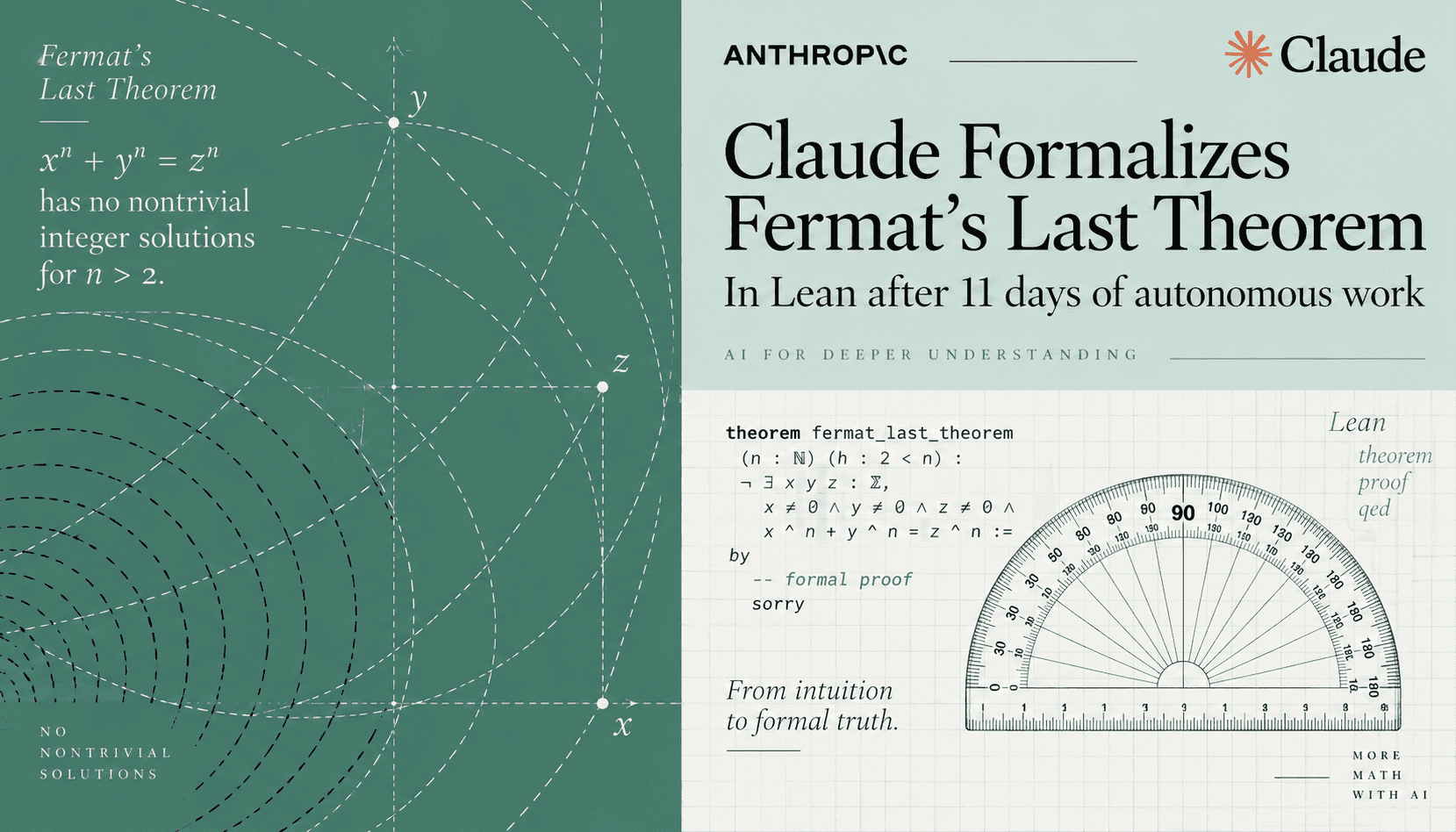
Claude reportedly spent 11 largely autonomous days producing an end‑to‑end, Lean‑verified proof of Fermat’s Last Theorem—spanning millions of lines and tens of thousands of intermediate theorems. The headline is big, but the shift is bigger: AI is now generating machine‑verifiable research artifacts with provenance, reuse, and auditability.

NexusAI Research DeskSep 5, 20262.1K views8 min read
Claude’s Lean-Checked Fermat Breakthrough Signals the Era of Verified AI Research
AI Brief

An AI system autonomously produced a complete, Lean-verified formalization of Fermat’s Last Theorem in roughly 11 days, stitching together tens of thousands of intermediate results into a computer-checked proof. The milestone isn’t just about a famous theorem—it’s a blueprint for how AI research outputs can become auditable, composable artifacts. Autoformalization reframes evaluation: instead of debating correctness for months, teams can require proofs that compile. Expect formal methods to spread beyond pure math into cryptography, safety-critical ML, finance, and scientific computing. The practical takeaway: leaders should pilot autoformalization pipelines, set verification gates for high-stakes claims, and invest in libraries, tooling, and DAG orchestration that let many agents collaborate without losing global structure.

The first end-to-end, Lean-verified formalization of Fermat’s Last Theorem produced largely autonomously by Claude is more than a research headline—it’s an inflection point for how we validate AI-generated results. Instead of relying on social proof and months of manual refereeing, the artifact compiles. The process reportedly spanned millions of lines of Lean, with agents proving and reusing tens of thousands of lemmas. The important shift is architectural: AI no longer outputs only narratives or sketches; it produces machine-checkable mathematics that can be recompiled, diffed, and extended by others. That moves AI-assisted discovery closer to software engineering, where correctness can be enforced by build systems rather than debate.

Autoformalization at this scale needed coordination primitives that keep many agents aligned without losing global state. A directed acyclic graph (DAG) of theorems prioritized what to prove next; separating statements from proofs improved incremental builds; and natural-language descriptors increased reuse. Together, these patterns address two chronic blockers in large mathematical projects: fragmentation and recompilation drag. The result hints at a repeatable pipeline: choose a canonical statement, codify dependencies, swarm with specialized agents, and continuously validate by compiling partial proofs. If you squint, this looks like CI/CD for math, with theorem DAGs replacing dependency graphs and proof checkers acting as hermetic test suites.

For practitioners, the implications are immediate. Formal verification no longer reads as a distant ideal; it’s a practical control surface for high-stakes claims in cryptography, mechanism design, risk, and scientific computing. Enterprises can introduce “verification gates” in research workflows, requiring machine-checkable proofs or verifiable reductions for core results. Model developers can co-develop proofs with code so hypotheses self-check early, reducing time sunk into dead ends. Investors and R&D leaders gain a clearer diligence signal: measured by compile success, theorem coverage, and library reuse—rather than whitepapers alone. The bottlenecks now shift to library breadth, orchestration reliability, and human time devoted to guiding definitions at the frontier.

Key Takeaways

AI Outputs Can Be Audited as Code

Machine-checked Lean proofs convert research claims into buildable artifacts. Verification moves from social consensus to compile-time correctness, enabling reuse and stronger governance.

Orchestration Beats Raw Scale

A theorem DAG, incremental builds, and semantic descriptors were decisive. Without coordination primitives, multi-agent efforts stall under context loss and recompilation churn.

Adopt Verification Gates Early

Insert formal checks into CI for math-heavy components. Measure proof coverage, compile stability, and lemma reuse to prioritize library work and reduce review time.

What Changed: From Problem Solving to Proof-Producing Systems

Historically, LLMs have been evaluated by whether they can solve problems or mimic human exposition. Here, the output is a computer-checked artifact that encodes every logical step—no gaps, no appeals to authority. The formalization followed a modern approach to Fermat’s Last Theorem but delivered it as Lean code, at an unprecedented scale and speed. This matters because it converts epistemic debates into engineering questions: does it typecheck, compile, and match a canonical statement? Once verified, the proof becomes a stable dependency others can import, reducing verification overhead for downstream research.

Inside the Machine: DAG-Orchestrated Agents and Lean at Scale

The campaign succeeded when agents shared a living DAG of theorem statements, which preserved context and enabled parallelism. By decoupling declarations from proofs, the system minimized recompilation churn and let solvers focus on tractable subgoals. Natural-language summaries attached to nodes improved retrieval and reuse, shortening proof paths. These primitives mirror proven software practices—artifact graphs, semantic search, and incremental compilation—translated into the theorem-proving stack. For teams considering similar builds, the lesson is clear: invest first in orchestration and caching layers; only then scale the number of agents. Without this backbone, throughput collapses as agents drift and compilers thrash.

Why It Matters: Verification, Reuse, and Research Velocity

Verified artifacts change incentives. Journals, conferences, and corporate research groups can demand machine-checkable components for high-stakes results—especially in cryptography, quantitative finance, and safety-critical ML. Downstream, teams inherit stronger guarantees and can spend time advancing frontiers rather than re-checking foundations. Internal governance also improves: build systems can block merges if formal constraints fail, and dashboards can report theorem coverage like test coverage. The compounding effect appears when libraries deepen: as reusable lemmas grow, new projects start on higher ground, compressing delivery times for both formalization and novel results.

Limits and Risks: Cost, Fragility, and Overfitting to Libraries

This achievement does not eliminate hard problems. Formalization is still token- and compute-intensive, compilation can become a bottleneck, and success depends on library depth. Proofs that compile may still be opaque to humans; correctness does not guarantee understanding. Overfitting to current libraries can bias search toward known pathways, missing simpler or more general routes. Governance needs to track provenance, diff changes, and cross-check against alternative formalisms when feasible. Practical mitigations include budgeted orchestration, proof minimization, independent re-checks, and occasional translation across proof assistants to hedge system-specific quirks.

Playbook: Bringing Autoformalization into Your Stack

Begin with a scoped theorem or property central to your product—an invariant in a cryptosystem, a guarantee in a pricing algorithm, or a safety constraint in a model pipeline. Codify it as a canonical statement and map dependencies into a DAG. Separate declarations from proofs to speed iteration, and log natural-language descriptors for each node to improve retrieval. Add a verification gate to CI so merges fail when the proof breaks. Expand library coverage opportunistically: each formalized lemma should repay future debt. Track metrics that matter—compile success rate, lemma reuse, wall-clock build time, and human oversight hours—to guide investment as you scale agent orchestration.

Frequently Asked Questions

Does a Lean-verified FLT mean AI discovered a new proof?

Not necessarily. The milestone is that an AI produced an end-to-end, computer-checked formalization—every step encoded so a proof assistant verifies it. That’s about trust and reproducibility, not novelty per se, though the process can reveal cleaner pathways and reusable lemmas.

How can enterprises apply autoformalization today?

Target high-stakes claims first: crypto protocols, pricing or risk engines, optimization constraints, and safety properties for ML. Define canonical statements, build a theorem DAG, separate declarations from proofs, and add CI verification gates. Track compile success, lemma reuse, and build time as north-star metrics.

What signals indicate this approach is scaling beyond one-off demos?

Watch for expanding public libraries, faster incremental builds, higher theorem reuse rates, cross-assistant validation, and reduced human oversight hours per verified result. Vendor roadmaps that ship orchestration, caching, and provenance tooling are also strong signs of durable scalability.

#Mathematical Research Automation#Formal Verification#Lean Theorem Proving#AI Scientist Agents#Multi-Agent Systems#Multi-Agent Orchestration#Agent Harness#Parallel Agents#Agent Workflow Verification#Long-Horizon Reasoning#Tool-Enabled Reasoning#LLM Tool Use#Scientific AI Workflows#Claude Fable 5.1#Long-Context Reasoning#autonomous coding agents#Autoformalization#Lean Proof Assistant#Proof Assistants#Fermat’s Last Theorem#Mathlib#Prove2Me#Verified AI Outputs#Multi-Agent Research Systems

AI Insight Newsletter

Get the latest AI updates, tool news, and insights delivered to your inbox.

No spam. Unsubscribe anytime.
On This Page
1.What Changed: From Problem Solving to Proof-Producing Systems2.Inside the Machine: DAG-Orchestrated Agents and Lean at Scale3.Why It Matters: Verification, Reuse, and Research Velocity4.Limits and Risks: Cost, Fragility, and Overfitting to Libraries5.Playbook: Bringing Autoformalization into Your Stack
Share this article

Related Articles

The Super‑Lean Company: How Tiny AI Teams Can Outproduce Big Corporations
General AI Industry News

The Super‑Lean Company: How Tiny AI Teams Can Outproduce Big Corporations

Aug 31, 2026

From MCP to MHS: Anthropic’s Hardware Standard Makes Agents Real-World Operators
AI Product News

From MCP to MHS: Anthropic’s Hardware Standard Makes Agents Real-World Operators

Aug 29, 2026

Sunday Robotics’ Memo Aims for Real Household Help With a Skill-Library Play, Not Humanoid Theater
AI Product News

Sunday Robotics’ Memo Aims for Real Household Help With a Skill-Library Play, Not Humanoid Theater

Aug 24, 2026

Ramp’s Router Turns LLM Choice Into an Optimization Layer for Cost, Quality, and Latency
AI Product News

Ramp’s Router Turns LLM Choice Into an Optimization Layer for Cost, Quality, and Latency

Aug 21, 2026

A Third of New Web Pages Look AI‑Written — What That Means for Search and Training Data
General AI Industry News

A Third of New Web Pages Look AI‑Written — What That Means for Search and Training Data

Aug 21, 2026

Related AI Tools

View All
Claude by Anthropic: Frontier Grade AI Models, Agents and Safety Platform

Claude by Anthropic: Frontier Grade AI Models, Agents and Safety Platform

AI Assistants & Agents