

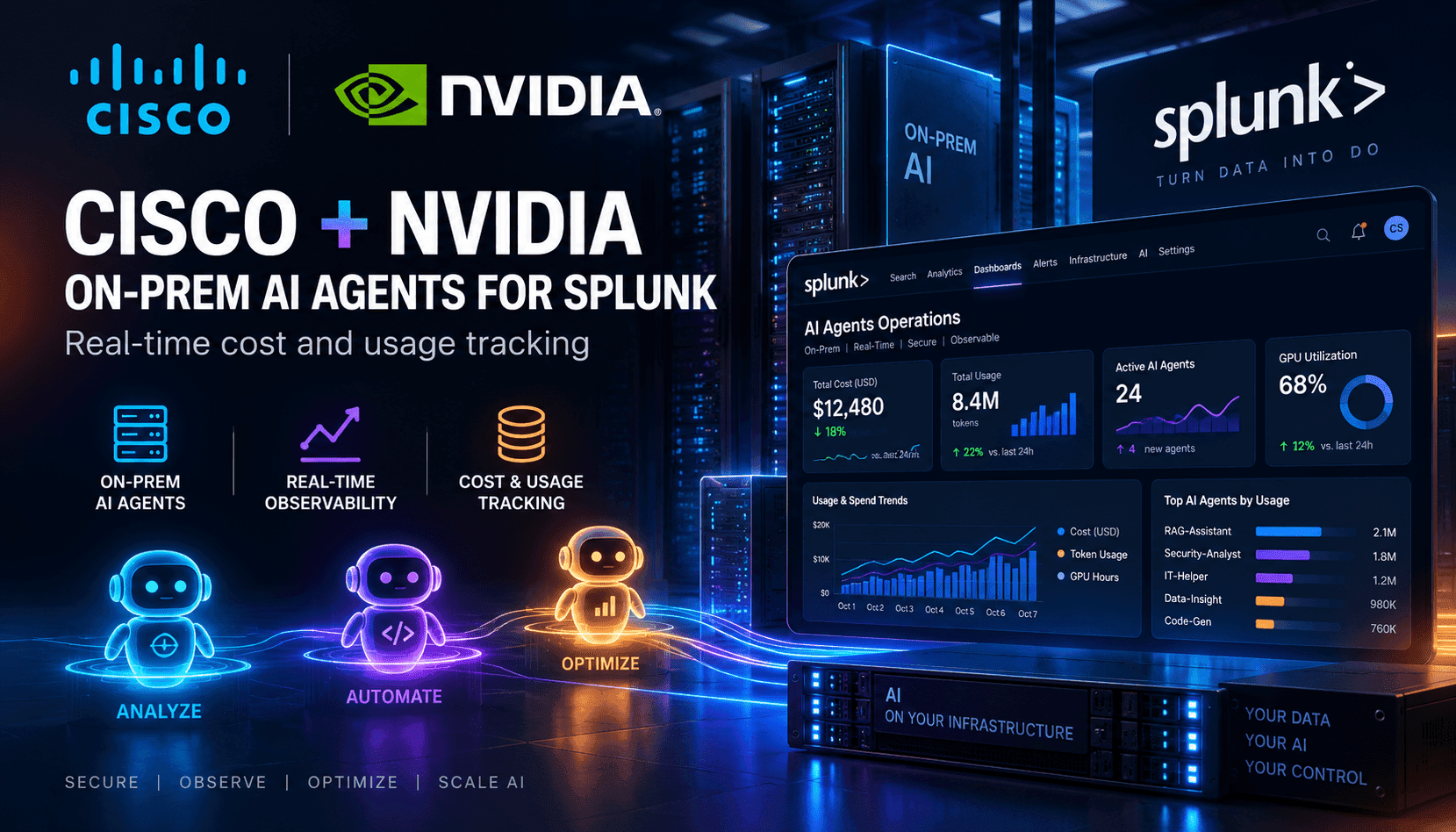
Enterprises that centralize telemetry in Splunk have long faced a tradeoff: keep data on‑prem for sovereignty and security, or move it to the cloud to access modern AI agents. Cisco’s new AI POD for Splunk, built on NVIDIA‑accelerated compute and a Kubernetes runtime, collapses that gap. It lets teams run Splunk’s AI Assistant and an emerging Agent Launchpad right next to their logs and metrics, while self‑hosting a mix of open and proprietary models. The pre‑validated stack reduces integration risk and time‑to‑value, giving operations and security teams an agent substrate they can harden with the same controls they already use for their observability estate.
The standout operational change is cost and behavior visibility. Splunk Agent Observability’s Tokenomics capability tracks token spend by agent, user, and workflow—including coding agents like Claude Code, Codex, or Cursor—so leaders can tie adoption to value, not anecdotes. It forecasts consumption with time‑series modeling, alerts on runaway loops, and attributes costs back to business units. Because the same platform inspects prompts, responses, and tool calls, teams can apply runtime guardrails to block unsafe actions and clamp down on hallucinations. In practice, that means you can set budgets, prevent overuse in real time, and prove ROI with unit economics instead of end‑of‑month surprises.
Strategically, this architecture accelerates the transition from pilots to a governed agent fabric. By bringing model execution to the data, enterprises avoid brittle ETL paths and reduce egress exposure. Model choice remains flexible: teams can run open‑weight options such as NVIDIA’s Nemotron family alongside domain‑specific models like Cisco’s Deep Time Series Model for forecasting. The tradeoff is operational maturity—Kubernetes, GPU scheduling, model evaluation, and prompt risk management must be treated as first‑class disciplines. For buyers, the question shifts from “Can we use AI here?” to “Which agents earn their keep, on what hardware, and under which guardrails?” The organizations that answer that precisely will scale faster with fewer rewrites.