

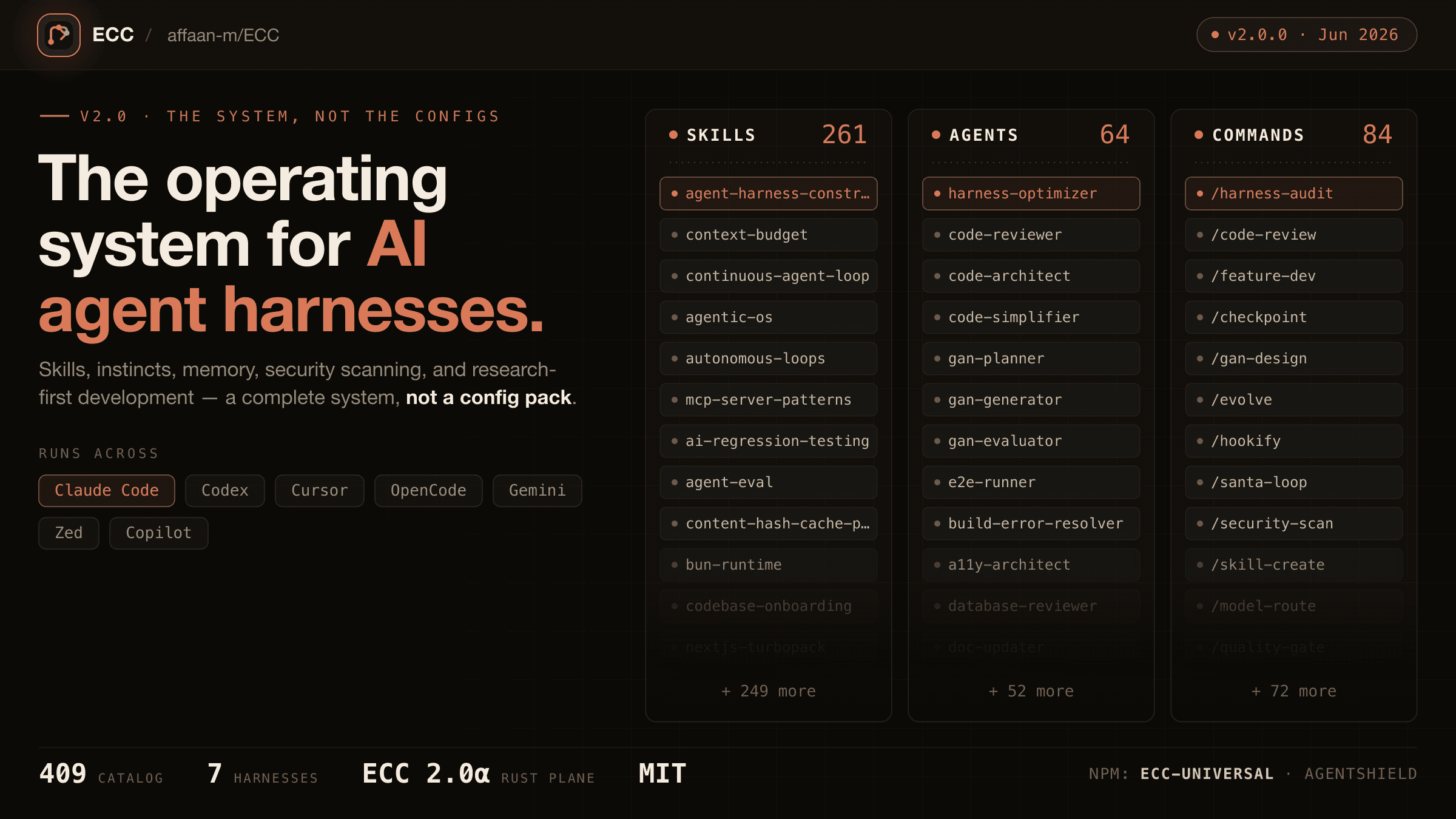
Agent harnesses have matured, but most teams still stitch together prompts, plugins, and local scripts without a unifying operational model. ECC’s answer is to treat the harness as an operator system: a control plane for agents where skills, instincts, memory persistence, verification, and security are first-class. This shifts work from “good demo” to “reliable service.” Instead of bespoke setup per IDE, ECC provides profiles, hooks, and orchestration that make cross-harness behavior predictable. That predictability is what lets you track improvements in throughput, stabilize pass@k, and put hard limits around recursion, cost, and runtime permissions.
ECC 2.0 builds on daily, real-world use by adding a more explicit control-plane substrate: session adapters for structured state, an MCP inventory for safe tool exposure, and worktree lifecycle services to coordinate branches and checkpoints. The orchestrator family (orch-*) standardizes multi-agent execution with guardrails and deterministic status. Critically, the system maintains cross-harness parity—so the same skill and rule surfaces behave consistently across Claude Code, Cursor, Codex, OpenCode, Gemini, and others. For leaders, that means less lock-in and a single governance path; for engineers, it’s fewer surprises and easier rollback.
Performance here is practical, not theoretical. Token budgeting and model routing reduce context bloat; decision ledgers make agent steps auditable; verification loops enforce pass/fail gates; and parallelization patterns keep latency under control for larger repos. Security is tightly integrated via scanning and permissioning so you can let agents operate closer to production without opening attack surfaces. The net effect is a measurable drop in iteration time and rework—especially on multi-service codebases—while maintaining clear handoff snapshots for PR reviews, launches, and incident response.