

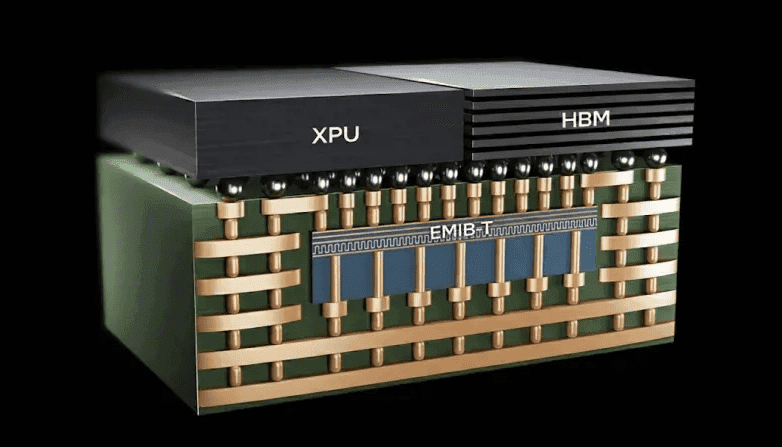
Advanced packaging has become a first-order design decision for AI compute. Intel’s EMIB embeds short silicon bridges in an organic substrate to connect adjacent chiplets, while TSMC’s CoWoS uses a full silicon interposer to route dense signals across larger distances and to HBM stacks. The distinction drives topology choices: bridges favor localized, modular stitching; interposers favor massive fan-out and memory adjacency. Buyers must now evaluate the package as a system asset—routing density, latency, power delivery, thermals, test access, and rework strategies—because these parameters increasingly determine achievable performance, cost, and schedule as much as process node selection.
In practice, CoWoS tends to dominate at the very high end where multi-die GPUs/accelerators require wide, low-loss routing and co-packaged HBM with predictable thermal paths. Its maturity and ecosystem depth are advantages, though lead times and capacity allocations can constrain schedules. EMIB, by contrast, can reduce dependency on large interposers and enable cost-optimized module layouts with targeted high-density links only where needed. That can simplify substrates and improve effective yield by shortening the highest-risk routes. For chiplet programs targeting iterative releases, EMIB’s modularity can also shorten spin cycles and open more flexible sourcing strategies across dies and substrates.
Yet the choice is rarely binary. Teams planning two to three generations ahead should model not just today’s bandwidth needs but also roadmap transitions—hybrid bonding, glass substrates, UCIe adoption, and evolving HBM form factors. CoWoS may still be the fastest route to dense memory adjacency at extreme scales, while EMIB can relieve cost and schedule pressure in mixed-IO or bridge-length interconnects. A sophisticated evaluation weighs capacity risk, known-good-die strategy, test coverage, warpage controls, warpage-induced yield losses, thermal design margin, and vendor lock-in. The winner is the packaging stack that delivers reliable lanes per watt per dollar on your real supply, not the brochure maximums.