

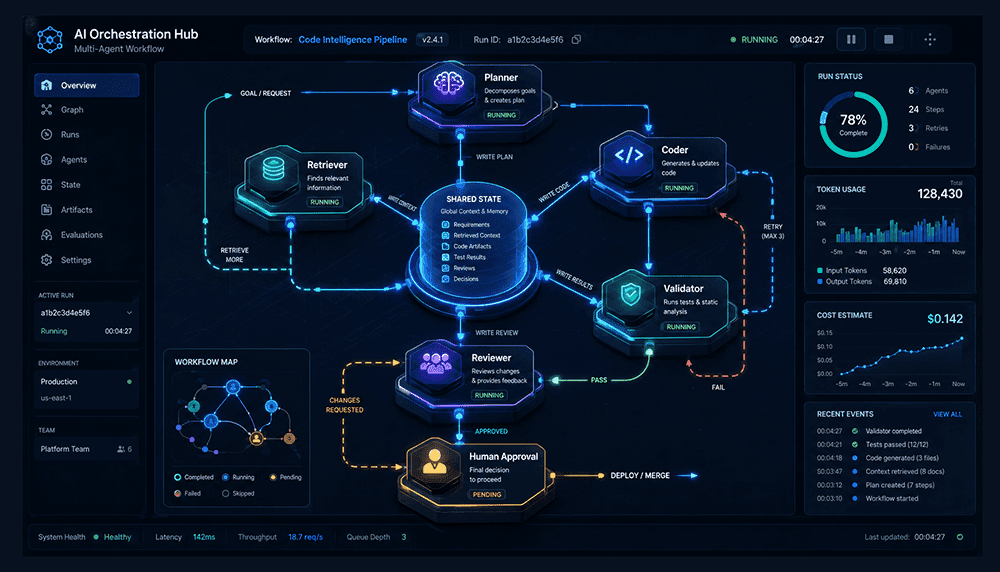
The first wave of agents proved that iterative loops—plan, act, verify, recover—outperform single-shot prompts for complex tasks. Yet as workflows cross teams, systems, and risk thresholds, a single loop becomes an opaque bottleneck. It must juggle unrelated domains, manage brittle toolchains, and preserve extensive context. Reliability, auditability, and maintainability degrade with scale. Graph engineering counters this by organizing work across many focused actors and deterministic routes, so complexity lives in the architecture rather than in an ever-more-clever prompt or monolithic loop.
A graph frames an AI system as nodes, edges, and shared state. Nodes specialize—planner, retriever, coder, validator, reviewer, approver—each with clear tools and permissions. Edges encode flow: sequential handoffs, parallel branches, conditional routing, and retry paths. Shared state synchronizes memory, artifacts, and execution logs so every node sees the same evolving context. The result is predictable execution and fine-grained governance: you can observe each stage, insert human approvals, cap resource usage, and isolate failures without restarting the entire workflow.
Modern orchestration frameworks now make this practical. They let teams model stateful graphs, gate tool access, run independent branches in parallel, and persist long-running processes. With explicit orchestration, engineers decide when to branch or loop, which outputs to cache, and where to collect evidence for audits. Add observability—tracing, cost and latency telemetry, prompt and artifact snapshots—and operations teams finally get the levers they expect from production software: rollbacks, safe deploys, and testable contracts between nodes.
Adopting graph engineering is not about maximal complexity—it is about purposeful modularity. Start with a single-loop baseline and factor out only what improves reliability or speed: separate verification, externalized retrieval, or human approvals for regulated steps. Define success metrics early—first-pass yield, mean time to recovery, cost per successful outcome—and instrument the graph to measure them. The payoff is compound: simpler reasoning per node, safer tool boundaries, faster parallelism, clearer failure surfaces, and a system you can evolve without rewriting the core agent.