

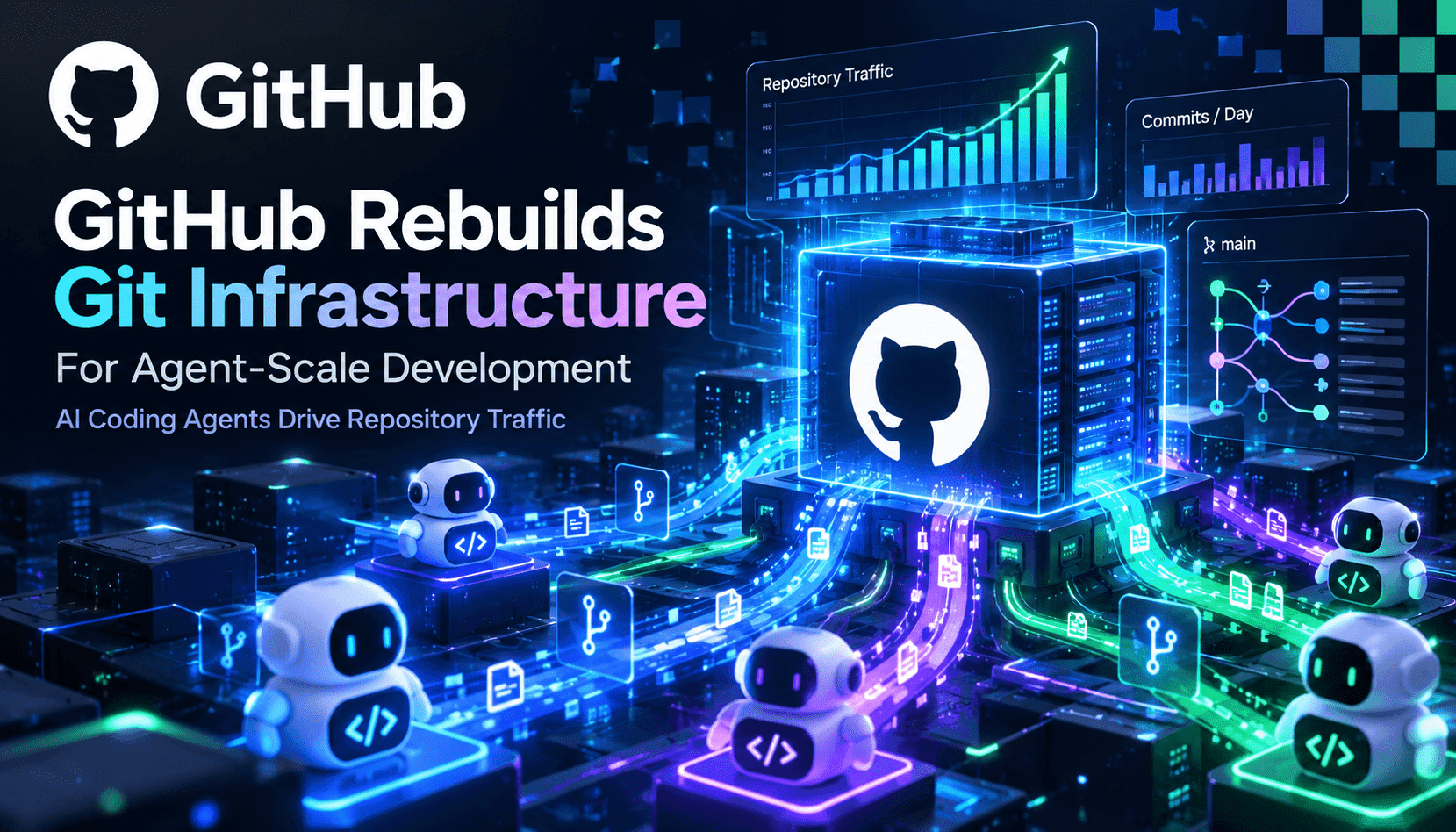
Agent-scale development is not a marginal increase in activity — it's a qualitatively different workload profile. GitHub reports multi‑x growth in pushes, clones and CI runs as autonomous agents checkpoint and validate almost every step. That behavior converts what used to be occasional bursts into sustained, highly concurrent traffic patterns: thousands of writes to many branches, extreme fan-out of reads for CI and scans, and frequent merges competing on single refs. The result breaks assumptions baked into many repository architectures and forces a rethink of how durability, visibility and latency tradeoffs are handled.
The core engineering pivot GitHub describes is separating storage durability from read scale and shrinking the critical path for pushes. Today’s approach relies on multiple full replicas: fast for reads but costly for writes because every replica participates in commits. In an agent-first world you must accept a push quickly and do heavier maintenance asynchronously, coordinate only the minimal reference update that requires agreement, and run compaction and garbage collection off the serving path. That model preserves low-latency acknowledgements for agents while keeping long-term correctness and auditability.
Operationally this redesign touches every layer teams depend on. CI systems must stop assuming a single, immutable branch tip and tolerate near‑instant branching and rebasing by agents. Code review and protection rules need to remain authoritative even when thousands of agent-created pull requests appear per hour. Security tooling must scale scans without imposing synchronous costs on commits. For platform operators, the challenge is delivering stronger guarantees (durability, audit trails, policy enforcement) without reintroducing the coordination bottlenecks that slowed down agent loops.
For engineering leaders and architects, the practical implications are immediate: instrument agent behavior to shape load, design CI and testing to prefer fetch and incremental checks, and adopt storage patterns that allow fast visibility without global locking. Investing in observability for per-branch and per-agent activity, conditional policies that scale with volume, and a maintenance pipeline that compacts and prunes asynchronously will reduce operational surprise. The architecture choices GitHub is making raise the baseline for repository performance and resilience — they’re as important for small teams as for the largest fleets.