

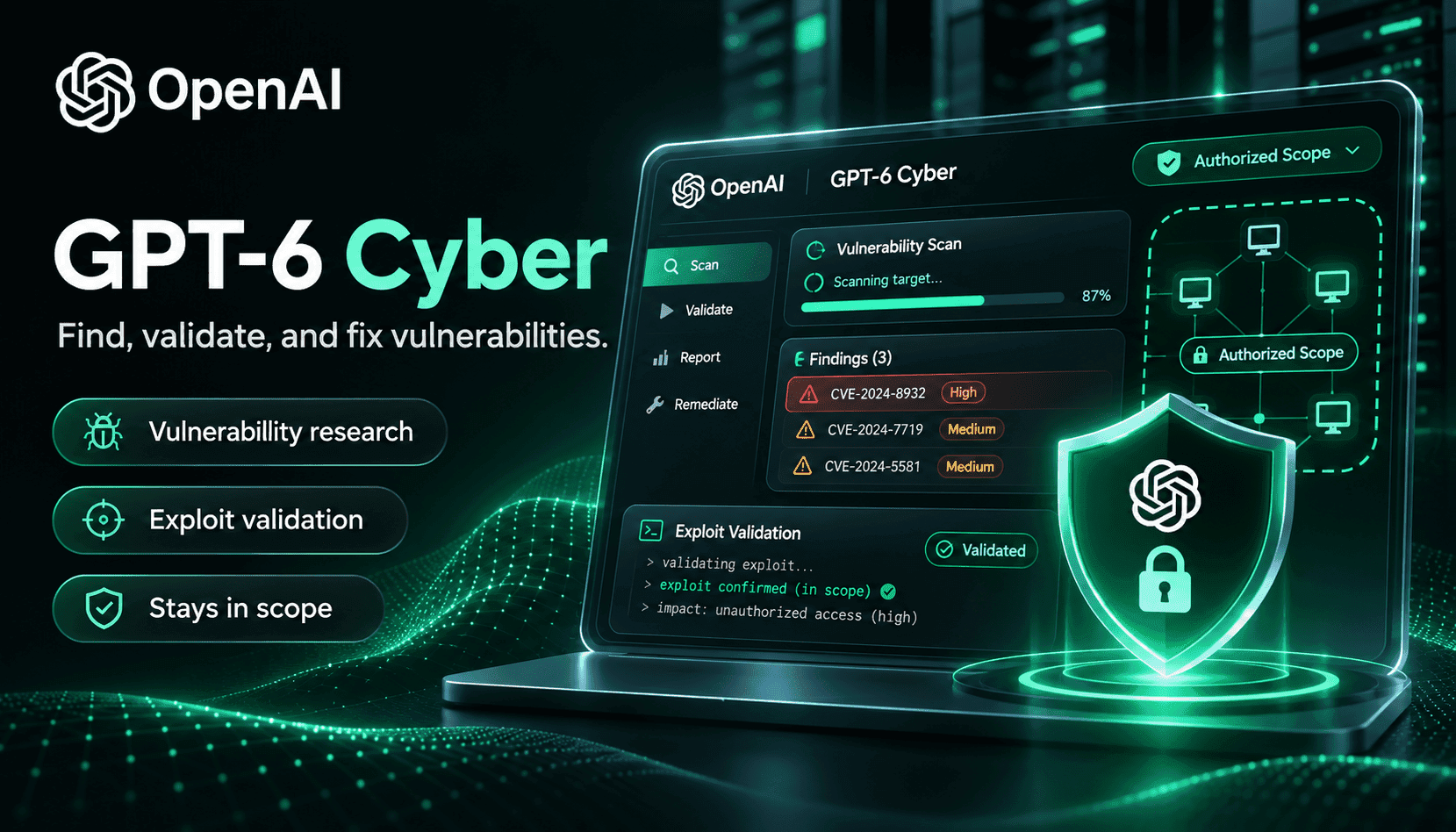
OpenAI’s GPT‑6 Cyber marks a deliberate shift from generalist code assistants toward a specialist, high-capability cybersecurity agent designed for defenders. Rather than a generic coding release, GPT‑6 Cyber was trained and evaluated on benchmarks that measure exploit development, vulnerability discovery and — crucially — adherence to researcher-defined rules of engagement. The company reports substantial gains over GPT‑5.6 Cyber on ExploitGym and new remote exploit benchmarks, and claims step-change improvements in staying within operational scope. For teams that run authorized red-team and vulnerability research, this model promises higher-quality, reproducible findings; for defenders of critical infrastructure, it delivers controlled access channels and additional safeguards.
Practically, GPT‑6 Cyber is built to do three linked tasks reliably: locate candidate vulnerabilities from source and binary artifacts; reproduce and verify exploitability in a controlled harness; and propose candidate patches and verification tests. OpenAI’s published results show the model reproduced thousands of issues and developed hundreds of working exploit proofs-of-concept during internal research campaigns. That combination—discovery plus reproducible verification—changes the operational posture for security teams: findings can be triaged with stronger evidence, triage throughput increases, and engineering handoffs include demonstrable tests that validate fixes faster.
But power brings policy trade-offs. OpenAI pairs GPT‑6 Cyber with the Daybreak access framework: Daybreak Blue for vetted defenders who need fewer refusals, and Daybreak Red for deeper exploit workflows with strict network allowlists and monitoring. The company also layers cyber-specific misuse detectors, private safety processing for sensitive logs, and sandboxing recommendations. For any organisation thinking about adopting GPT‑6 Cyber, the operational ask is as important as technical capabilities: access governance, network isolation, human review gates, and incident-handling procedures must be in place before you run high-risk experiments.
For security leaders, GPT‑6 Cyber is both opportunity and project: it can accelerate vulnerability discovery and generate higher-quality patch candidates, but teams will need to redesign workflows around reproducibility, risk controls, and disclosure discipline. This article breaks down how GPT‑6 Cyber works, why the Daybreak Red model matters, what teams should change in their vulnerability lifecycle, and which safeguards are essential to use the model defensibly and effectively.