

Most production agents still operate with blunt instruments: shared API keys, service accounts, or embedded credentials. That works for small fleets running non‑critical tasks, but it collapses under multi‑agent orchestration that touches payments, patient records, or privileged infrastructure. When a downstream MCP server or database sees a request authenticated by a key, it can’t determine which agent or human intended the action, so teams either over‑trust or lock everything down and break workflows.
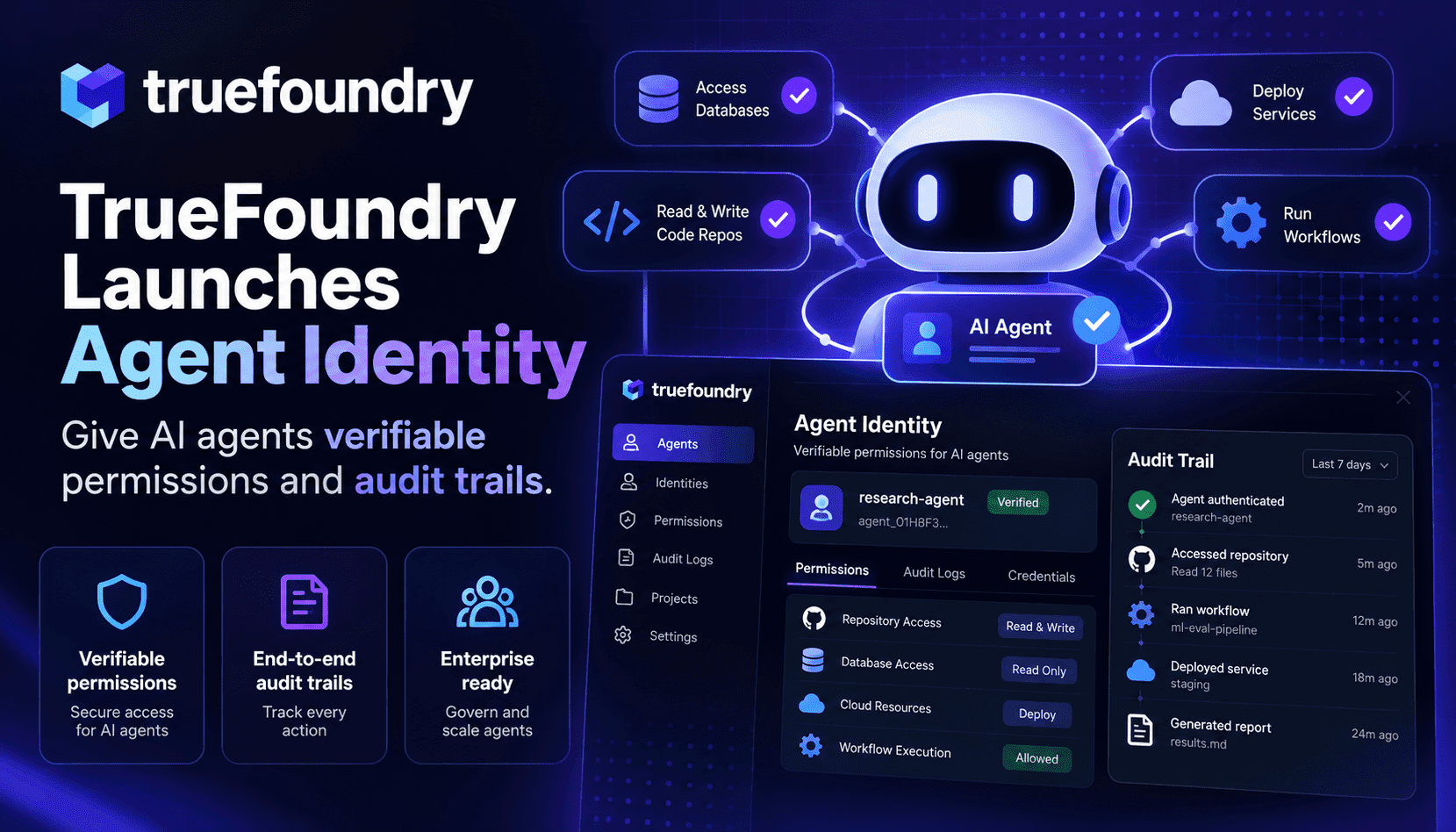
TrueFoundry’s Agent Identity reframes the problem: each agent is a principal with a verifiable credential, issued by TrueFoundry or backed by your IdP (Okta, Microsoft Entra, OIDC, SPIFFE). That identity is independent of runtime and hosting, so agents on Bedrock AgentCore, Vertex AI, LangGraph, or custom services can be governed without code changes. The gateway handles token lifecycle, caching, and exchanges — eliminating bespoke token plumbing in every agent implementation.
Critically, Agent Identity doesn’t just name the agent — it models who the agent is acting for. Gateway options include token pass‑through, OAuth2 client credentials (agent as itself), and on‑behalf‑of (OBO) token exchange which binds agent and user context into a downstream token. That lets the system of record apply per‑user permissions at the final hop without trusting intermediary code or duplicating auth logic in every agent.
For platform and security teams, the benefits are practical and immediate: precise allow‑lists (who can call an agent), scoped egress permissions (what models, MCP servers, or tools an agent may invoke), revocation without collateral damage, and end‑to‑end audit trails that attribute actions to agent and user context. These capabilities reduce incident response time, limit lateral movement when an agent is compromised, and support compliance by mapping actions back to accountable identities.