

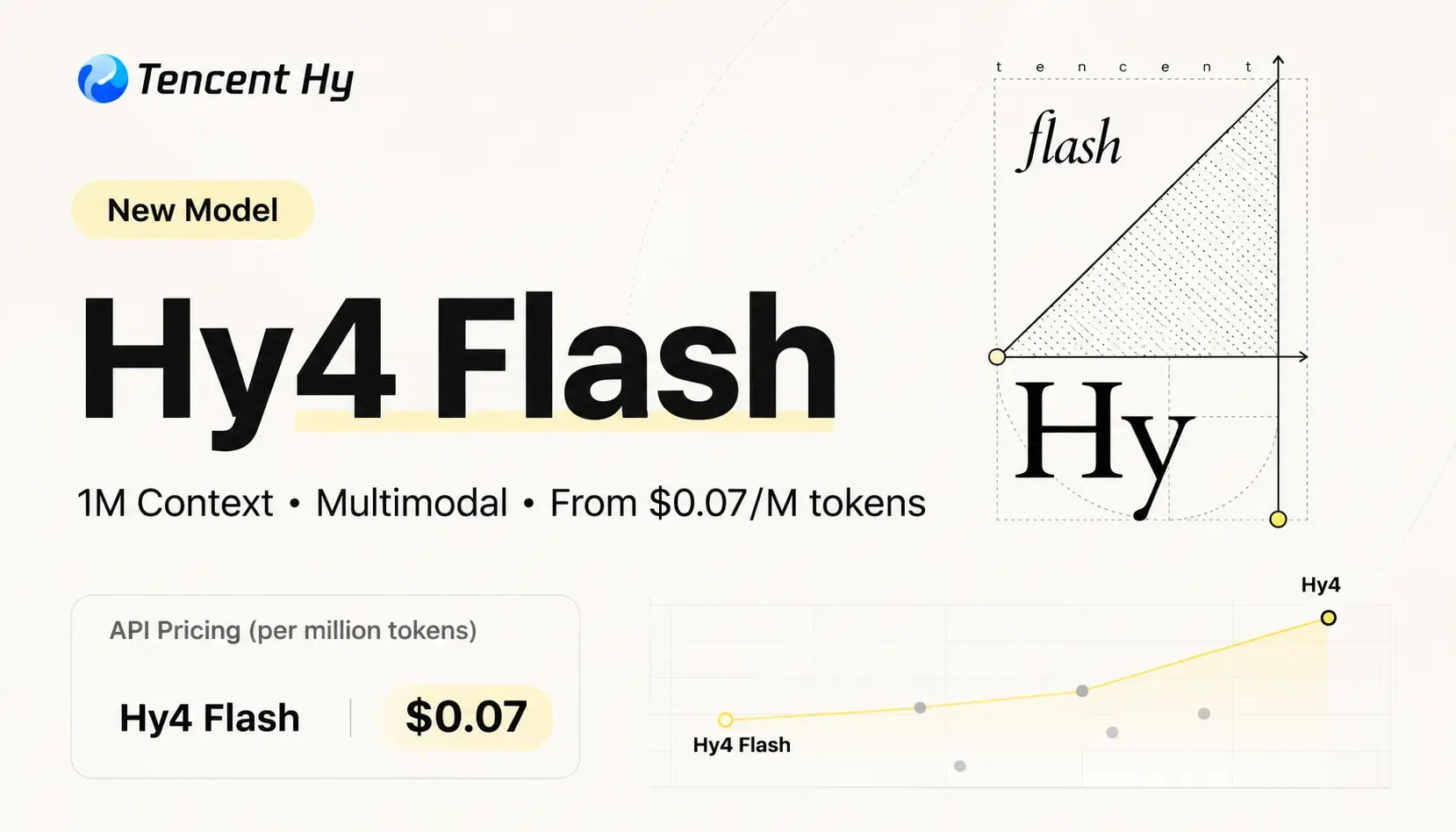
Tencent’s Hy4 flash is designed as a price‑performance challenger rather than a pure capability leader. The model combines 224 billion total parameters with only 12 billion active parameters during inference, a design that targets lower runtime cost without discarding large offline capacity. Tencent emphasises multimodal inputs and a 1,000,000‑token context window, claiming decoding speeds above 150 tokens per second through a stack of inference optimizations. For teams evaluating model selection, Hy4 flash promises a pragmatic middle ground: substantial contextual memory and visual understanding at a fraction of per‑task cost compared with some frontier alternatives.
Under the hood, Hy4 flash uses architectural features introduced across the Hy line: Engram parameterization to compactly store long‑term knowledge, LatentMoE conditional capacity to concentrate compute where needed, and hybrid attention to scale context efficiently. Tencent also reports a dramatically reduced KV cache footprint — a deliberate engineering trade that lowers memory and cache I/O cost at inference. Post‑training reinforcement learning is credited with halving average end‑to‑end output token lengths on typical tasks, an outcome that directly reduces output token billing and speeds turnaround time for many workplace workflows.
The claimed 1M‑token context window and decoding speed above 150 tokens/second are the most operationally meaningful features for enterprise deployments. Tencent attributes these results to combined techniques: megakernel optimization, 4‑bit quantization, DFly execution strategies and a compact KV cache. In practice, long context plus fast decoding enables single‑pass handling of entire documents, slide decks, or multi‑file threads that otherwise require costly chunking, state stitching, or agent orchestration. These benefits can reduce engineering complexity and latency in real customer workflows if the model’s context handling matches real‑world robustness.
Economically, Tencent lists approximate API prices near $0.070 per million input tokens and $0.281 per million output tokens, with an ultra‑low cached input rate. The company claims Hy4 flash delivers much lower per‑task cost on its internal WorkIndex compared with larger Hy4 variants and other frontier models. That framing is useful: for organizations prioritising throughput, predictable bills and document workflows, Hy4 flash could materially lower operational spend. However, buyers should treat Tencent’s internal benchmarks and blind‑user results as informative but not independently verified; comparative cost and quality must be validated on representative, third‑party tasks.