
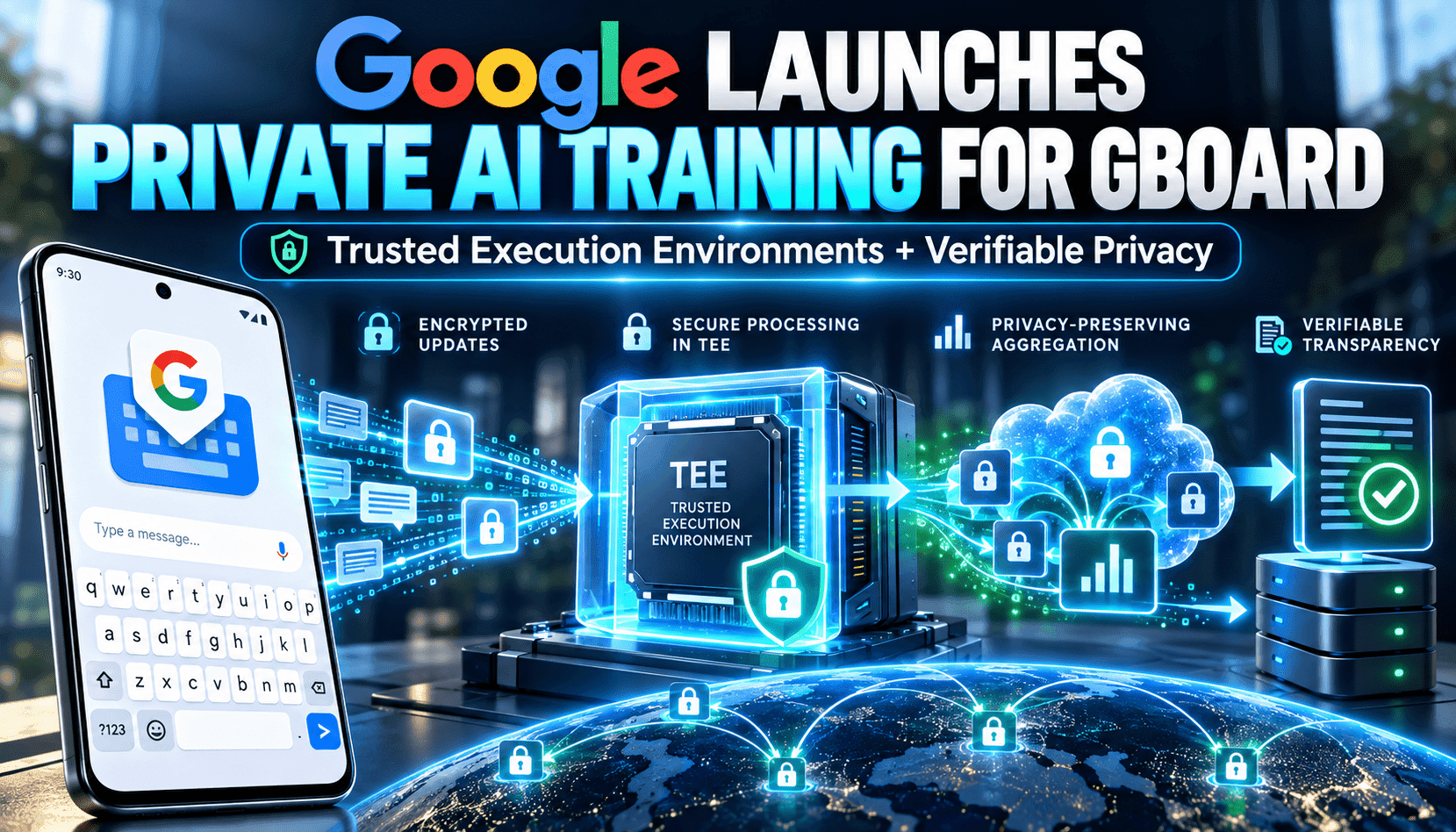
Google’s announcement marks a notable shift in federated learning practice: instead of relying primarily on client-side computation and trust in server operators, the new system uploads encrypted device examples and restricts server-side processing to attested Trusted Execution Environments (TEEs). Devices publish the access policies they pre-authorize to a public transparency log; the Key Management System (KMS) then only releases decryption keys to TEEs whose attested workloads match those policies. That combination—encrypted uploads, attestable execution, and policy binding—creates an auditable path that external verifiers can follow to confirm the system behaved as promised.
Operationally, the system still targets the same product outcomes—faster model iteration, larger cohorts, and improved accuracy for Gboard—while providing stronger privacy evidence. Moving heavy compute to server-side TEEs reduces dependence on variable device availability and on-device CPU, allowing coordinated training schedules, tighter DP parameter tuning, and parallelized execution across worker TEEs. In practice this has translated into substantial reductions in training time for Gboard next-word models, while enabling smaller noise multipliers through optimized cohort selection and centralized orchestration that remains auditable.
Crucially for auditors and privacy teams, the architecture stitches together technical controls that address different aspects of the trust problem: reproducible builds and open-source code let third parties recreate the binaries; Rekor-style transparency logs make the set of authorized workloads public; attestation and KMS policy checks bind keys to specific attested code; and differential privacy ensures any released aggregate model weights do not leak individual data. Understanding how these components interact—rather than viewing each in isolation—is necessary to evaluate whether a deployment actually removes the need to trust the operator.