

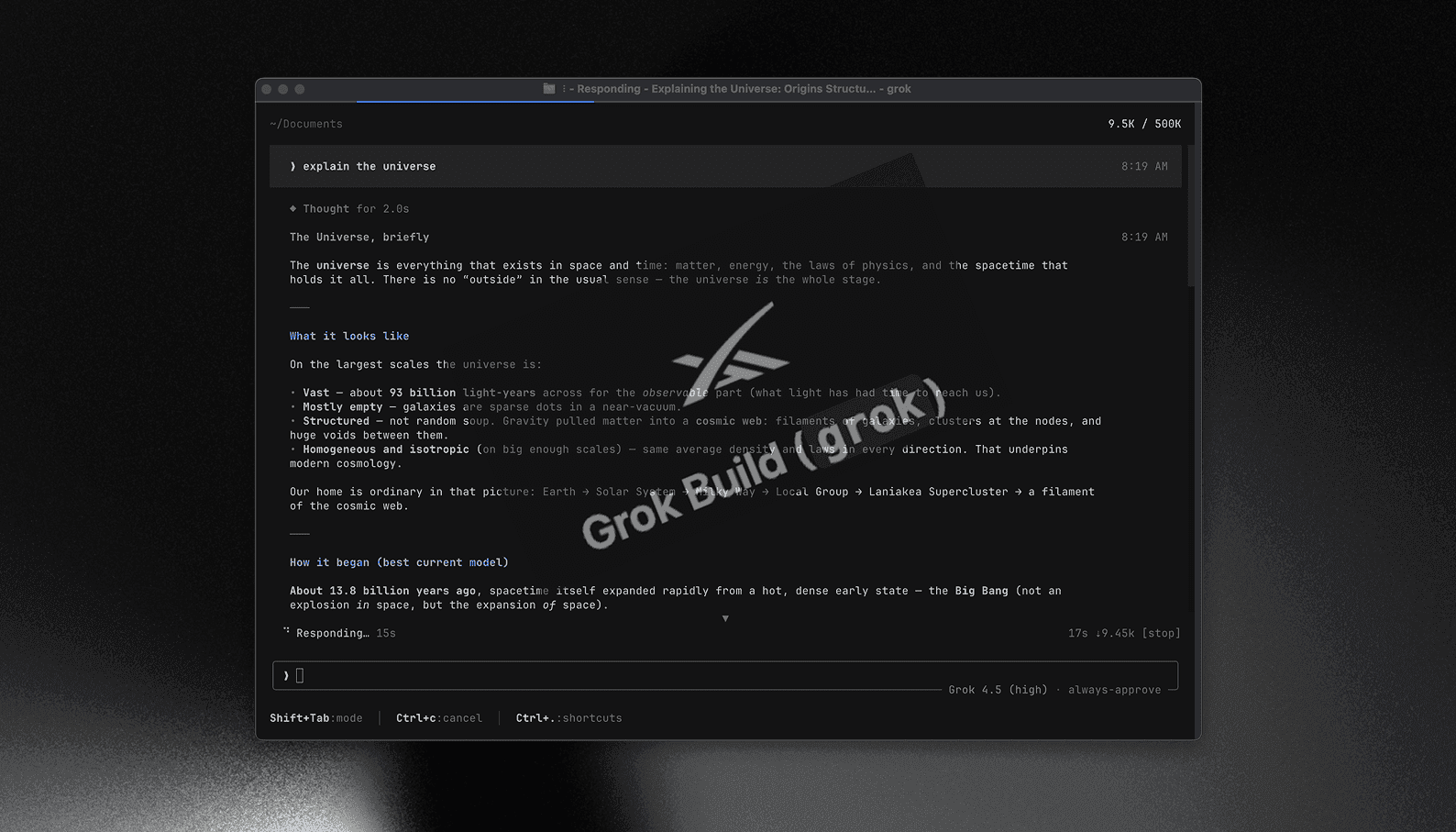
Grok Build reframes AI coding assistance as an execution harness anchored to your repository, not a floating chat tab. The full-screen terminal UI drives structured prompts, tool calls, and diff application in-context—editing files, executing shell commands, searching the web, and coordinating long-running jobs. Crucially, the same agent can run headlessly for CI and scripting or embed in editors via the Agent Client Protocol (ACP), keeping one mental model across surfaces. This reduces the classic friction of agents that feel different in chat, IDE, and automation. For buyers, the unification matters: auditability, reproducibility, and operational control improve when an agent runtime is consistent everywhere developers work.
Under the hood, the runtime composes tools for shell, file I/O, search, and workspace management, while the TUI provides scrollback, prompts, modals, and rendering with mouse support. The design emphasizes deterministic application of changes—streamed reasoning with explicit diffs rather than opaque magic—so teams can checkpoint, review, and roll back. It is extensible via skills, plugins, and MCP servers, enabling safe access to databases, cloud resources, or proprietary APIs with clear boundaries. Headless mode brings the same capabilities to CI or batch jobs, turning agent tasks into repeatable pipelines. The outcome is a pragmatic balance: fast iteration for individuals, controlled execution for teams, and a single policy surface for security.
Operationally, Grok Build fits several high-value workflows: repo exploration and onboarding; large, incremental refactors with measurable checkpoints; incident response runbooks in constrained sandboxes; and reliable upgrade automation (dependency, SDK, framework) gated by tests. ACP-based embeds make agents feel native in editors while preserving the same tool contracts and logs. Because the agent is codebase-aware, prompts stay grounded in project context and version control history. Teams can layer policy—approved tools, network egress rules, model choices—without reinventing flow per surface. The big advantage is convergence: one agent, three modes, and uniform observability to track latency, success rates, and developer time saved.
The strategic question for leaders is not whether to adopt agents, but how to institutionalize them without fragmenting workflows. Start with interactive TUI pairing for safe trials and local experimentation. As prompts and tools stabilize, promote durable tasks to headless scripts or CI jobs with secrets management, caching, and policy gates. Finally, embed via ACP where developer ergonomics matter most. Evaluate on predictable diffs, test pass rates, task completion time, and integration cost with your editor stack, MCP servers, and security controls. Treat Grok Build like any core dev tool: require auditable logs, reproducible outcomes, and graceful failure modes under flaky networks or limited permissions.