

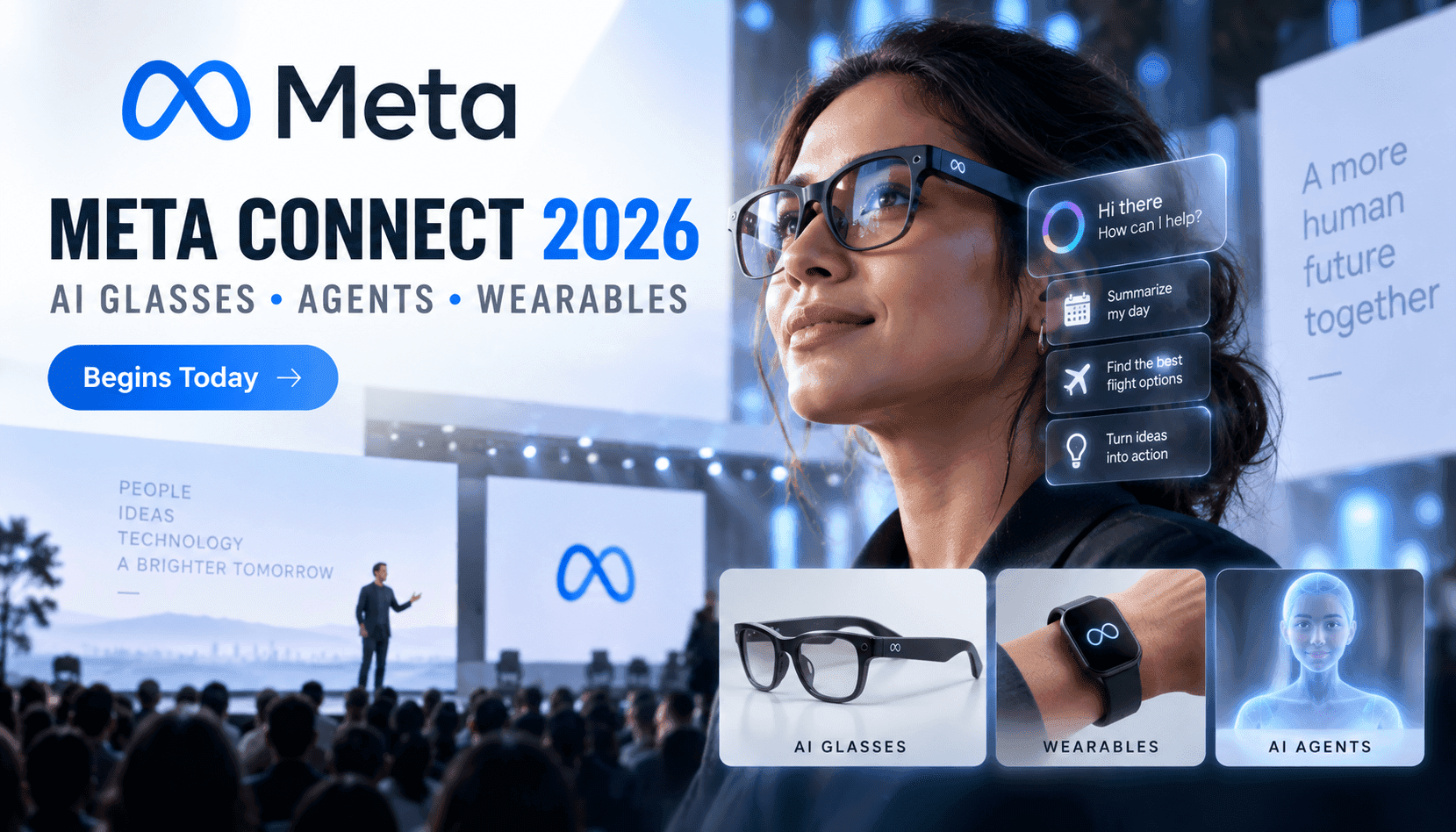
Meta’s annual Connect keynote is increasingly the place where wearable AI and agent UX leave the lab and meet distribution at social scale. This live-watch brief tracks what matters for buyers and builders: whether AI glasses move beyond companion novelty, if agents gain durable entry points inside Meta’s apps, and how much functionality can run locally versus the cloud. Expect polished demos; the real filter is deployability—battery and thermals, privacy posture, developer ergonomics, and measurable reliability. Teams should come prepared with a test plan, procurement guardrails, and an integration hypothesis that can survive device churn over the next product cycle.
For glasses, the pivot is on-device intelligence and input fidelity. Sub-10B class models, speech and beamformed audio, gaze or pinch inputs, and low-latency visual understanding are the levers that turn a wearable into a daily assistant. Watch for details on NPUs or co-processors, camera privacy indicators, and how the device handles continuous listening or capture without draining power. Display readability outdoors, FOV, and notification ergonomics will decide day-two retention. Cloud fallback is fine, but if core tasks require uplink or produce unpredictable latency, the experience will stall in pilot. The most credible path is a layered approach: fast local intent detection with graceful handoff to cloud tasks.
Agents will matter less for their cleverness and more for where they live. Distribution inside WhatsApp, Instagram, and Messenger unlocks service, commerce, and creator workflows if Meta exposes safe tool-use APIs, business messaging hooks, and identity with granular permissions. The evaluation lens should be task success under constraints: how well agents route to tools, recover from ambiguity, and hand off to humans. Track metrics like first-response latency, tool-call accuracy, and privacy boundaries for messages and media. If Meta demonstrates stable surfaces for payments, booking, and customer service, early adopters can stitch agents into existing channels without provisioning another app.
For decision-makers, the most useful outcomes today are go/no-go rules for pilots, not long bets on a single device. Seek developer kits with clear roadmaps, SDKs for multimodal capture and redaction, and enterprise identity integration. Verify data retention defaults, content moderation paths, and regional compliance options. Budget for human-in-the-loop review on agent decisions and set stop-loss thresholds on reliability. If the keynote lands with credible tooling and a partner program, greenlight 90-day trials tied to channel conversion or field productivity; otherwise, double down on software agents and keep the hardware track in discovery with quarterly reassessment.