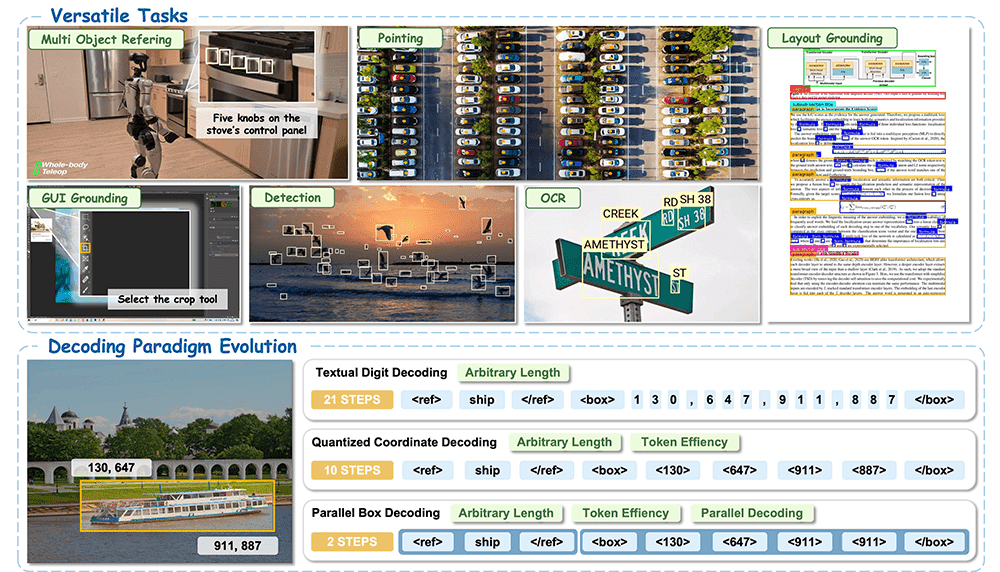
NVIDIA LocateAnything uses Parallel Box Decoding to localize objects, GUI elements, text and visual regions faster than token-by-token grounding models.
NVIDIA LocateAnything targets one of the most practical problems in multimodal AI: grounding language in exact visual locations. A model may understand that a user is asking about a button, object, text block or visual region, but real applications need coordinates, boxes or points that machines can act on.
Traditional vision-language grounding models often generate bounding box coordinates token by token. That creates a mismatch between the geometry of a box and the sequential nature of text generation. LocateAnything changes the decoding strategy by treating a box or point as a complete unit, allowing more parallelism and better geometric consistency.
The result is important for developers building visual agents, document AI, UI automation, robotics and inspection systems. If a model can locate targets accurately and quickly, it becomes more useful as a perception layer for agents that need to click, inspect, annotate, count, navigate or act in the physical and digital world.
Why visual grounding matters for AI agents
A vision-language model that only describes an image is useful, but an agent needs more than description. It needs to know where something is. GUI agents must locate icons and buttons, document agents must find tables and text regions, and robotics systems must identify objects in cluttered scenes.
LocateAnything is designed for this action-oriented layer. It supports tasks such as open-set object detection, dense multi-object localization, referring-expression grounding, GUI element grounding, OCR localization, layout grounding and point-based localization. That makes it relevant to both enterprise intelligence and physical AI.
Where LocateAnything could be useful
For GUI automation, LocateAnything can help an agent understand where to click or inspect on a screen. For document AI, it can localize text, layout blocks and tables. For robotics and industrial inspection, it can support object localization in cluttered environments where precise boundaries matter.
The model is also relevant for dataset labeling and annotation workflows. If developers can ground natural-language queries into accurate boxes or points, they can accelerate the creation of training data for detection, OCR, visual search and embodied-agent systems.
The model is available, but not a simple commercial plug-in
LocateAnything-3B is available on Hugging Face with examples for Transformers, vLLM, SGLang and Docker-style deployment. That makes it accessible for researchers and developers who want to test grounding performance inside local or server-based multimodal pipelines.
However, the model card states that the release is for research and development under an NVIDIA non-commercial license. Teams should read the license carefully before using it in a product, customer-facing feature or commercial automation workflow.