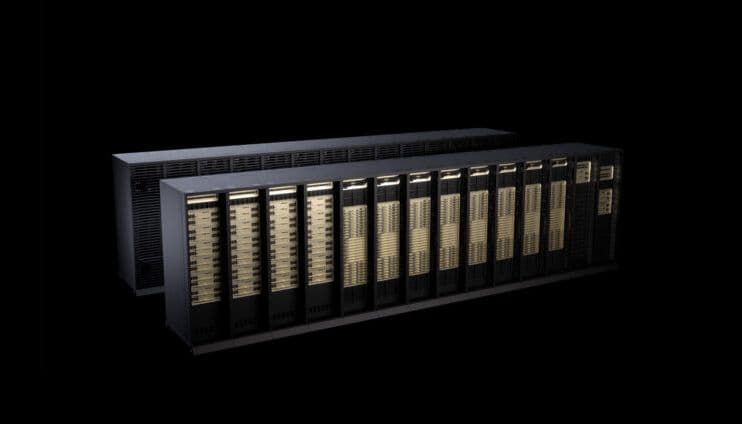
NVIDIA Vera Rubin combines AI acceleration, native FP64 scientific computing and 45°C liquid cooling to turn dense GPU racks into more practical supercomputers for research and AI factories.
NVIDIA Vera Rubin is expanding the definition of an AI supercomputer. Rather than separating conventional high-performance simulation from machine learning, the platform is designed to run numerical solvers, scientific AI models, data analytics and agentic research workflows within one accelerated computing environment.
NVIDIA says a Vera Rubin scientific computing system can provide more than seven exaflops of AI performance, five petaflops of native double-precision performance and extreme memory bandwidth across configurations containing up to 144 GPUs. That combination targets workloads such as climate modeling, computational fluid dynamics, quantum chemistry, materials research and energy exploration.
However, denser computing creates a physical challenge: heat. Vera Rubin systems are designed around direct liquid cooling that can operate with coolant supplied at up to 45°C. Counterintuitively, allowing warmer cooling water can improve facility efficiency by reducing or eliminating mechanical chilling in suitable climates.
Vera Rubin brings AI and traditional supercomputing together
Many scientific workflows combine several computing stages. Researchers may run a high-precision simulation, train a surrogate model, compare experimental data and use AI to search an enormous parameter space. Moving those stages between disconnected systems introduces delays, data movement and operational complexity.
Vera Rubin combines Rubin GPUs, Vera CPUs, high-speed chip connections, networking, data-processing units and CUDA-X scientific libraries. Native FP64 support is important because many simulations require substantially greater numerical precision than mainstream generative AI inference. The platform is therefore intended to serve both conventional HPC and emerging AI-for-science workloads.
Major research institutions are building around Vera Rubin
The announced deployments give Vera Rubin a role beyond NVIDIA's commercial AI factory narrative. The Leibniz Supercomputing Centre plans to use the platform for Blue Lion, a system scheduled for 2027 that will support astrophysics, environmental science, life sciences, simulation and machine learning.
NERSC's Doudna system is being built for molecular dynamics, fusion energy, materials science, drug discovery, astronomy and other Department of Energy research. Los Alamos National Laboratory has also selected Vera Rubin technologies for systems spanning national security, open science, foundation models and complex simulations. Commercial systems from multiple manufacturers are expected to begin arriving in late 2026.
Why cooling AI servers with 45°C liquid matters
Direct-to-chip liquid cooling captures heat close to GPUs, CPUs and other high-power components. Liquid carries considerably more heat than air, allowing racks to support computing densities that would be difficult to cool using fans and conventional room-level air conditioning.
A higher allowable coolant temperature creates a larger opportunity to reject heat using ambient air or simpler facility equipment. Operators may need less mechanical chilling, which can reduce cooling electricity, water consumption and infrastructure complexity. Actual savings will still depend on local climate, rack utilization, water-loop design and the temperature difference achieved across the cooling system.
AI system design now extends into the building
The Vera Rubin generation demonstrates that the server can no longer be evaluated separately from the facility. Compute trays, cold plates, coolant distribution units, power delivery, networking, rack mechanics and heat-rejection systems must be designed together if operators want consistently high utilization.
This changes AI infrastructure purchasing. Organizations must assess available electrical capacity, cooling-loop temperatures, redundancy, leak detection, maintenance procedures and heat-reuse opportunities alongside GPU specifications. A faster accelerator delivers limited value when facility constraints prevent it from operating at full density.
What Vera Rubin means for AI users and infrastructure buyers
For researchers, Vera Rubin could shorten workflows that combine simulation, scientific data and AI-assisted analysis. For model developers and cloud providers, the same full-stack engineering may increase the amount of useful computation produced within a fixed power and cooling envelope.
Buyers should treat NVIDIA's performance and efficiency figures as system-design targets that require validation against their own workloads and facilities. Application scaling, software readiness, acquisition cost, electrical upgrades, cooling conversion and operational maturity will determine whether Vera Rubin's theoretical advantages become measurable research or business outcomes.