

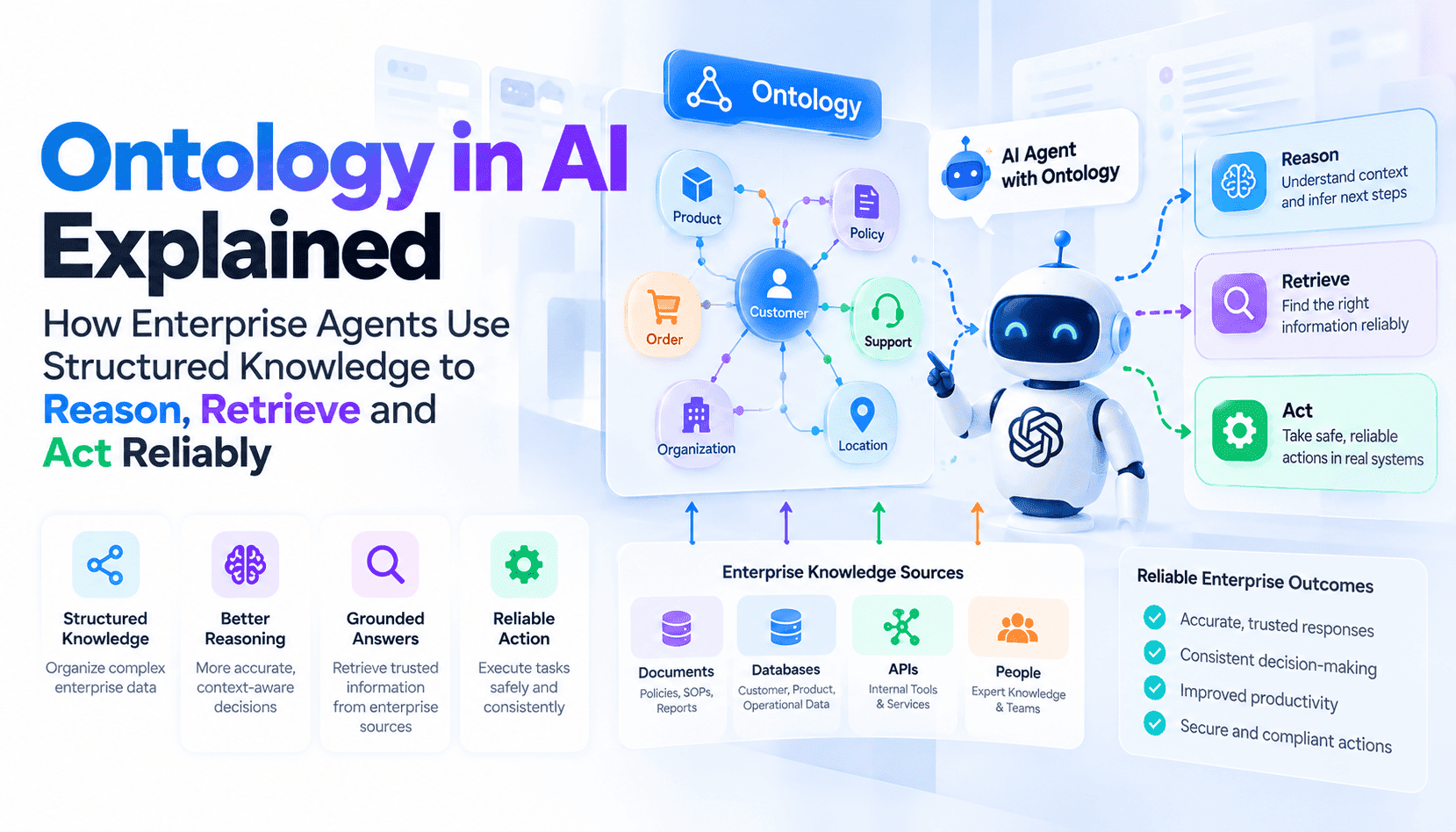
Enterprise AI has largely solved data plumbing: connectors, warehouses and retrieval methods are mature. The harder problem now is consistent meaning at scale. An agent can query every table and still misinterpret a field like customer_status or revenue. Ontology fixes this by encoding business concepts, their properties, relationships and axioms so an AI system can reason about what data means rather than treating it as unlabeled tokens or schema elements. That shift matters for downstream decisions — from automated underwriting to executive reports — because mistakes compound when they are programmatic and repeated.
This article takes a practical, use-case-first approach. We explain what components make an ontology useful for agents, show how ontologies differ from taxonomies, knowledge graphs and semantic layers, and offer concrete examples — customer risk profiles, revenue metrics, insurance claims — that reveal the governance, lineage and access signals agents need at runtime. The goal is operational: design an AI-ready ontology that provides traceability, authoritative definitions, and enforcement hooks so agents choose the right data and actions, and humans can audit decisions with confidence.
Ontologies unlock inference. While a catalog or taxonomy classifies assets, axioms let agents infer facts not explicitly stored: a dataset containing PII inherits restricted access, two entries sharing a tax ID imply the same legal entity, or a lapsed subscription does not terminate customer obligations. These inferences reduce brittle rule lists and make runtime decisions more robust. But they require intentional modeling: classes, instances, properties, directed relationships and formal constraints that map to physical data, owners and policies.
Finally, we provide a lightweight implementation framework you can apply in the first 4–8 weeks. Start with a single decision or agent workflow, model 20–50 high-impact concepts, define relationships and axioms that matter for inference, and immediately link concepts to lineage, quality scores and access rules. Measure success through reasoning accuracy, traceability and access awareness rather than just adoption. That way your ontology becomes a living governance asset that scales with AI use instead of decaying in a documentation silo.