Open-Source vs Closed AI Models: Cost, Privacy, Performance and Control — A Buyer’s Playbook
Choosing between open-source and closed AI isn’t just about raw benchmark scores. This playbook compares total cost of ownership, privacy posture, performance and reliability, customization options, security and compliance risks, maintenance overhead, and vendor dependence—then shows when to mix models and route workloads to unlock material savings without sacrificing outcomes.
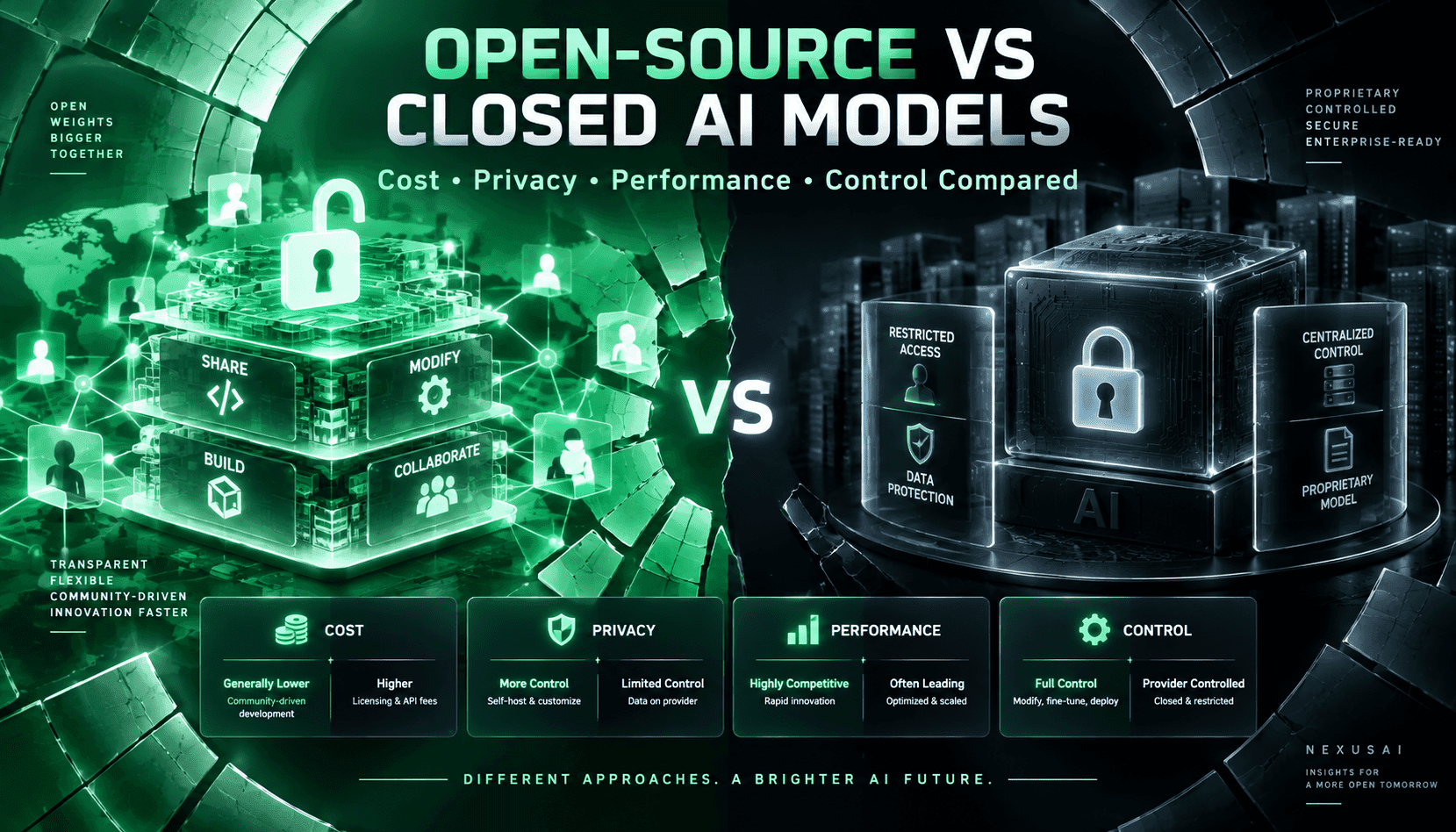
AI BriefThe open-source vs closed model choice is a procurement decision, not a leaderboard beauty contest. Open-weight systems often deliver near-frontier results for coding and structured tasks at a fraction of the output cost, while closed models still lead on breadth, reliability across complex agentic workflows, and enterprise safeguards. The winning strategy for most teams is a routing architecture: push high-stakes reasoning and multi-agent orchestration to premium models; send implementation, summarization, and bounded tasks to cost-efficient open weights. Decide first on your data-control posture (self-hosted vs managed), then quantify total cost of ownership factors—verbosity, context, retries, logging, eval loops—before committing budget.
Most teams still frame model selection as a race for the highest score, yet the operational decision is broader: What does the outcome cost, and who controls the data path? Open-weight models now land close to premium systems on many practical workloads, particularly coding and structured output. Closed options continue to lead on general reasoning depth and agentic reliability. The modern buyer playbook blends both: route by task type, not brand, to capture meaningful savings without trading off quality where it matters most.
Token list prices are only the starting point. Effective cost depends on verbosity, context length consumed, tool-use patterns, retries, and monitoring overhead. With smart routing, organizations routinely find 5–8x output-cost deltas between premium closed models and strong open weights for similar implementation tasks. But that advantage compresses when verbosity spikes or when reliability requirements force multiple attempts. Put differently: the cheapest model per million tokens is not always the cheapest model per solved task. Instrument your workloads and price the whole pipeline, not just inference.
Privacy posture is the second decision, not an afterthought. Self-hosted open weights can deliver strong data control, deterministic egress, and the option to keep logs entirely on your estate—useful for regulated teams and ML platforms with sensitive code or PII. Managed closed services, meanwhile, often provide turnkey compliance artifacts, mature abuse safeguards, and stable SOC 2/ISO reporting. Both paths can be secure; they merely concentrate risk differently: open shifts responsibility to your team; closed concentrates trust in a vendor’s controls and roadmap.
Performance remains nuanced. Closed models typically retain an edge on hard multi-step reasoning and long-running multi-agent workflows. Open weights are increasingly competitive on coding, retrieval-augmented tasks, and well-scaffolded workflows. Benchmarks help but do not settle procurement: harness differences, output verbosity, and prompt scaffolds can move scores meaningfully. Validate on your stack with representative repositories, tool schemas, and latency budgets, then lock routing rules and SLAs into your runbooks.
Key Takeaways
Route by Task, Not Brand
Send complex multi-agent reasoning and repo-wide operations to premium closed models; route implementation, summarization, and bounded tasks to strong open weights. This mix often delivers 5–8x lower cost per solved task with no material quality loss.
Decide Data Control First
Pick your privacy posture—self-hosted open weights or managed services—before benchmarking. Data residency, logging, and DPA terms narrow viable choices and prevent costly rework later.
Price the Outcome, Not the Token
Instrument verbosity, context usage, retries, and human-edit rates. A higher-priced model may win on cost per accepted artifact; a cheaper one can lose when verbosity or failures inflate total spend.
Total Cost of Ownership: Price the Whole Pipeline
TCO spans far beyond input/output rates. Measure output verbosity, context tokens, retries, tool calls, and evaluation loops; then fold in observability, cache strategy, and incident response. Open-weight models can be dramatically cheaper for implementation-heavy tasks, but verbosity or wider context can erase savings. Conversely, closed models with stronger instruction fidelity may resolve tasks in fewer turns and lower the per-solved-unit cost despite higher token rates. The right answer is evidence, not brand loyalty.
Practical steps: 1) instrument token in/out and latency per task; 2) capture failure/rollback rates; 3) run A/B routing across representative workloads for at least one week; 4) model cost per accepted PR, doc page, or ticket resolved; 5) convert target SLAs (accuracy, time-to-merge) into budget thresholds. Lock policies like “closed for repo-wide refactors, open for unit-test scaffolding” and revisit quarterly.
Privacy, Residency, and Control Surfaces
Decide your control posture upfront. Open-source deployments can run on your VPC or on-prem with KMS, private subnets, and no persistent logs—maximizing control and enabling data-residency guarantees. You also gain options like redaction at the gateway, content hashing for deduplication, and per-tenant policies for agent tools. The trade-off: you own patching, model updates, and supply‑chain risks for weights, containers, and dependencies.
Closed services centralize risk in a vetted vendor stack with mature DPA terms, SOC/ISO attestations, regional hosting, and fine-grained logging. Ask for data-retention defaults, training holdbacks, model-specific privacy controls, red-team methodology, and bring‑your‑own‑key support. Map these to workload sensitivity levels so high‑risk flows never ride permissive defaults.
Performance, Reliability, and Benchmark Caveats
Leaderboards compress complexity. Differences in harnesses, prompt scaffolds, or tool availability can shift results meaningfully, especially on coding and long-context tasks. Also, output verbosity changes economics: a cheaper model that writes 3–4× more tokens per task can end up more expensive. Finally, benchmark mixtures often underweight operational reliability—session continuity, error recovery, and concurrent tool calls—all critical in agentic pipelines.
Run your own bake-off: evaluate exact workflows (e.g., multi-file refactors, test generation, RAG with tables), capture pass/fail at the artifact level, measure retries and human edits, and compare cost per accepted artifact. Set guardrails for hallucination-prone steps (schema‑validated output, constrained decoding, retrieval filters) and route high-stakes tasks to the most reliable model even if tokens cost more.
Customization and Governance: Shape the Model to the Work
Open weights offer maximum extensibility: parameter-efficient finetuning, domain adapters, and guardrail layers that you can version and ship. They pair well with internal RAG corpora, code conventions, and tool schemas. You control release cadence and can harden behaviors with eval gates before promotion. The cost is operational: MLOps maturity, inference optimization, and people time to maintain the stack.
Closed models usually deliver better structured-output adherence, robust tool-use, and stable multi-agent coordination without customization overhead. Where possible, bring your governance to the edge—typed tool contracts, JSON schema validation, automated fallbacks—and treat closed APIs as components inside your policy envelope. In mixed estates, use a router with policy awareness so governance rules travel with the request, not the model.
Maintenance, Security, and Vendor Dependence
Self-hosting means you own patch velocity, dependency hygiene, and vulnerability management. Require SBOMs for base images, sign artifacts, and stage upgrades behind eval gates. Budget for incident response across the model gateway, caching layer, and vector stores. Build runbooks for model rollback, traffic shedding, and emergency model switches when quality regressions surface.
Closed vendors reduce ops overhead but introduce concentration risk: pricing changes, rate limits, model deprecations, or regional availability can impact SLAs. Mitigate with a dual-sourcing plan, abstracted SDKs, and golden prompts/tests that allow fast switchover. Contract for uptime SLAs, privacy carve‑outs, and advance notice on model changes. Treat vendor management as part of your reliability strategy.
Frequently Asked Questions
How should we pilot a mixed open/closed routing strategy?
Start with three representative workloads (e.g., repo refactor, test generation, RAG Q&A). Instrument token in/out, latency, retries, and human-edits. Route high-stakes steps to a premium model; route bounded steps to an open weight. Run for 1–2 weeks, compare cost per accepted artifact, then codify routing rules and SLAs in your gateway.
What privacy and compliance artifacts should we request from vendors?
Ask for DPA terms, regional data residency controls, retention defaults, training holdbacks, SOC 2/Type II and ISO 27001/27018 reports, red-team summaries, incident response SLAs, and BYOK support. For self-hosted paths, document data flows, enable KMS, disable logs by default, and implement schema validation to minimize sensitive leakage.
When does open-source reduce risk rather than increase it?
When data residency is strict, logs cannot leave your estate, or continuity matters more than vendor roadmaps. Open weights let you pin versions, harden guardrails, and avoid sudden pricing or deprecations. The trade-off is operational responsibility—patching, monitoring, and performance tuning become core competencies.