

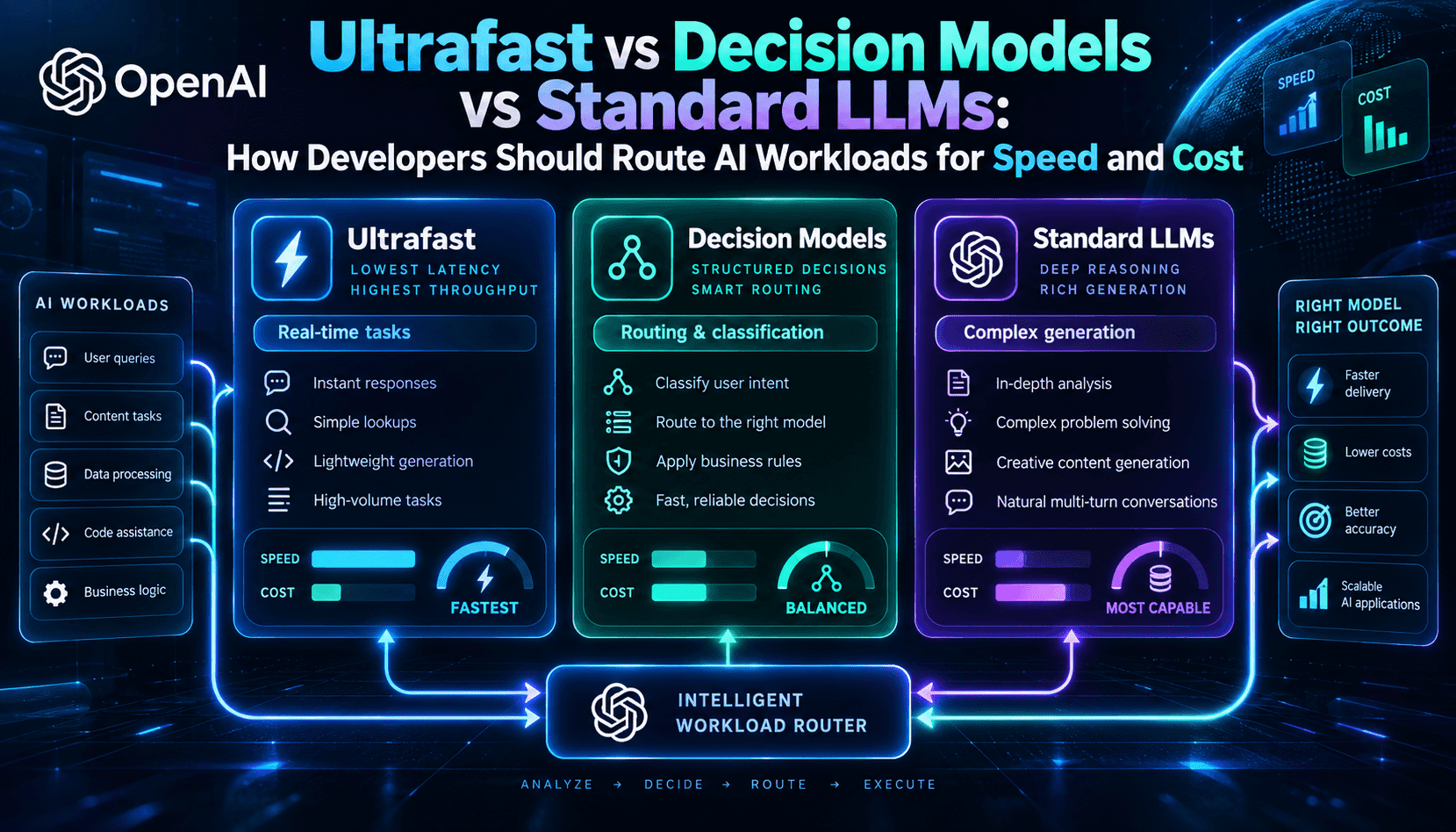
Developers face a frequent architecture choice: send everything to the most capable model or route work to cheaper, faster specialized endpoints. OpenAI’s recent additions—GPT-6.1 Sol Ultrafast and GPT-6 Luna Decisions—make that choice more actionable. Ultrafast Sol reduces token output latency for generative flows; Luna Decisions provides typed answers and decisions at roughly an order-of-magnitude faster throughput than full Responses endpoints. This article translates those platform advances into pragmatic routing patterns you can adopt today.
Before routing anything, classify workloads along four axes: required reasoning depth (shallow classification vs deep chain-of-thought), acceptable latency (sub-100ms UI vs multi-second batch), output structure (typed decision vs free-form text), and cost sensitivity. For example, short deterministic classification and routing tasks often need only the Decisions API. Conversational generation with rich creativity benefits from full-reasoning Sol or Astra variants; high-throughput UI token streaming benefits most from the Ultrafast tier. Mapping workloads to these axes prevents overuse of expensive frontier models.
In practice, implement three complementary routing lanes: a Decisions lane (Luna) for structured, high-throughput decisions and classification; an Ultrafast generative lane (GPT-6.1 Sol with service_tier:"ultrafast") for low-latency token streaming and interactive UIs; and a Reasoning lane (GPT-6 Sol/Astra) for complex reasoning, code synthesis, or multi-step tool use. Add a lightweight router that selects lanes based on metadata (prompt size, expected reasoning effort, latency budget, and whether the request needs structured typed output).
Concrete examples: use Decisions for spam detection, intent routing, feature-flag decisions, simple classification and typed outputs; use Ultrafast for streaming chat, autocomplete, real-time suggestions, and UI experiences where users tolerate slightly less deliberation for instant response; reserve full-reasoning models for code generation, multi-step analysis, or when tool invocation and long-form reasoning materially change outcomes. These patterns reduce overall cost while keeping accuracy where it matters most.