

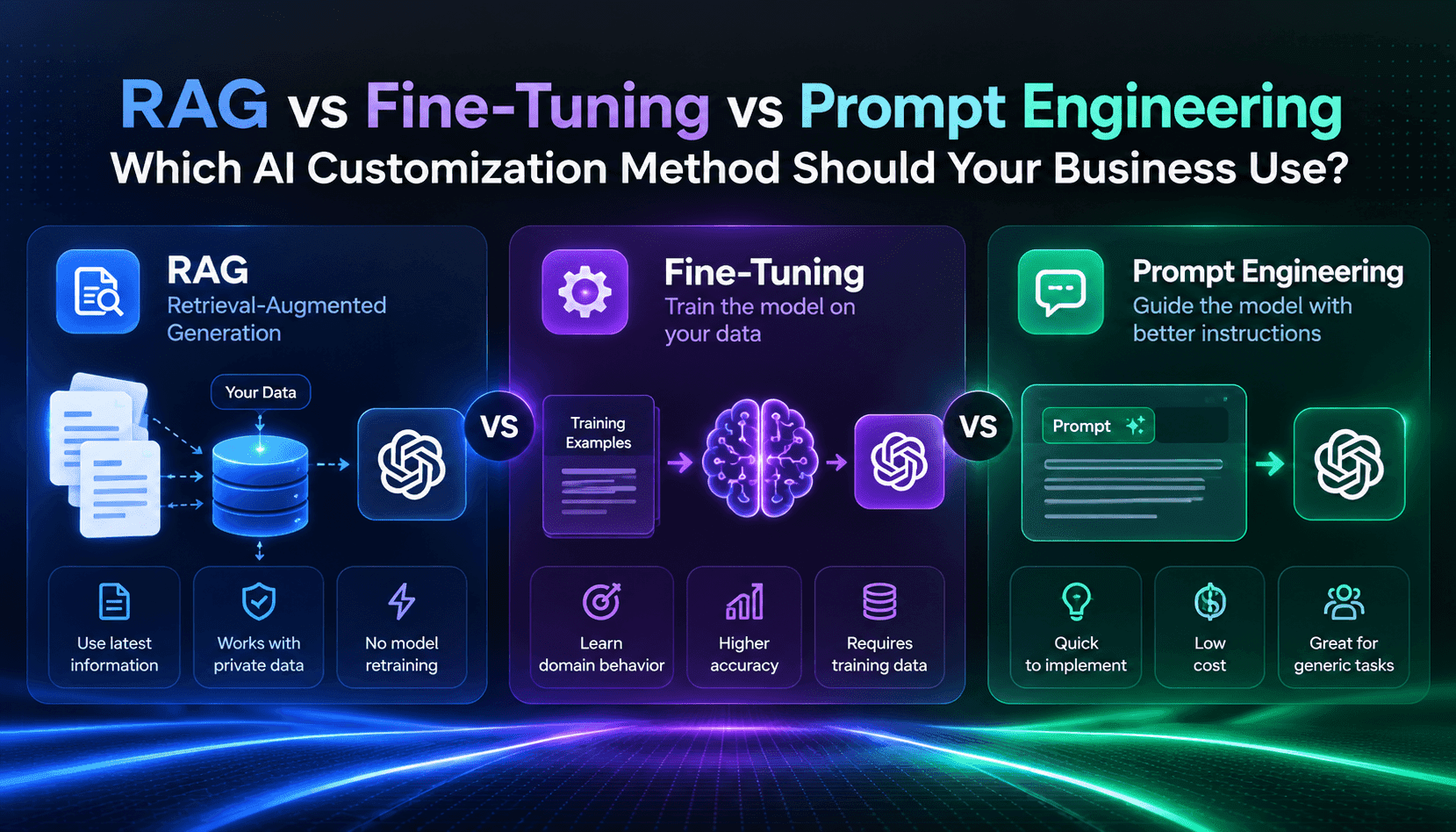
Choosing between prompt engineering, retrieval-augmented generation (RAG), and fine-tuning is less about ranking tools and more about matching levers to the problem you face. Prompt engineering tweaks instructions to get a better response without changing the model. RAG supplies up-to-date, proprietary, or domain-specific context at runtime so the model can reason over fresh facts. Fine-tuning changes model behavior by training on curated examples to increase consistency and produce deterministic outputs. Each technique shifts accuracy, latency, operational cost, data exposure, and maintenance burden in different directions—so the right choice depends on the specific business constraints and the failure cost of the task.
Start every optimization effort with a diagnostic: define the decision-critical errors, measure failure cost, and run a prompt-first baseline. For many tasks—translation, summarization, small-scale classification, and templated copy—careful prompting and few-shot examples reach production quality quickly. When outputs are wrong because the model lacks current facts or company documents, RAG buys accuracy with relatively low development overhead. When errors are behavioral—formatting, tone, deterministic classification—or when you need repeatable, auditable outputs at scale, fine-tuning becomes defensible despite higher data and operations costs.
Implementation economics matter. Prompt engineering is cheap and fast: iterate prompts, add examples, and instrument outputs. RAG requires building a retrieval pipeline, indexing documents, and tuning relevance; it introduces additional latency and a surface for data governance but keeps the model unmodified and knowledge current. Fine-tuning demands curated labeled examples (often 50–500+), model training and serving, versioning, re-training as specs drift, and controls for safety. Many robust production systems combine RAG with a fine-tuned model for behavior, then use deterministic post-processing and validators to reduce hallucinations.
This guide lays out a simple decision matrix and practical steps per scenario—customer support, internal knowledge assistants, document analysis, structured output generation, domain-specific writing, and specialized classification—so product and engineering leaders can pick the minimum viable lever, know when to escalate to the next level, and design for privacy, latency, and maintainability in production.