

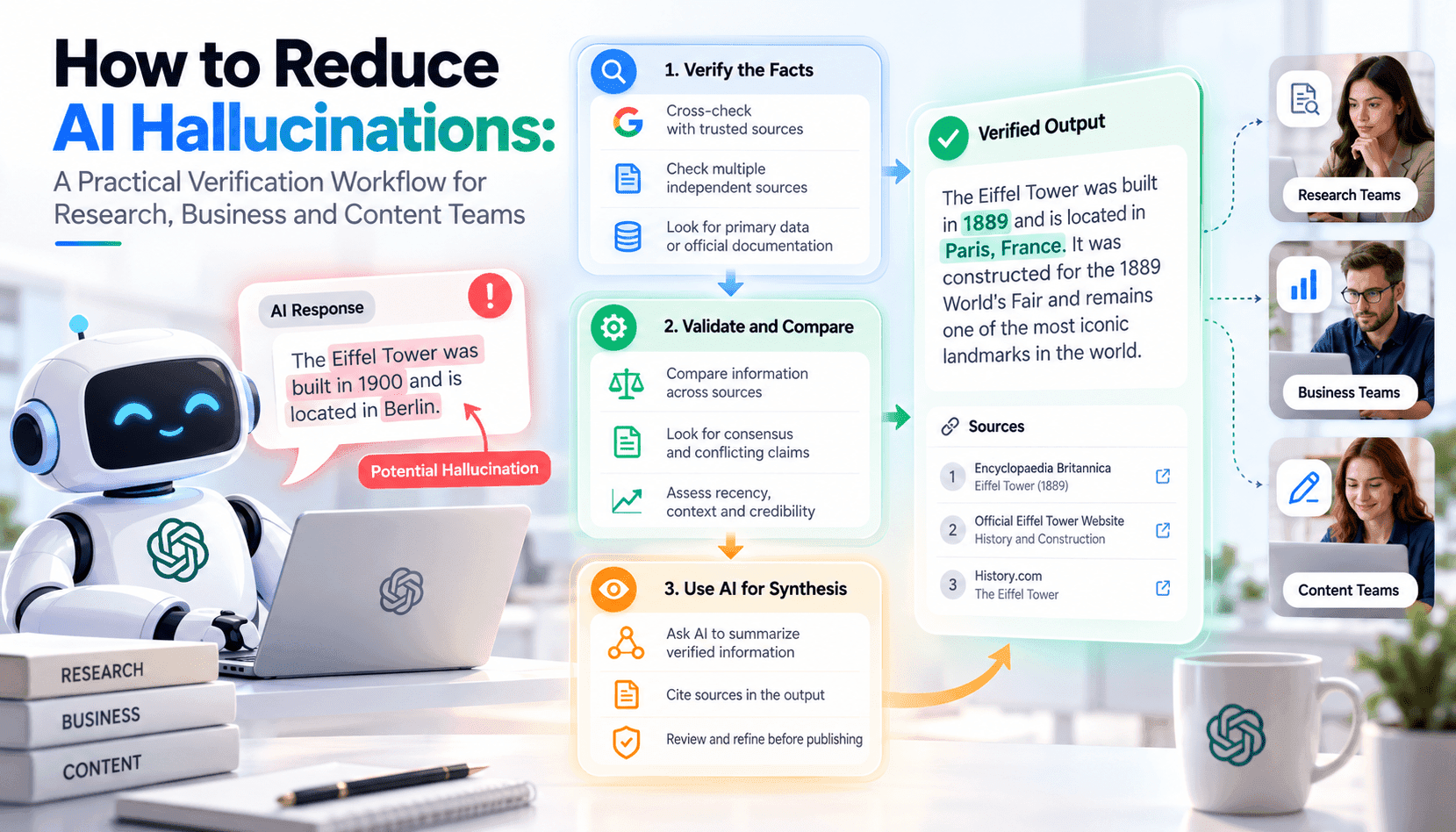
AI systems deliver outsized productivity gains—drafting research summaries, drafting executive briefings, and answering customer questions. But for teams that rely on those outputs for decisions, budgets or public-facing content, an unverified model response can cause reputational, financial, or regulatory harm. This article shifts the conversation from whether hallucinations exist to how teams can limit them with a practical, repeatable verification workflow that fits within existing review processes and scales from lightweight checks to expert validation where needed.
Hallucinations arise for concrete reasons: missing context in prompts, weak or stale retrieval, ambiguous user intent, outdated training data, and models that produce confident but unsupported assertions. Understanding these failure modes helps teams choose controls that match the risk: stronger retrieval, source-grounded prompting, structured fact extraction, confidence thresholds and cross-model comparison. The goal of the workflow is not to eliminate AI use, but to treat model outputs as asserted claims that must be verified before they become decisions or published material.
This guide lays out a step-by-step verification loop: define the claim, require explicit evidence, check primary sources, compare independent references, separate fact from inference, flag uncertainty, and document final approval. Each step includes practical checks and examples for common team workflows—market research, executive reports, SEO content, support responses and internal assistants—plus a simple risk matrix so teams can decide when a lightweight check suffices or when expert validation is mandatory.