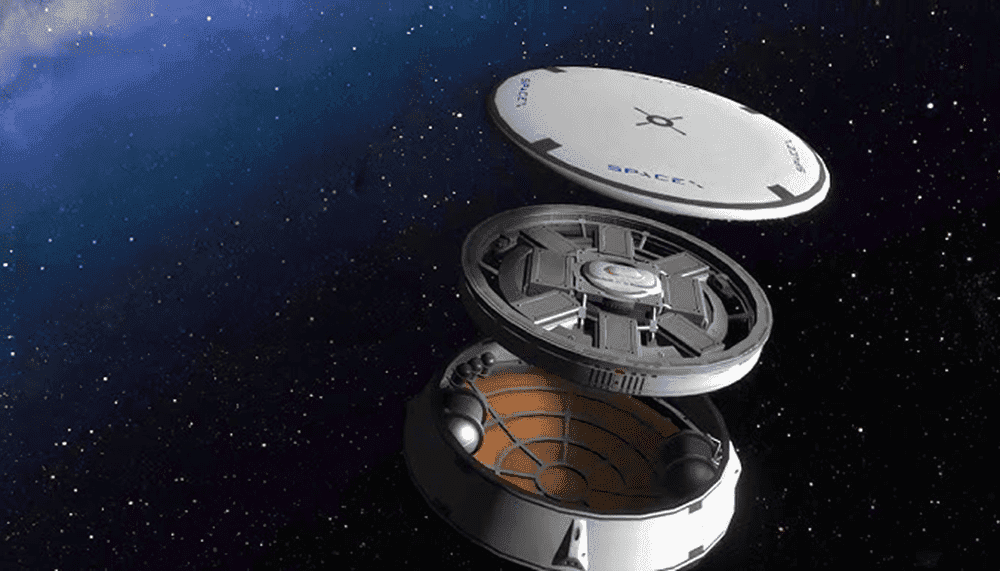
SpaceX’s Starfall reentry vehicle program points to a future where orbital manufacturing, microgravity research, space logistics and AI infrastructure become part of the same industrial stack.
SpaceX Starfall is emerging as one of the most interesting infrastructure signals in the new space economy. The program centers on reentry vehicles that can return cargo from space to Earth, creating a missing logistics layer between launch systems, orbital manufacturing, microgravity research and future space-based industrial operations.
The AI connection is not that Starfall itself is an AI model or an AI app. The deeper story is that artificial intelligence is becoming increasingly dependent on physical infrastructure: chips, power, robotics, materials, thermal systems, satellites, data centers and automated manufacturing. If SpaceX can make return logistics cheaper and more repeatable, it could help unlock space-based production systems that are managed, optimized and automated by AI.
For AI users, founders and technology researchers, this is worth watching because infrastructure breakthroughs can reshape the tools that appear years later. Orbital manufacturing could affect advanced materials, semiconductor research, photonics, medicine, robotics components and space-based compute systems. Starfall could become one of the practical bridges between AI factories on Earth and production environments in orbit.
Why Starfall matters for the next space economy
Most people think of SpaceX as a launch company, but Starfall points to a broader logistics strategy. Launching cargo into orbit is only half of the problem. If companies want to manufacture, test, refine or process valuable products in space, they also need a dependable way to bring those products back to Earth.
That return capability could become especially important as the International Space Station approaches retirement and private space stations, orbital labs and commercial manufacturing platforms become more relevant. A reusable or mass-producible reentry vehicle gives the market a way to think about space as an industrial supply chain rather than a one-way destination.
The missing link is return logistics
Space manufacturing only becomes commercially interesting if products can return safely, predictably and at a useful cost. Microgravity can enable research and production conditions that are difficult to reproduce on Earth, but the output still needs to be recovered, inspected, packaged and delivered into normal terrestrial supply chains.
Starfall appears designed to address that gap. A compact reentry vehicle that can be launched by Falcon 9 or Starship and recovered after splashdown could support experiments, prototypes, specialized components and high-value goods that need orbital conditions but Earth-based customers.
How Starfall connects to AI factories
AI factories are usually described as giant data centers that turn electricity, chips and data into intelligence. But the same AI factory concept can extend into physical production. Advanced manufacturing increasingly depends on AI for simulation, process control, robotic handling, quality inspection, materials discovery and predictive optimization.
If microgravity manufacturing becomes commercially viable, AI systems will likely coordinate many parts of the workflow: deciding which materials to produce, optimizing orbital process conditions, monitoring equipment, scheduling reentry, inspecting results and improving future production cycles. Starfall could become the return path that makes that closed loop more practical.
The opportunity is real, but still early
Starfall should not be treated as proof that large-scale space manufacturing is already solved. The program is still in an early test and regulatory stage. Space manufacturing faces difficult challenges around cost, reliability, payload limits, recovery, contamination control, quality assurance, customer demand and competition from Earth-based production.
The stronger interpretation is that Starfall makes the space manufacturing business model more concrete. Instead of imagining orbit as a laboratory with limited return options, companies can begin thinking about repeatable cargo return as part of the industrial workflow. That is a meaningful shift even before the market reaches scale.
What NexusAI users should watch next
NexusAI users should watch whether Starfall completes successful test flights, how much payload it can return reliably, which customers use it, and whether SpaceX positions it as a broader logistics platform for in-space manufacturing. The most important proof will be repeatability: not one exciting reentry, but a workflow that can support commercial operations.
The broader lesson is that AI infrastructure is expanding into physical and orbital systems. Future AI tools may depend on space-based sensing, orbital compute, robot-managed manufacturing, advanced materials and logistics networks that move between Earth and orbit. Starfall could become one of the enabling layers behind that shift.