

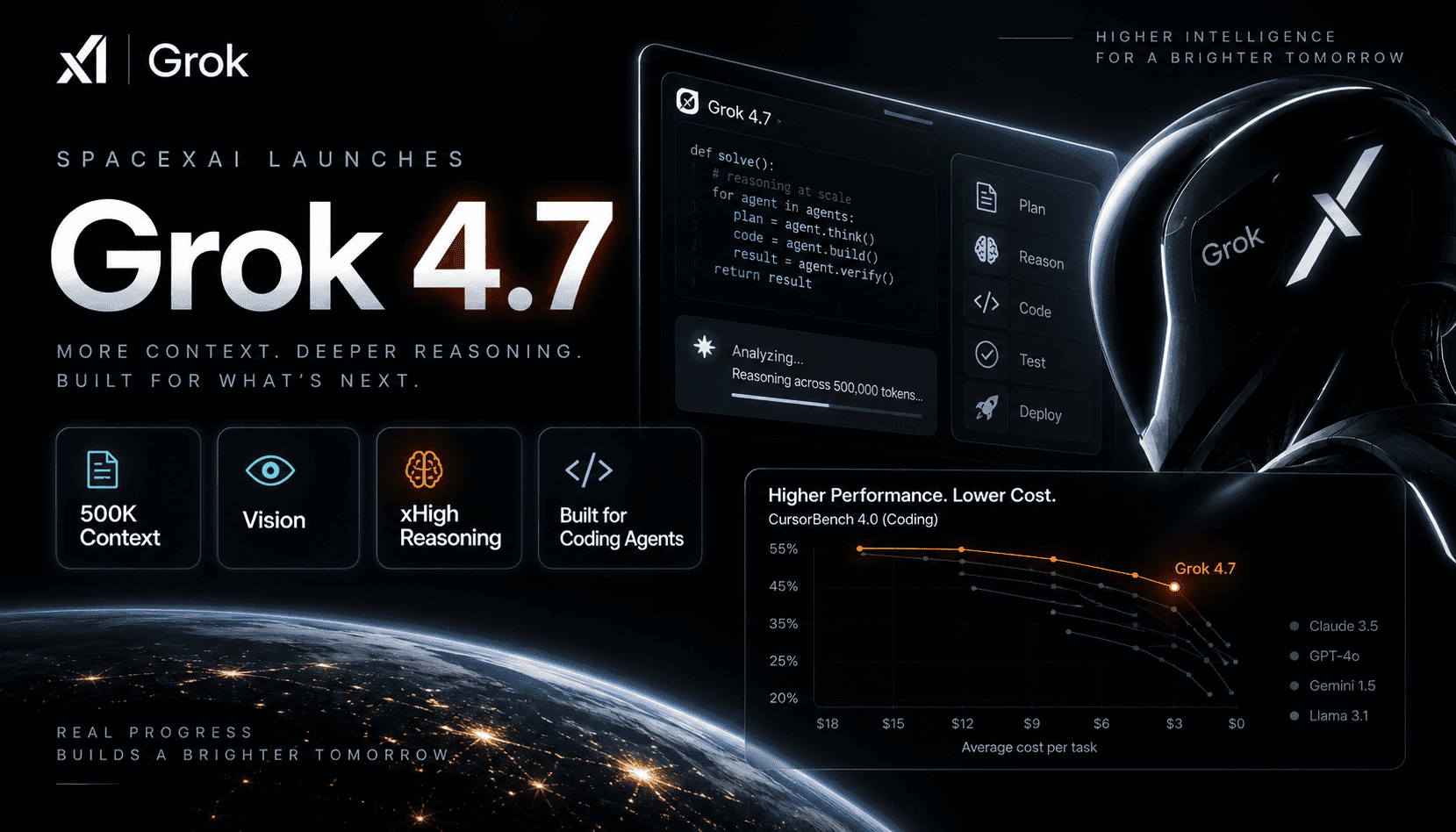
SpaceXAI’s Grok 4.7 is built for sustained coding and knowledge work. A 500K-token context window reduces retrieval churn by allowing entire repositories, multi-file diffs, or extensive spec documents to sit in memory. The model’s native vision adds utility for debugging screenshots, reviewing charts, and explaining UI states. Most importantly, 4.7 emphasizes xHigh reasoning and self-verification, enabling longer, more reliable multi-step executions with fewer handoffs between tools. Served at the same price tier as 4.6 with a fast variant available, it directly targets developer environments, coding agents, and multi-hour professional tasks where previous context and verification ceilings added friction.
Early signals point to strong price-performance for long-running code tasks, with improvements on CursorBench 4.0 and better stamina on multi-hour office and terminal work. Gains on DeepSWE and EEBench imply stronger reasoning fidelity and error recovery in technical domains, while the model’s harness-aware training aims to reduce conversational drift in agent workflows. The combination of longer context and safer defaults should simplify architecture: fewer chunking hacks, leaner retrievers, and smaller prompt scaffolds. For teams juggling large specifications or compliance documents, 4.7’s expanded working memory may convert multi-pass flows into single-pass plans with in-context scratchpads and structured self-checks.
Safety is notably firmer. The new safeguard stack reports stronger jailbreak resistance and better dual-use handling without over-blocking legitimate security work. That matters for enterprise adoption, where agentic systems often intersect with terminals, code execution, and sensitive data. Operationally, 4.7 is available via API, coding harnesses, and routers at $2 per million input tokens and $6 per million output tokens, with an optional faster tier at twice the speed and price. Teams should run head-to-head pilots on their real workloads, measuring task completion quality, tool-call reliability, and total cost per completed task rather than isolated latency or one-off benchmark scores.