

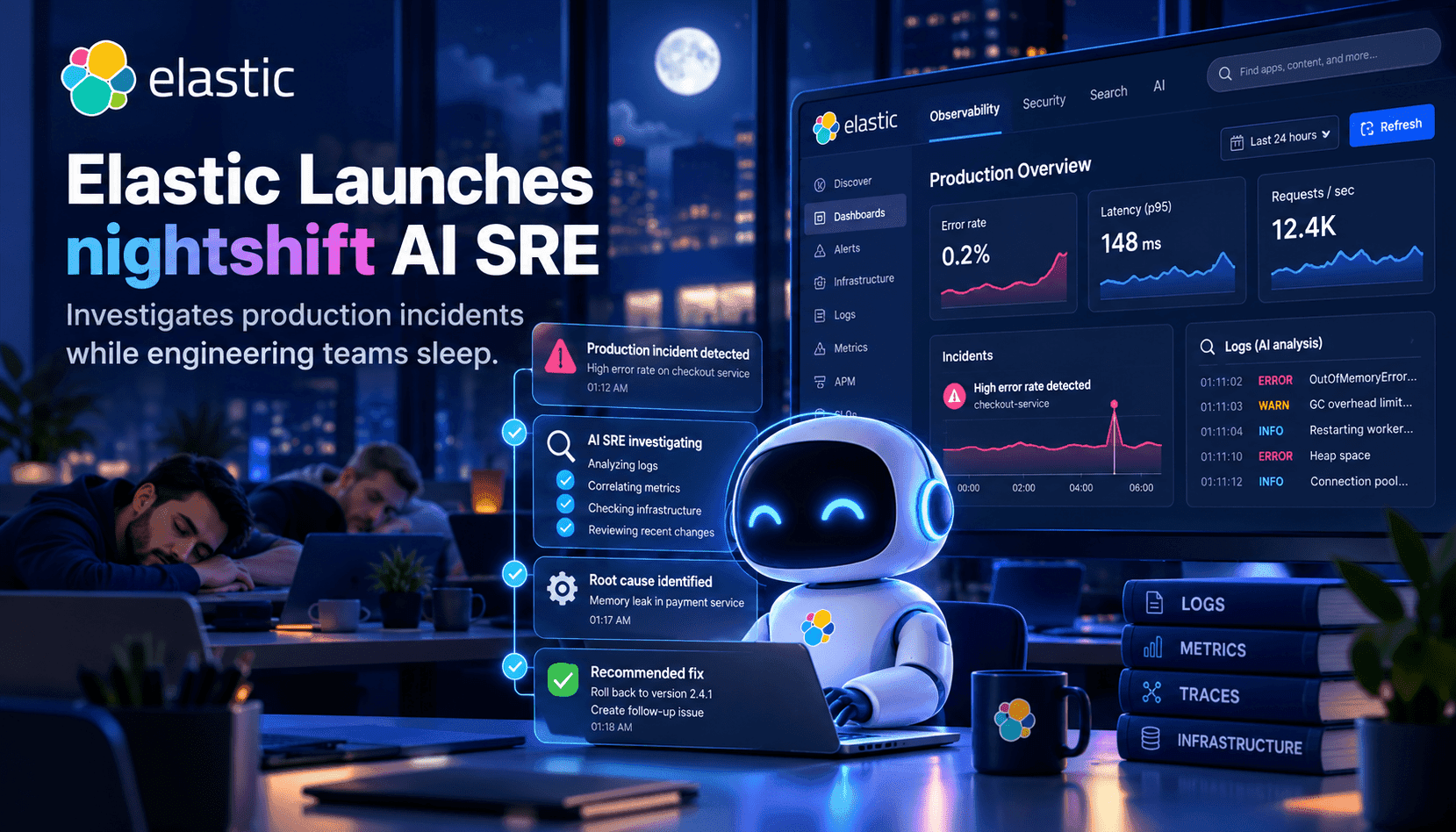
Elastic’s new nightshift AI SRE positions an autonomous agent at the front line of reliability: rather than waiting for a human to query dashboards, the agent continuously watches logs, metrics, traces and contextual data to spot anomalies, triage incidents and assemble evidence. The practical benefit is simple and immediate—when an engineer is paged, they arrive with a structured investigation already begun: correlated events, probable root-causes, and suggested remediation steps. That early work narrows scope and reduces the most expensive part of incident response—orienting to noisy, distributed telemetry.
Technically, nightshift relies on three capabilities working together: high-fidelity ingestion and query across logs/metrics/traces, a context store that maps runbooks and topology to telemetry, and agentic reasoning that sequences read, synthesize, and act steps. Elastic’s stack already provides strong ingestion and search primitives; the distinctive move is bundling those primitives into persistent agents that maintain state across hours and escalate only when human judgment is required. That changes how observability data is shaped, prioritized and surfaced—agents become the active consumers and curators of telemetry, not passive dashboard viewers.
From an operational perspective, persistent agent investigations cut mean time to detection and resolution by tackling the discovery and correlation phase continuously. Nightshift can gather logs, produce timeline evidence, validate hypotheses against historical baselines, and run guarded remediation steps (e.g., circuit breakers, log level toggles, or safe failovers). However, the model’s value depends on trust signals: testable playbooks, transparent provenance for agent actions, and clear escalation boundaries so teams retain ownership while benefiting from automated work done outside office hours.
For engineering leaders and SREs evaluating nightshift-style agents, the immediate questions are practical: how to onboard runbooks, what telemetry fidelity is required, how rollback and blast-radius controls are enforced, and how to measure ROI. Pilot projects should focus on well-scoped classes of incidents—memory leaks, noisy retries, or failing external dependencies—where correlation rules are clear and safe remediation steps exist. Success metrics should include reduction in noisy wake-ups, time-to-identify, and time-to-repair, alongside qualitative trust measures from on-call teams.