

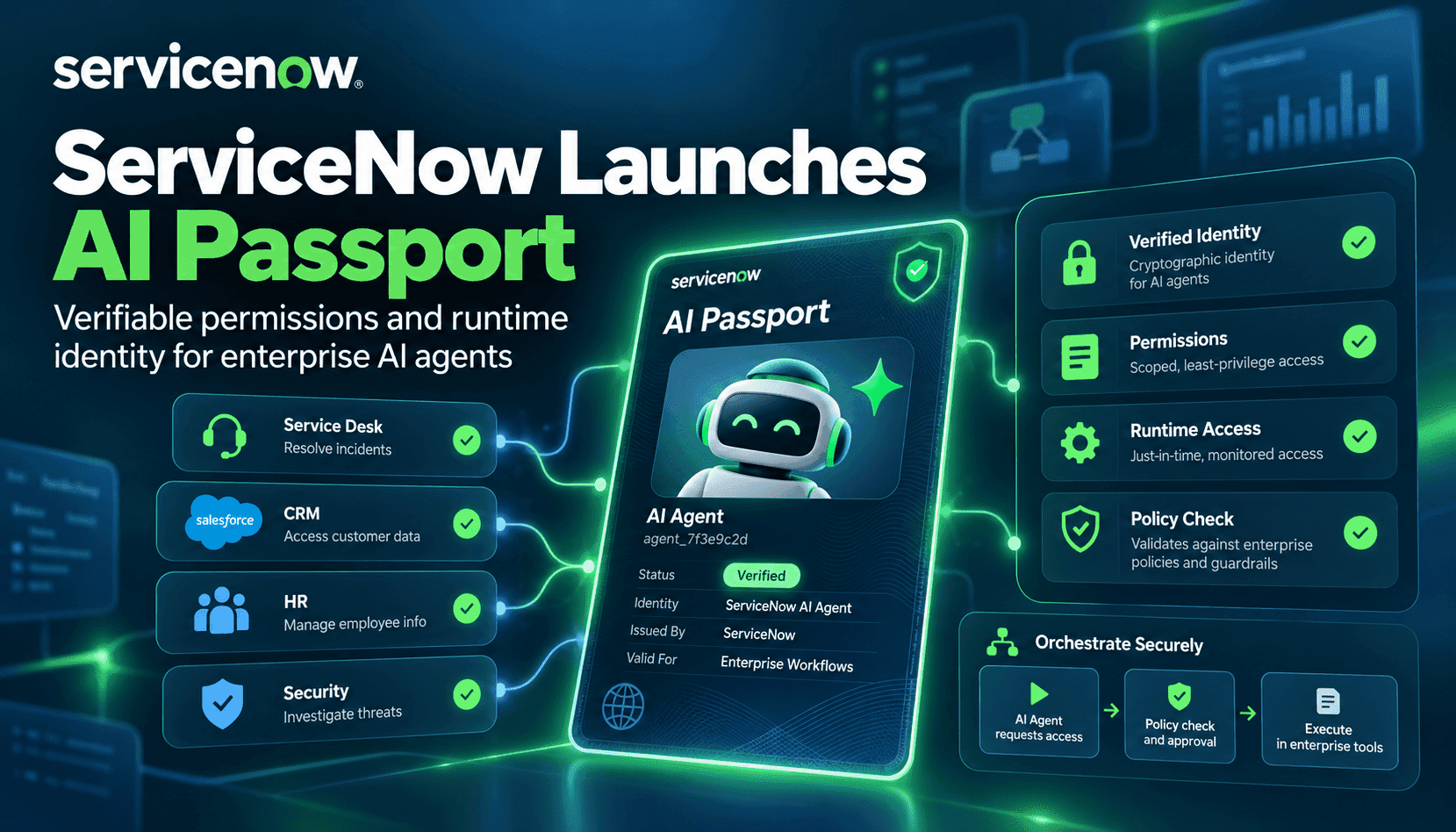
ServiceNow’s AI Passport reframes agent governance around runtime attestation rather than retrospective logging. Passport issues cryptographically signed credentials that an agent and its runtime must present and verify at each step of a workflow; those credentials convey scope — which data, API calls, or application actions are permitted — and are grounded in the enterprise’s live context from CMDB, GRC, and workflow approvals. The practical benefit is prevention: if an agent attempts an action outside its authorized scope, enforcement points can throttle, redirect, or terminate the agent immediately rather than relying on slow human remediation.
Technically, Passport is built on open specs so identity providers, enforcement layers, and third-party runtimes can issue and verify credentials. ServiceNow is pairing Passport with MCP-aware controls and a production enforcement implementation designed with NVIDIA Open Agent Safety Platform components. That combination matters: cryptographic attestations are only useful if the runtime — whether in an on-prem GPU cluster, a hyperscaler enclave, or an embedded SaaS agent — performs continuous verification and enforces policy at machine speed. For enterprises, that means linking identity, entitlement mapping, and runtime telemetry into one operational control plane.
Discovery and continuous observability are central to making Passport effective. ServiceNow’s Super Intelligence Control Tower surfaces shadow AI, maps agent entitlements to actual access rights, and centralizes audit trails so authorization decisions are provably tied to business context. Critically, Passport supports precision revocation and scoped delegation: enterprises can narrow delegated permissions across agent chains and revoke attestations without widespread credential churn. For regulated industries, the combination of discovery, runtime enforcement, and auditable decisions turns an amorphous operational risk into a tractable control problem.
Adoption will bring both operational gains and new workstreams. Teams must integrate Passport issuers into identity flows, extend enforcement hooks to runtimes and MCP servers, and align policy definitions with the CMDB and GRC systems. There will be edge cases — transient agents spun up by third parties, model updates that change behavior, and multi-tenant runtimes that complicate enforcement — but starting with clear, scoped credentials and continuous verification reduces blast radius and improves incident forensics compared with ad hoc agent deployments.