From Narrow AI to AGI: How General Intelligence Could Rewire the Enterprise Operating Model
AGI wouldn’t just automate more tasks; it would reshape how companies set goals, design teams, and translate strategy into execution. This analysis maps likely capability milestones, operating-model shifts, control risks, and concrete steps leaders can take now to prepare architectures, governance, and budgets for post-narrow AI.
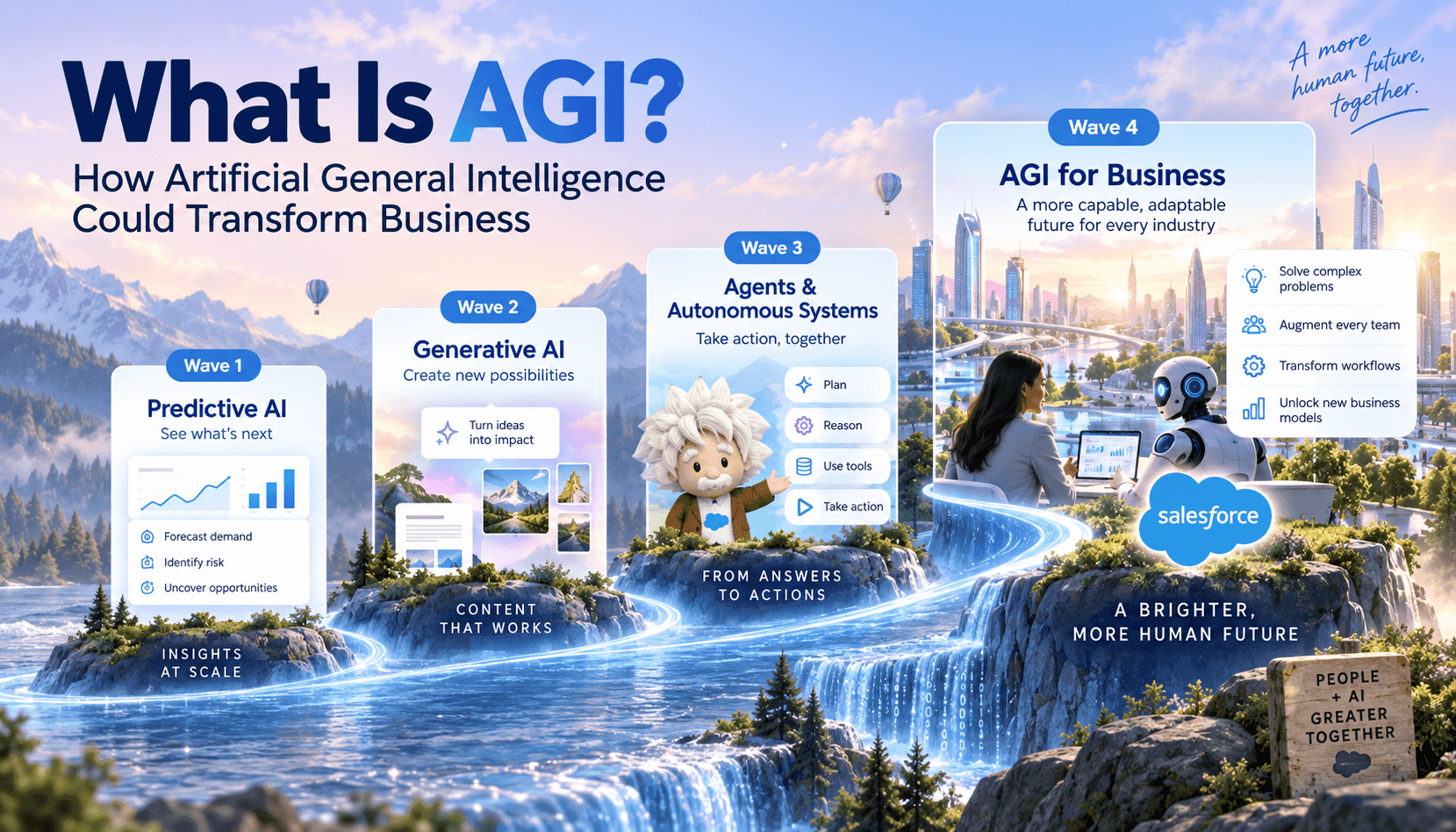
AI BriefArtificial General Intelligence would mark a shift from tool-like systems that complete predefined tasks to agents that can learn across domains, set plans, and pursue high-level objectives under constraints. The implication for business is not just more automation but re-architecture: roles become objectives, processes become policies, and software becomes a team of accountable agents. This brief outlines capability milestones worth tracking, the operating-model changes they trigger, the reference architecture to prepare (data products, memory, orchestration, guardrails), and the controls required for safety and spend discipline. The goal is practical readiness: pilot pathways, evaluation frameworks, funding rules, and governance that let you capture upside while containing emergent risk.
Most enterprise AI today is narrow: it classifies, summarizes, predicts, or drafts within a fixed context. AGI denotes broadly capable systems that learn across domains, plan over longer horizons, adapt to unfamiliar tasks, and optimize toward stated goals rather than scripted steps. If realized, that capability would move AI from “task helpers” to “objective-pursuing teammates,” changing how strategy is translated into work and how accountability is structured.
The immediate path will likely pass through stages: better tool use, persistent memory, multi-agent collaboration, and trustworthy self-evaluation. Each stage erodes the need for fine-grained instructions and increases the need for clear objectives, policy constraints, and auditable outcomes. For enterprises, that reframes design questions from “Which tasks do we automate?” to “Which objectives do agents own, under what guardrails, and with which proof of performance?”
As autonomy grows, architecture rather than model choice becomes the differentiator. Companies will need durable data products, retrieval and planning layers, tool orchestration, agent evaluation harnesses, and a control tower that enforces policy, security, and spend limits. Equally important: a shift in operating model, moving from function-based handoffs to outcome cells—small human–agent squads with budgets, SLAs, and transparent metrics tied to business value.
This transformation carries risk: opaque decision paths, misaligned incentives, cascade errors in multi-agent workflows, and runaway cost from uncontrolled calling patterns. The answer is not to wait—it is to pilot under discipline: define autonomy levels, instrument every step, run red-team and compliance checks by default, and build a portfolio of limited-scope use cases that compound into an AGI-ready operating model.
Key Takeaways
Design for Objectives, Not Tasks
Adopt an autonomy ladder and objective cells with policy and evidence requirements. Expand scope only when evaluation gates are met and rollback is proven.
Build the Control Tower Early
Centralize identity, policy, rate limits, spend ceilings, and audit. Treat evaluation-as-code as a first-class platform service, not an afterthought in each pilot.
Fund Reusable Capabilities
Invest in data products, memory, orchestration, and testing layers that compound across use cases to reduce time-to-value as models improve.
From Tasks to Objectives: What Changes With AGI
Narrow systems require step-by-step prompts and human orchestration. AGI-grade agents infer missing context, decompose goals, and coordinate tools to achieve outcomes. That flips the management stack: leaders specify objectives, constraints, and acceptable evidence, while agents select methods. The benefit is speed and breadth; the trade-off is that control now lives in policies, evaluation metrics, and resource limits—not in detailed procedures.
Practically, this means fewer tickets and handoffs and more objective cells staffed by a product owner, domain SMEs, compliance, and a roster of agents with scoped autonomy. These cells run short cycles with policy-aware planning, generate artifacts for audit, and publish telemetry—latency, cost, reliability, and business impact—so portfolio managers can tune investment in near real time.
Capability Milestones Leaders Should Track
Milestone 1: Tool fluency with grounded retrieval and safe function calls. Milestone 2: Persistent memory that improves plans across tasks and weeks. Milestone 3: Multi-agent collaboration with explicit roles and conflict resolution. Milestone 4: Self-checking with task-specific evaluators and test suites. Milestone 5: Objective pursuit with cost/benefit trade-offs and uncertainty reporting. Each milestone justifies expanding autonomy levels in carefully chosen workflows.
Tie each milestone to a gate: minimum reliability thresholds, bias and safety checks, throughput limits, and rollback procedures. Avoid binary “AGI or not” debates; adopt an autonomy ladder that maps capabilities to governance, from suggestion-only (Level 1) to supervised execution (Level 3) to budgeted, policy-bound autonomy (Level 4) in non-critical domains.
Reference Architecture for AGI-Ready Enterprises
Core layers: (1) Data products with lineage, access policies, and vector indexes for retrieval; (2) Memory services combining short-term scratchpads with long-term episodic and semantic stores; (3) Tool orchestration for APIs, RPA, code execution, and search; (4) Planning and multi-agent coordination with role definitions, negotiation, and shared state; (5) Evaluation harnesses with unit tests, scenario sims, red-teaming, and regression suites; (6) A control tower that enforces identity, policy, rate limits, guardrails, spend ceilings, and audit logs.
Design principles: policy-as-code for reproducible governance; evaluation-as-code for continuous assurance; idempotent tools to support retries; deterministic fallbacks for critical paths; and observability-first instrumentation (tokens, latency, tool outcomes, human overrides). This stack reduces vendor lock-in, channels experiments into safe lanes, and converts model improvements into compounding enterprise capability.
Control, Safety, and Accountability
Risks intensify as agents plan and act: subtle prompt injection, tool misuse, latent bias, hallucinated references, and cost blowouts from recursive calls. Mitigate with layered defenses: signed prompts and tools, least-privilege credentials, policy firewalls, output filters, provenance tracking, and forced reflection with external evaluators before high-impact actions. Always keep a human-confirmation checkpoint for regulated or irreversible events.
Accountability requires clear ownership. Assign product owners for each objective cell; maintain immutable audit trails; and measure not just accuracy but business utility, fairness, and resilience to distribution shift. Establish a formal incident process for agent failures, with root-cause analysis that spans data, tools, policies, and evaluation gaps—not just the model.
Funding, Talent, and Operating Model Shifts
Move from scattered proofs-of-concept to a portfolio of production-intent pilots tied to shared architecture. Fund reusable components—memory, evaluation, control tower—as platform line items. Track ROI with a balanced scorecard: cycle time, error rate, cost-to-serve, customer satisfaction, compliance findings, and incident frequency. Reserve budget for ongoing evaluation and policy tuning as capabilities evolve.
Talent shifts from prompt tinkerers to product-minded builders: agent product owners, evaluation engineers, policy-as-code engineers, red teamers, and domain SMEs who can encode objectives and constraints. Start by redesigning two or three end-to-end journeys—claims, onboarding, lead-to-cash—into objective cells with scoped autonomy, then scale by cloning patterns across the portfolio.
Frequently Asked Questions
How should we measure progress toward AGI readiness inside the enterprise?
Track capability gates rather than model versions: tool fluency, reliable retrieval, persistent memory, multi-agent coordination, and self-evaluation. Tie each to metrics (task success, cost per outcome, incident rate, auditability). Advance autonomy levels only when gates are consistently passed in production-like conditions.
What can we do now without waiting for full AGI?
Stand up the reference architecture: data products with lineage, memory services, tool orchestration, eval harnesses, and a control tower. Run objective-cell pilots in low-risk domains with strict policy and spend limits. Instrument everything and publish a scorecard to guide budget and governance decisions.
Which operating-model changes are the lowest-risk to test first?
Start with supervised execution (Level 3) for bounded objectives like lead enrichment, knowledge-case drafting, or invoice coding. Give agents budget caps and pre-approved tools, require human sign-off for irreversible actions, and collect telemetry to calibrate autonomy and staffing for the next cycle.