

NexusAi logo

NexusAi

  • Products
  • Category
  • Prompts
  • Search
  • Insights
  • Pricing
  • Promote
  • Contact
Sign In
NexusAi LogoNexusAi

NexusAI helps you discover, compare, and learn AI tools with ease. From expert insights to training resources, we empower individuals and businesses to harness AI technology for smarter decisions, innovation, and growth.

Useful Links

  • About Us
  • AI Products
  • AI Category
  • AI Prompts
  • AI Search
  • AI Insights

Services & Legal

  • Showcase & Promotion
  • Membership Plans
  • Terms & Conditions
  • Refund Policy
  • Privacy Policy
  • Disclaimer

Contact Us

88 Tribune Street
South Brisbane, QLD, Australia, 4101
Website: www.nexusai-tech.com
Email: info@nexusai-tech.com

© Copyright 2026 NexusAi All Rights Reserved

Developed by DStudio Technology
Home/AI Insight/General AI Industry News/AI Chip and Memory Selloff Is a Positioning Reset, Not a Demand Stall
General AI Industry NewsChip Strategy Watch

AI Chip and Memory Selloff Is a Positioning Reset, Not a Demand Stall

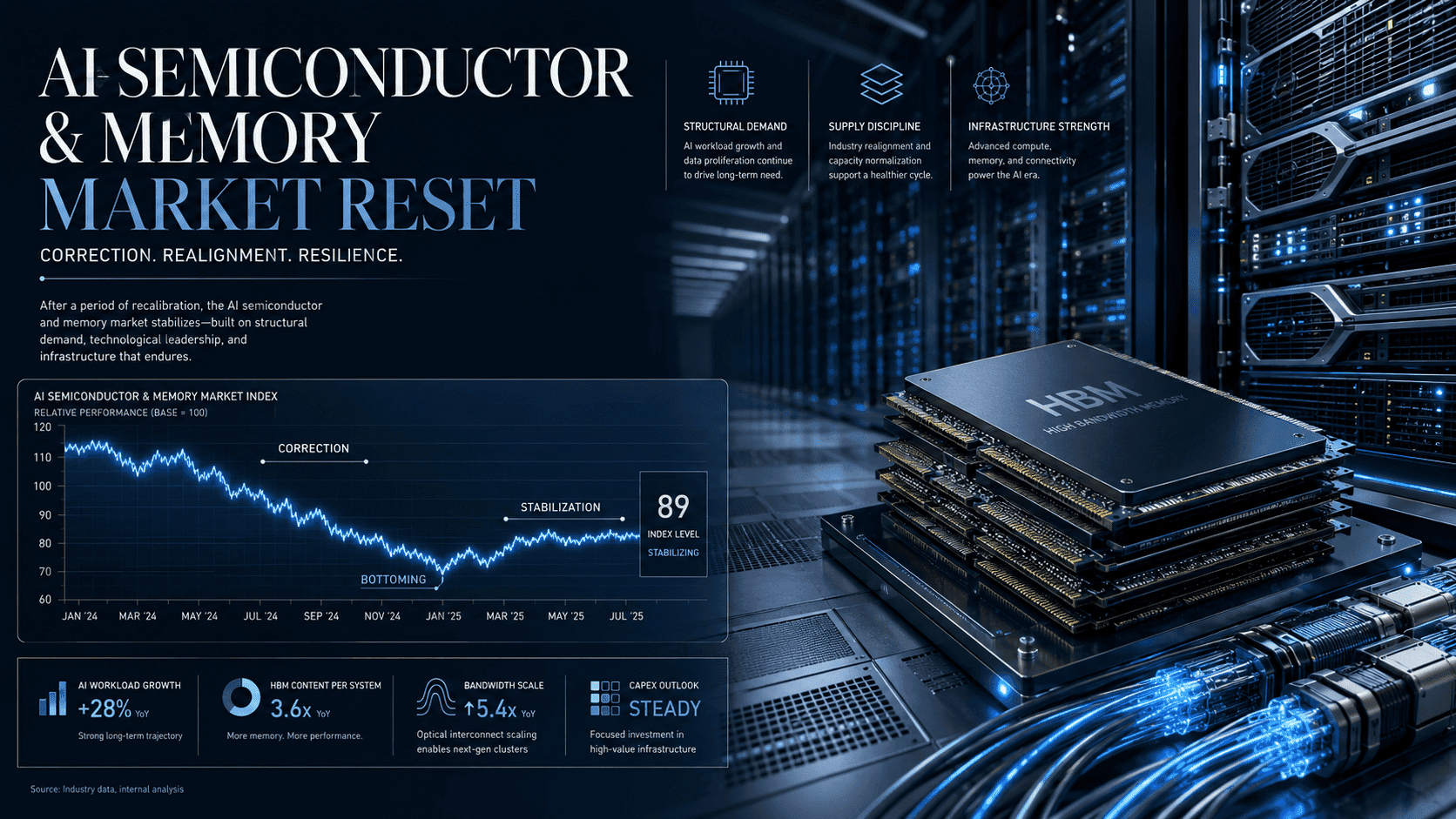
Semiconductor and memory stocks slid on crowded positioning, sky-high earnings bars, and inventory optics—not collapsing AI demand. With GPUs, HBM, and data center buildouts still absorbing record capex, the near-term reset could reprice timing risk rather than long-term cash flows—if supply, pricing, and power constraints stay manageable.

NexusAI ResearchJul 30, 20261.6K views9 min read
AI Chip and Memory Selloff Is a Positioning Reset, Not a Demand Stall
AI Brief

The recent drawdown across AI chips and memory looks more like an expectations and positioning reset than a structural demand break. The earnings bar rose faster than deployments could be racked and powered, while leverage and momentum crowded the trade. Meanwhile, AI factory buildouts, HBM upgrades, next-gen GPU ramps, and early enterprise agent pilots continue. Expect lumpier quarters as capex, packaging, and power timelines catch up, but the multi-year compute and memory cycle remains intact. Investors should underwrite scenarios by backlog durability, HBM mix and pricing, CoWoS/advanced packaging capacity, and hyperscaler power permits. Buyers should lock allocation where possible, design for memory bandwidth, and budget for networking and energy as much as GPUs.

Premium Partner

Featured AI Partner

Promote your AI Tools

The selloff in AI semiconductors and memory resembles an expectations reset: positioning was crowded, earnings bars unrealistic, and short-term delivery friction collided with headline fatigue. None of that equals demand destruction. Hyperscaler and enterprise pipelines for training and inference clusters are still expanding, but revenue recognition lags when projects hinge on packaging lead times, electrical permitting, and data center readiness. When a trade becomes consensus, small misses on margin or shipment mix can cascade through quant and options flows, exaggerating price action without rewriting multi-year cash flow potential.

On the ground, the AI factory thesis remains anchored by constrained infrastructure: advanced GPUs, HBM stacks, CoWoS/SoIC packaging, 800G/1.6T networking, and megawatt-scale power. As enterprises pilot agentic workflows and retrieval-centric apps, memory bandwidth intensity rises, not falls. Backlogs in GPUs and HBM3E are real, but deliveries phase with substrate availability and thermal design, creating quarter-to-quarter noise. This is why guidance volatility can coexist with rising multi-year commitments—procurement is synchronized to power, floorspace, and network fabric, not to clean calendar quarters.

For investors, the key is mapping valuation to scenario timing rather than debating secular demand. A prudent base case assumes unit growth persists while mix and margins normalize as competitors catch up and yields improve. A bull case compounds HBM bandwidth per GPU, sustained software-driven utilization gains, and faster power approvals. A bear case requires broad order cancellations, negative HBM pricing surprises, or architectural shifts that materially reduce memory intensity—none visible today, though efficiencies in inference could smooth growth trajectories. Price moves have outrun fundamental drift; timing risks, not terminal value, are what the market is repricing.

Operators and buyers should treat this reset as a window to secure allocation and negotiate SLAs around packaging and delivery milestones. Engineer for memory-to-compute balance, prioritize interconnect and cooling early, and plan capacity in phases that align with power ramps. Track HBM3E availability, substrate bottlenecks, and switch/router lead times alongside GPU bookings. For many deployments, the gating factor won’t be accelerator purchase orders but energy and facilities readiness; budget time and capital accordingly.

Key Takeaways

Reset, Not Reversal

Price action reflects crowded positioning and timing friction, not collapsing AI demand. Watch delivery cadence and utilization, not just headline misses.

Bandwidth Is the Bottleneck

HBM3E mix, advanced packaging, and optical interconnects govern shipment timing and margins. Lock memory-rich configurations and network capacity early.

Underwrite Timing Risk

Value leaders by backlog durability and power-permit visibility. Use base/bull/bear scenarios tied to HBM pricing, packaging yield, and facility readiness.

What Drove the Drawdown

The immediate catalysts were tactical: momentum-heavy positioning, levered derivatives exposure, and consensus beats priced beyond operational reality. Small variances in mix—more accelerator shipments tied to future HBM availability, or deliveries gated by packaging—translated into guidance haircuts. Quant and volatility strategies amplified the move. Importantly, order books for training and high-bandwidth memory remain supported; it is the quarterly pacing, not the destination, that is under negotiation.

Signals to watch for a true cycle turn would include broad cancellations, abrupt HBM price compression, or sustained utilization declines at major clouds. What we see instead is schedule friction: customers aligning network, cooling, and power, pushing some ramps by quarters—not abandoning them.

Where Demand Still Accelerates

Training and inference footprints are expanding, with memory bandwidth per node rising as models adopt larger context windows, multi-modal inputs, and agentic chaining. HBM3E adoption increases bandwidth without exploding TDP per package, strengthening ROI for memory-rich configurations. Parallel investments in 800G/1.6T switching, optical transceivers, and structured cooling indicate customers are building for sustained utilization rather than one-off experiments.

Enterprise pilots are moving from proofs of concept to staged production, especially in retrieval-augmented generation, code intelligence, and analytics. This favors clusters with high memory bandwidth and fast interconnects to keep agent loops responsive. These dynamics support a multi-year capex runway even as quarter-to-quarter revenue recognition remains lumpy.

Valuation and Earnings Reset Scenarios

Base case: unit growth persists, HBM mix steps up, and packaging yields improve, normalizing gross margins while sustaining revenue CAGR. Bull case: accelerated HBM3E penetration, faster AI factory commissioning, and improved utilization drive upside to cash conversion. Bear case: industry-wide order deferrals tied to power permits or a memory pricing step-down compresses near-term margins. Map multiples to these timelines; re-rating follows delivery cadence, not headlines.

For memory makers, track bit supply discipline, HBM vs. commodity DRAM mix, and long-term agreements. For GPU vendors, watch subscription software attach and networking pull-through. For integrators, monitor service margins as they navigate thermal, rack integration, and delivery SLAs tied to facility readiness.

Supply Chain Pressure Points to Track

HBM3E stacking and yield are central: they set available bandwidth per accelerator and determine margin profile. Advanced packaging (CoWoS-class substrates, 2.5D/3D integration) is a hard bottleneck; any incremental capacity can pull forward revenue. On the network side, 800G optics and high-radix switches must land with low failure rates to avoid stranded GPUs. Facilities are the silent constraint—power delivery, cooling, and floor loading drive actual commissioning dates.

Practical watchlist: HBM pricing vs. cost curves, substrate lead times, OSAT throughput, optics RMA rates, and data center power permits. Improvements here tend to convert backlog into revenue ahead of schedule; slippage compounds into guidance volatility.

Portfolio and Procurement Playbook

Investors: tilt toward assets with durable HBM mix, packaging access, and networking pull-through. Prefer vendors with visibility into multi-quarter LTAs and software attach that supports utilization. Use scenario bands on power permitting to discount delivery risk rather than hair-cutting secular growth. Rebalance on signs of disciplined bit supply and improving yield in advanced packaging.

Buyers: reserve HBM-rich SKUs early, negotiate packaging and delivery SLAs, and design for bandwidth-to-compute ratios aligned with target workloads. Budget interconnect, cooling, and power with equal rigor to GPUs. Phase deployments to match facility milestones, and instrument utilization so software improvements translate to measurable ROI.

Frequently Asked Questions

How can I tell if this is a reset versus an actual downcycle?

Track cancellations and HBM pricing. A reset shows schedule shifts, stable backlogs, and tight HBM supply; a downcycle shows broad order cuts, price compression, and sustained utilization declines at major clouds.

Which suppliers are most sensitive to the next two quarters?

HBM vendors and advanced packaging houses drive bandwidth and margin. Networking and optics set cluster readiness. Improvement in substrate and OSAT throughput is the cleanest leading indicator for revenue pull-forward.

What should enterprise buyers do during the volatility?

Secure HBM-rich allocations, negotiate packaging and delivery SLAs, and phase deployments against power milestones. Engineer memory bandwidth and interconnect first; GPUs without power, cooling, and fabric create stranded capacity.

#big tech ai spending#ai data centers#HBM Memory#hbm chips#Frontier Compute Supply#Compute Economics#Agentic Workloads#Enterprise Agents#Data Center Interconnect#Rack-Scale Networking#ai investment boom#Data Center Leases#HBM3E#advanced packaging#CoWoS Capacity#Data Center Power#Agentic Computing#AI Factories#Optical Interconnects#Inventory Correction#Semiconductor Valuations#Backlog Conversion

AI Insight Newsletter

Get the latest AI updates, tool news, and insights delivered to your inbox.

No spam. Unsubscribe anytime.
On This Page
1.What Drove the Drawdown2.Where Demand Still Accelerates3.Valuation and Earnings Reset Scenarios4.Supply Chain Pressure Points to Track5.Portfolio and Procurement Playbook
Share this article

Related Articles

AI-Accelerated Vulnerability Discovery Is Overloading Patch Tuesday Operations
General AI Industry News

AI-Accelerated Vulnerability Discovery Is Overloading Patch Tuesday Operations

Jul 20, 2026

ZML LLMD Targets Multi-Chip LLM Inference Without Nvidia Lock-In
AI Product News

ZML LLMD Targets Multi-Chip LLM Inference Without Nvidia Lock-In

Jul 9, 2026

Agility Robotics Opens 60,000-Square-Foot Training Facility to Industrialize Humanoids
General AI Industry News

Agility Robotics Opens 60,000-Square-Foot Training Facility to Industrialize Humanoids

Jul 19, 2026

Spotify’s New Conversational Assistant Turns Discovery Into Two-Way Personalization
AI Product News

Spotify’s New Conversational Assistant Turns Discovery Into Two-Way Personalization

Jul 15, 2026

NEO’s 25‑DoF Tendon Hands Make Humanoids Read‑Write Instruments
AI Model & Platform Updates

NEO’s 25‑DoF Tendon Hands Make Humanoids Read‑Write Instruments

Jul 15, 2026

Related AI Tools

View All
NVIDIA: Accelerated Computing, AI Infrastructure & Physical AI Platform

NVIDIA: Accelerated Computing, AI Infrastructure & Physical AI Platform

AI Infrastructure & Hardware

AMD: AI Infrastructure, Instinct GPUs, EPYC CPUs & Ryzen AI Computing Platform

AMD: AI Infrastructure, Instinct GPUs, EPYC CPUs & Ryzen AI Computing Platform

Developer & Coding AI

Micron: AI Memory, HBM, DRAM and SSD Platform for Data Centers and Edge

Micron: AI Memory, HBM, DRAM and SSD Platform for Data Centers and Edge

AI Infrastructure & Hardware

Samsung Semiconductor: Memory, Storage, Processors and Sensors for AI Systems

Samsung Semiconductor: Memory, Storage, Processors and Sensors for AI Systems

AI Infrastructure & Hardware

SK hynix: High-Performance Memory and Storage for AI, Server & Mobile

SK hynix: High-Performance Memory and Storage for AI, Server & Mobile

AI Infrastructure & Hardware

Sponsored AI Tools (0)

Promote your AI Tool