

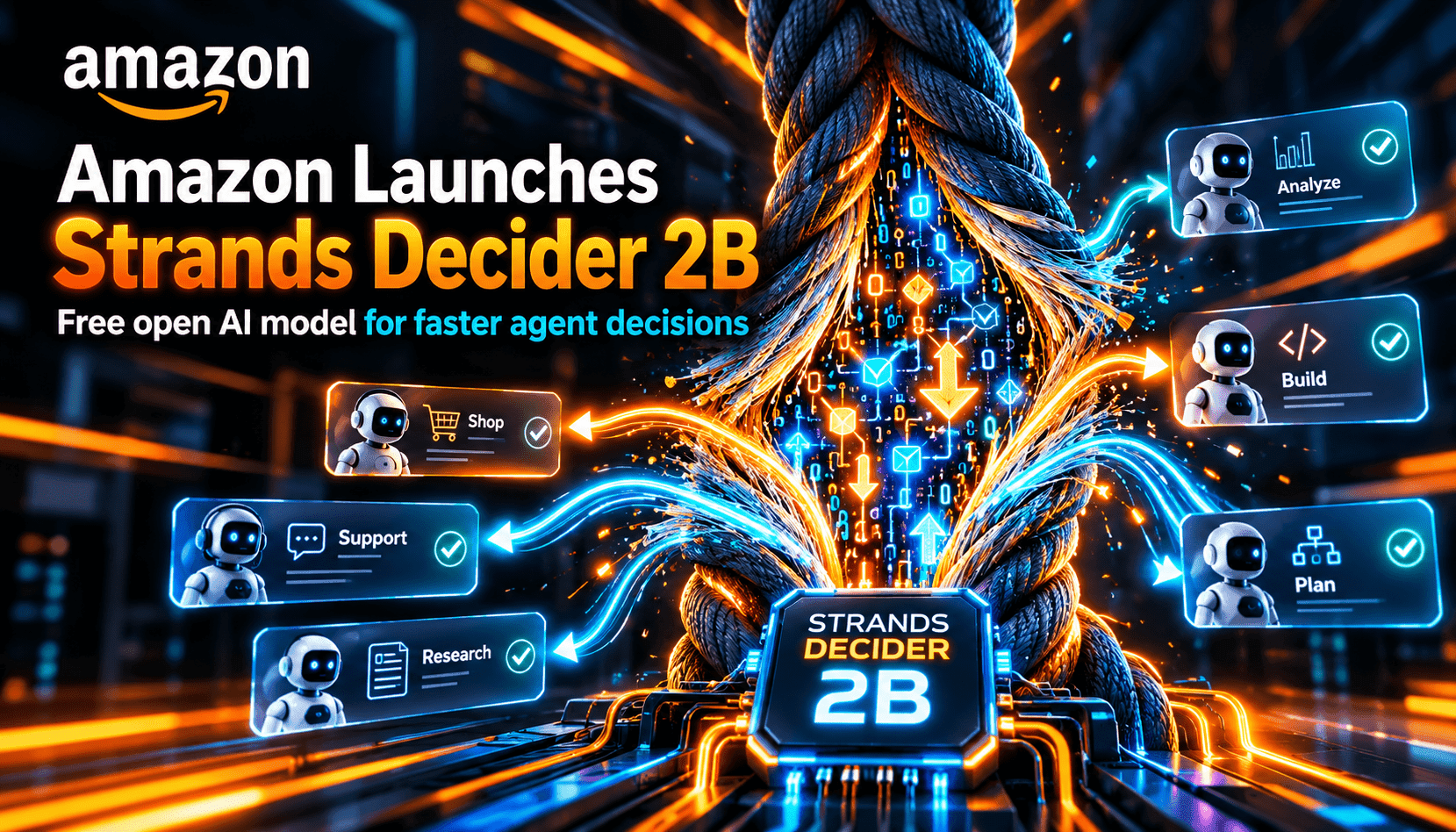
Strands Decider 2B exemplifies a growing pattern in agent design: push simple, bounded choices to a tiny, fast model and reserve the heavyweight LLM for tasks that truly need generative reasoning. Instead of prompting a full LLM just to ask “Should I run the calendar tool?” the agent queries the decider, which returns a deterministic class or score in milliseconds. That swap improves tail latency, de-risks cascading errors, and delivers cleaner observability—especially when teams treat decider outputs as policy-enforced gates rather than suggestions.
In practice, a decider sits between event intake and tool orchestration, answering questions like route selection (search vs. retrieval), action approval (safe to email client?), or run/skip (execute code or not). Because the label space is small and the format is structured, a 2B-parameter model—often quantized—can run on modest GPUs or even performant CPUs at the edge. That enables offline, batch, or on-device decisions, reducing cloud round-trips. Crucially, the model’s bounded schema makes outcomes easier to audit and calibrate than free-form text scoring from an LLM.
Operational success hinges on three elements: clear decision taxonomies, calibrated thresholds, and robust fallback. Teams should define unambiguous labels (e.g., approve, deny, escalate), then tune thresholds using offline datasets and online A/Bs. When confidence dips or inputs fall out-of-distribution, the agent escalates to a larger LLM or a human approval path. Logging every decision, input feature, and final outcome enables continuous retraining and bias checks—preventing policy drift while preserving the latency and cost gains that made the decider attractive in the first place.
The business case is straightforward: if a typical LLM call takes 300–800 ms and costs cents per thousand tokens, replacing thousands of micro-decisions per hour with a sub-10 ms, near-zero-token decider compounds savings. Tool invocations become more predictable, SLOs stabilize, and audit becomes policy-centric rather than prompt-centric. The tradeoff is accountability: decision models require proper datasets, evaluation harnesses, and guardrail design. Teams that invest in those basics will see better conversion on agent tasks, lower infrastructure bills, and fewer safety escalations.