

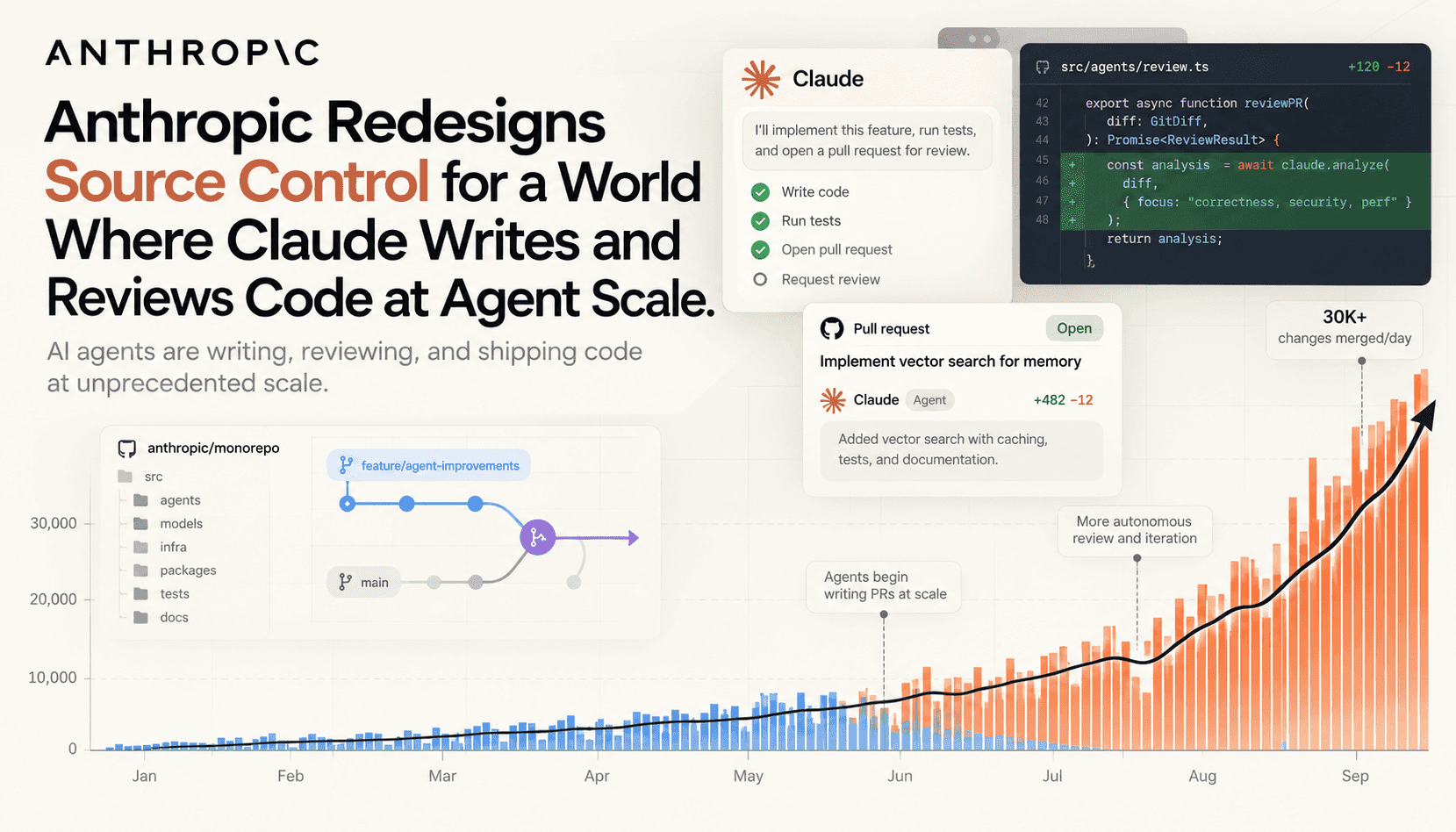
Anthropic’s migration from git to a bespoke system—Scion—was a structural response to an operational inflection: autonomous agents, notably Claude, began producing and merging tens of thousands of changes per day, breaking assumptions baked into tools designed for human-scale workflows. The company found that decentralized assumptions (full clones, packfile-based exchange, local refs) became a liability when most clients are online agents that need only slices of a repository. Scion reframes the problem as one of high-throughput, server-driven metadata and sparse file delivery, and that reframing has consequences for how teams design pipelines, monitor state, and audit changes.
At its core, Scion swaps git’s full-graph operations for server-side changesets plus derived indices computed from those changesets. Instead of shipping immutable packfiles to every client, Scion exposes content-addressed blobs, targeted tree requests, and server APIs for blame, ancestry, and diffs. The working copy is optional; CI and research jobs can query the server for metadata or materialize only the paths they read. That change compresses network, CPU, and storage use dramatically and makes commit creation cheap and lock-free—essential when merges per day scale by an order of magnitude.
Operationally, the move forces a rethink across tooling: CI, code review, IAM, and observability must assume a server-centric VCS. Pulls and builds become cache-driven read patterns against tiered servers rather than bulk clones against mirrors. Derived data (blame indices, path histories, skip lists) must be computed and stored incrementally, with choices about eager versus lazy computation directly affecting latency, storage and operational cost. Teams will need to redesign job bootstrapping, local developer ergonomics, and capacity planning to favor object caches, resumable fetches, and regional isolation.
For engineering leaders, the practical questions are immediate: how do you trust agent-generated changes at scale, how do you instrument and enforce policies, and how do you avoid creating a single coordination bottleneck? Anthropic’s experience shows these are solvable through a combination of server-side policy enforcement, programmatic review surfaces, adversarial validation pipelines, and conservative ref usage. The technical trade-offs—less local autonomy, more central compute, and new derived-data maintenance—are balanced by huge gains in speed, reproducibility, and the ability to operate at agent scale.