

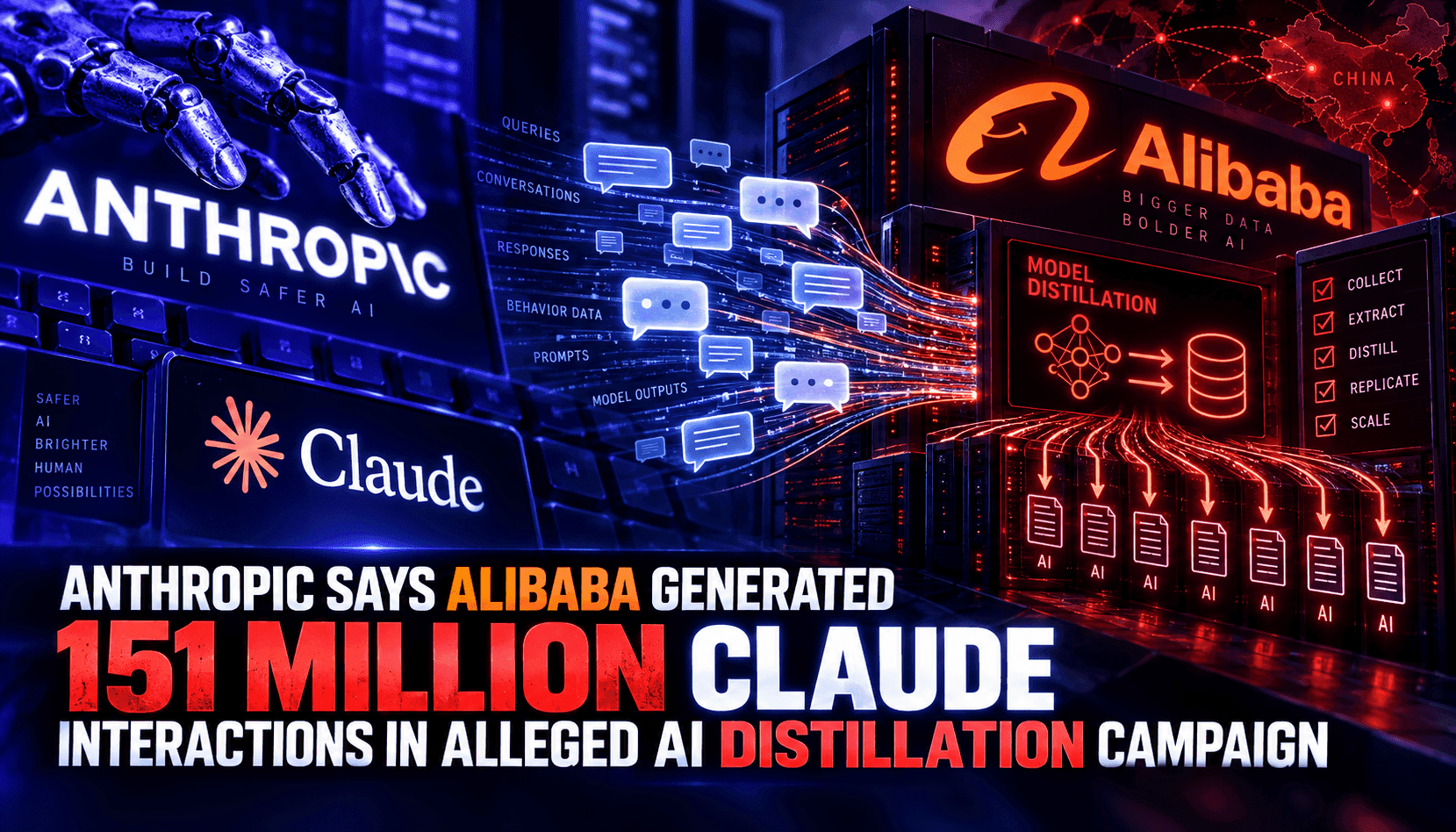
Anthropic alleges that entities tied to Alibaba executed roughly 151 million interactions against Claude to power a large-scale distillation workflow—an escalation from sporadic scraping to industrialized extraction. If accurate, this volume implies orchestration infrastructure: rotating proxies or residential IP pools, prompt mutation engines to avoid signature detection, and automated evaluation loops to harvest high-value outputs. It also suggests caching layers and adaptive scheduling to exploit price tiers and latency windows. The claim reframes API misuse not as isolated abuse but as a supply-chain: coordinated agents, cloud resources, and quality-control processes aimed at replicating model behavior with acceptable fidelity.
The economic logic is straightforward. If an attacker can convert millions of API calls into a competent student model, they potentially replace months of supervised fine-tuning and red-teaming. The arbitrage sits between API spend and the avoided GPU hours, data acquisition, and alignment costs. But at 151 million calls, provider-side telemetry becomes statistically powerful: inter-request timing, prompt entropy drift, result diversity, and region/IP correlation can reveal automation patterns. This is where API security must look more like payments fraud prevention—combining device fingerprinting, behavioral clustering, and dynamic risk-scored rate limits instead of static caps that high-volume orchestrators can learn around.
For enterprises depending on third-party models, the incident highlights second-order risks. Distilled models can inherit provider quirks and safety gaps, then be deployed without comparable guardrails, raising brand and regulatory exposure downstream. Meanwhile, providers will tighten terms, add friction (proof-of-human challenges, ephemeral keys, private subnets), and increase variance in sensitive domains to blunt teacher-student fidelity. Expect more robust watermarking, canary prompts that fingerprint harvesters, and tiered access that demands stricter provenance controls for high-volume automation. Buyers should prepare for stricter monitoring requirements, event streaming of usage telemetry, and potential cost changes as defense features move from add-ons to mandatory controls.
Technically, defending against industrial-scale distillation will require multi-layer control planes. At the edge: gateway-level anomaly detection, TLS fingerprinting, and proof-of-work or attestation under suspicious surge. In the core: risk-based orchestration that ties per-tenant risk scores to response strategies (throttle, degrade, add stochasticity, or challenge). In the model layer: instruction-level watermarks, response canaries, and adversarially trained detectors to spot distribution-shifted harvesting prompts. Finally, in governance: audit trails, incident playbooks, and cross-provider threat intelligence so sophisticated orchestrators cannot rotate targets without encountering harmonized defenses.